Ancient Chihuahuas in Southeastern U.S.?


Do three dog effigy pots excavated in Georgia in the 1930s at the Bull Creek Site and one from the Neisler Mound site represent the Chihuahua breed, a native dog of Mexico? Is the tribe most likely associated with these pots the Kasihta/Cussetta Creek Indians whose migration legends strongly suggest an origin in west Mexico, likely the state of Colima which is also known for similar dog effigy pots? 

Did the Kasihta raise Chihuahuas for food which they fattened up for this purpose as depicted by the pots and as recorded by early Spanish eye-witness accounts? Finally, does this evidence overturn all the conjecture and theories of possible Old World influence on the origin of the Chihuahua and prove that it is purely a New World dog that dates back at least to 100 AD in Mexico?

In 1937 archaeologists unearthed three dog effigy pots from the Bull Creek site in Muscogee County, Georgia.  The final report on the site only devoted a few paragraphs to the discussion of these pots. The first discussion stated:

“Bottles from the Bull Creek site consist entirely of mortuary vessels…This category includes three bottles commonly known as the Bull Creek cemetery dog pots. Figure 156 shows the three vessels and three examples of similar vessels from other sites in the region. The three vessels from Bull Creek and the one vessel from Neisler Mound are considered the only known examples of this one type of negative painted dog effigy vessel.”1

The dog pots were next discussed in the pottery types section of the report:

“The dog pots from Bull Creek included two varieties of painting. The two vessels from Burials 3 and 7 exhibited red spiral designs on a buff background. The third exhibited a black pattern on a reddish background. A third vessel is most similar to a dog pot recovered from Neisler Mound (see Figure 156).

In 1979 the Bull Creek negative painted pottery was given the type name Nashville Negative Painted variety Columbus and was considered a local copy of similar vessels from the northwest (Williams 1979). More recently Scarry gave the Bull Creek pots a new type status as Columbus Negative Painted variety Columbus (Scarry 1985:213).

Schnell has noted on several occasions that only four examples of the Bull Creek varieties of negative painted dog pots are known to exist (Schnell 1990:69). This conclusion has been reaffirmed through communications of both Schnell and the senior author with individuals knowledgeable of the antiquities market in the region. The recovery of three-fourths of the known examples of this vessel form from a single site, Bull Creek, does represent a unique occurrence.”2

(Continues…)

Were the Maya Mining Gold in Georgia?

Is there evidence that the Maya were in Georgia and Florida? If so, why were they there? Were they mining gold and shipping it back to Mexico? Does a gold artifact discovered in a Florida mound in the 1800s offer positive proof of this? Let’s look at the evidence and see what it suggests about the true goings-on in the southeastern U.S. before the arrival of Europeans.

Maya in Florida and Georgia?

A site in Florida called Fort Center near Lake Okeechobee offers the earliest evidence of corn agriculture in the eastern United States. The question naturally arises as to how corn, a Mexican plant, showed up in Florida before it showed up elsewhere in the southeast. If it came by land you would expect to see evidence of its cultivation in Texas, Louisiana, Mississippi and Alabama long before it arrived in south central Florida. The logical conclusion, then, is that it was brought by people who arrived by boat. The archaeologist who excavated the site, William Sears, asserted in his book/archaeological report, Fort Center: An Archaeological Site in the Lake Okeechobee Basin, that this is precisely how corn came to be at this site. But who brought it?

Interestingly, Lake Okeechobee was originally named Lake Mayaimi. It took its name from a tribe of Indians named the Mayaimi who lived around the lake. This is where the city of Miami gets its name. So in the same place where the first evidence of corn agriculture was discovered we find a tribe named Mayaimi. In nearby Cape Canaveral the Spanish recorded that a tribe named the Mayayuaca lived. Another nearby tribe recorded by the Spanish was the Mayaka. When the Spanish first reached the Yucatan in Mexico they encountered a tribe called Maia (Maya) living in a province called Maiam. Could the Maya have been responsible for bringing corn to Florida?

The migration legend of one Native American tribe, the Hitchiti, suggests this is the case. The Hitchiti migration legend as recorded in the book Creation Myths and Legends of the Creek Indians seems to place them in the Lake Okeechobee area after arriving on the coast of Florida:

Their ancestors first appeared in the country by coming out of a canebrake or reed thicket near the sea coast. They sunned and dried their children during four days, then set out, arrived at a lake and stopped there. Some thought it was the sea, but it was a lake; they set out again, traveled up stream and settled there for a permanency

At the time this legend was recorded, the Hitchiti lived in Georgia. Following this legend in reverse, the only place south or “down stream” from Georgia with a lake large enough to be confused with the sea is Lake Okeechobee. The fact they arrived at the sea coast suggests they arrived in Florida by boat.

Teotihuacan Pyramid of the Moon Courtesy Wikipedia
Pyramid of the Moon at Teotihuacan in Mexico. (Courtesy Wikipedia)

More importantly, this legend states  that the Hitchiti’s ancestors came out of a “reed thicket.” The actual Hitchiti word recorded in the legend is utski which translates literally as “reeds.” In the Mayan language, “reeds” or “place of reeds” is a metaphor for a large city. For instance, the Maya referred to the great Mesoamerican metropolis of Teotihuacan as Puh which means “reeds.” The great Toltec capital of Tula was also known as a “place of reeds.” “Place of Reeds” served as a metaphor relating the masses of reeds in a marsh to the masses of people in a metropolis thus a metropolis became a “place of reeds.”

The Hitchiti migration legend reference to their ancestors coming from “reeds” suggests they were Maya who left a major city in Mexico and then arrived on the coast of Florida and temporarily settled near Lake Okeechobee before heading upstream and settling in Georgia “for a pemanency.” Interestingly, the Itza Maya referred to their ancestors as Ah Puh which translates as “Reed People.” Could the Hitchiti be descendants of the Itza Maya?

Mayan Words and Glyphs Among the Hitchiti?

El Castillo at Chichen Itza (Courtesy Wikipedia)

If the Hitchiti were, indeed, descendants of the Itza Maya then there should be linguistic similarities between the Hitchiti and Mayan languages. And, in fact, there are. Chichen Itza, the great Mayan city in the Yucatan constructed by the Itza Maya, is translated as “Mouth of the Well of the Itza.”  Chichen means “mouth of the well” in Mayan with chi meaning “mouth” and chen meaning “well” as confirmed in an Itza Maya dictionary. According to a Hitchiti-English dictionarychi also means “mouth” and chahni means “well” thus chichahni means “mouth of the well” in Hitchiti.  (For more linguistic connections read: “Mayan Words Among Georgia’s Indians?“)

The Maya also had a writing system believed to have been passed down from the Olmecs which used glyphs to convey sounds and sometimes concepts. If the Hitchiti were related to the Itza Maya then you would expect to find evidence of this writing system among this tribe. In fact, there is. A pottery tradition known as Swift Creek pottery existed in the same areas of Georgia where the Hitchiti language is known to have been spoken. Designs on this pottery are similar and some cases identical to Mayan glyphs and symbols in Mexico. More importantly, this pottery tradition begins around the same time that corn first showed up around Lake Okeechobee.

For instance, one of the most important symbols among the Maya was that of Kukulkan, the plumed serpent. According to David Smith in his article “Quetzalcoatl- The Plumed Serpent,” (Quetzalcoatl was the Aztec name for this deity) this symbol also makes an appearance on Swift Creek pottery:

This Swift Creek design appears to represent Quetzalcoatl, the Plumed Serpent deity from Mexico.
Swift Creek design that appears to show the “plumed serpent.” (Courtesy David Smith)
Plumed Serpent at the Olmec site of La Venta near Veracruz, Mexico.

More importantly, Smith argues that the duck bill on this version of Quetzalcoatl represents a wind deity known as Ehecatl-Quetzalcoatl. (A gold duck bill pendant discovered near Lake Okeechobee will be discussed later which further supports a Mayan presence in Florida.)

In his article “Swift Creek Design Investigations” that appeared in the book A World Engraved: Archaeology of the Swift Creek Culture, researcher Frankie Snow notes that another Swift Creek design has an “Olmec look.” This design which he described simply as “unidentified creature” bares a striking resemblance to the Olmec Jaguar glyph:

Swift Creek design suggestive of the Olmec Jaguar Olmec Jaguar design

A quick perusal through the pages of A World Engraved reveals many other such designs. For instance, one design features a cartouche featuring two symbols, a diamond and cross. The fact that the Swift Creek potters decided to place both of these symbols in a cartouche reveals they believed these two symbols were closely associated. Among the Maya, these are both glyphs for the Mayan word Ek which means “star” or “Venus”:

Swift Creek diamond & cross design  Mayan cross-and-diamond Ek glyph

Another Swift Creek design appears to represent another version of the Mayan Ek glyph:

Swift Creek design Mayan Ek glyph

And this is just the tip of the iceberg. (Read “Mayan Glyphs on Georgia, Florida Pottery” for a more in-depth discussion.)

So to recap:

  1. There are Mayan words in the Hitchiti language
  2. A pottery tradition in the same areas of Georgia where the Hitchiti language was spoken contains designs identical to Mayan glyphs
  3.  The Hitchiti migration legend placed them arriving in Florida from a place of reeds, a known Mayan euphemism for a large city, and living at the very place where corn was first cultivated in the southeast.
  4. The pottery tradition and arrival of corn occur at the same time in the same areas where the Hitchiti are known to have lived

This is what the FBI would call “evidence.”


Getting here from there- Yucatan to Florida By Boat?

Now that it seems clear there was a Maya presence in Florida and Georgia the next question that must be answered is were the Itza Maya capable of crossing the Gulf of Mexico and reaching Florida? According to researcher Douglas Peck, the Maya most capable of crossing open ocean were the Chontal Maya. In his paper on the Chontal Maya and their seafaring accomplishments he noted they were great seafarers and navigators who controlled all the coastal trade routes from Mexico down to Central America. They also made voyages into the Caribbean. Thus the Chontal Maya were the most likely candidates to have traveled to Florida bringing corn along with them. Which begs the question: who were the Chontal Maya and what was their relationship with the Itza Maya? (Continues…)

Were Creek Indians from West Mexico?

Many of the cultural traditions and artifacts discovered in Mississippian period archaeological sites in Georgia have strong similarities to cultural traditions in the west Mexican states of Nayarit, Jalisco and Colima. These traditions include the creation of circular pyramids, shaft tombs, dog effigy pots, human ancestral pair sculptures, and tree of life symbolism. Other artifacts discovered in Georgia have strong similarities to Olmec artifacts from the west Mexican states of Guerrero and Jalisco including bird man masks, three-pronged ceremonial maces, and jaguar deities. Migration legends of historic Muskogee Creek Indian tribes living in Georgia also suggest an origin in west Mexico.

Two of the most famous artifacts discovered in Georgia are the male and female human effigy statues found at the Etowah Mounds site. Carved from local marble and discovered buried in a log-lined tomb in the Funeral Mound (Mound C) at Etowah, they are believed to represent venerated ancestors. It is theorized that these statues were part of an ancestor worship cult that existed throughout the Mississippian time period.

A similar tradition of ancestor pair ceramic sculptures buried in specialized tombs is known from west Mexico. These sculptures were part of what is referred to as the Western Mexico Shaft Tomb Tradition.[i] Such tombs and their associated artifacts are distributed across the states of Nayarit, Jalisco and Colima in west Mexico. It should be noted that in Colima by 600 AD the ceramic figures had become solid and they also integrated stone elements with their gods’ representations.[ii]

Etowah Mounds Human Effigy Statues Human Effigy Pair from Nayarit Mexico
Male and Female Human Effigies from Mound C at Etowah Mounds “Ancestral Pair” from Chinesco culture of western Mexico state of Nayarit (Metropolitan Museum of Art). Notice the face painting is very similar to the Mississippian styles.

In addition to the ancestral pair sculptures, dog effigy pots were also found buried in these shaft tombs. The most famous of the canine effigy pots are the Colima dog pots. These pots are thought to represent the Techichi breed. The Techichi was a small, mute dog that was fattened up to eat[iii]. The pots show the “fattened up” version of these dogs. The Techichi is the breed from which the Chihuahua is derived.

Colima dog pot Colima dog pot w/ spout
Colima Dog Pot Colima Dog Pot with spout

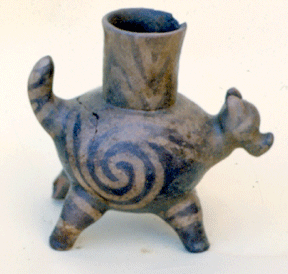
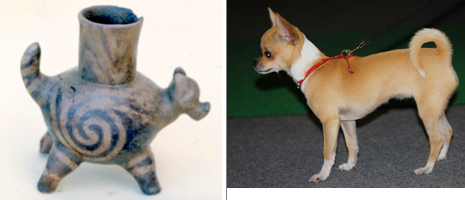
In Georgia a similar dog effigy pot showing a fat little dog was discovered at the Bull Creek site in Muskogee County. The pot includes a swirling design painted on its surface that suggests it was associated with the Creek Indian Wind Clan. Creek tradition holds that the Wind Clan was the most ancient clan among the tribe and the “aristocracy of all the clans.”[iv]

The breed of dog represented on the pot appears to be the Chihuahua. It has an upturned snout, bulbous forehead, erect ears and curved tail all consistent with the Chihuahua breed. The pot has been dated to 1325 AD.

Bull Creek Dog Effigy Pot from Muscogee County, Georgia chihuahua
Dog Effigy Pot from Bull Creek Site Modern-day Chihuahua for comparison

Historical eye-witness accounts of Chihuahuas or Techichis in Georgia exist in the journal entries of Spaniards that were part of the Hernando de Soto expedition. This expedition travelled through Georgia in the 1530s. In several entries the Spanish mentioned that Georgia tribes raised a “little dog” to eat which they kept very fat for that purpose. Like the Techichi, the Spanish noted that this dog could not bark.[v] Later historians thought the Spanish accounts could have referred to opossums instead of dogs.[vi] Yet the eye-witness descriptions of these “little dogs” along with the Dog Effigy Pot from Bull Creek seem to confirm they were Chihuahuas.

In addition to ancestral pair statues and dog effigy pots another type of artifact found in west Mexican shaft tombs were tableaux. One such tableau from Nayarit shows a “multi-layered tree with birds.”[vii] The tree is uniquely stylized. A similar uniquely stylized tree with birds was found engraved on a marine shell in Craig Mound at Spiro, Oklahoma. The object, known as Tree of Life with Birds, is the only such design known to exist throughout the southeast.[viii]

Tree of Life with Birds from Spiro Mounds Tableau featuring cedar tree with birds from west Mexico shaft tomb tradition
Tree of Life with Birds, A.D. 1200-1450, Spiro, Oklahoma A Nayarit tableau showing a multi-layered tree with birds.

The Spiro site, part of the Caddoan Mississippian Culture, is known to have had trade contacts with the Etowah Mounds site in Georgia. In fact, the population of Spiro moved away around 1250 AD[ix], the same time that a new population arrived at Etowah Mounds[x]. Is this a coincidence or did people from Spiro move to Etowah at this time? In fact, the funeral mound at Etowah was constructed after this 1250 AD repopulation of the site. It is in this funeral mound that we find the ancestral pair statues and other objects that seem to reflect the same west Mexican tradition as exemplified by the Tree of Life with Birds artifact found at Spiro.

Additionally, other artifacts at Spiro have shown it had trade connections with both Mexico and the Ancestral Puebloan peoples of the southwest. For instance, a single obsidian scraper unearthed at Spiro was shown to have come from Pachuca in central Mexico.[xi] Also pottery from the Ancestral Puebloan peoples of the American southwest has also been found at Spiro. Turquoise and pottery from the Ancestral Puebloan cultures of the southwest have been found in other Caddoan areas of Texas as well.[xii] It should be noted that the Ancestral Puebloans are known to have had trade contacts with the people of west Mexico and thus it is possible that these west Mexican cultural traditions arrived in the southeast via the southwest.

The Caddoans also produced unique pottery featuring human faces with distinctive scarring. The people in the western Mexican state of Colima also created such pottery showing distinctive scarring not only on human faces but also the afore-mentioned dog pots.

Hamilton Caddoan Head Pot Caddoan head pot with Puebloan sun symbol
This famous Caddoan human effigy pot shows distinctive scarring on its face. This head pot includes a Puebloan sun symbol on its forehead.
Colima hunchback pot with facial scarring Colima dog pot with facial scarring
This hunchback pot from Colima in west Mexico also shows facial scarring. This Colima dog pot also shows facial scarring.

Another artifact from the west Mexican state of Nayarit shows a model of a mortuary temple constructed on a mound covering a tomb. Similarly, a temple topped the funeral mound constructed at Etowah and within the mound were specialized log-lined tombs. (Continues…)

House of Living over House of Dead from West Mexico shaft tomb tradition
A ceramic model of a mortuary temple constructed over a shaft tomb from western Mexico. It is thought to represent the house of the living above the house of the dead.

Ocmulgee Mounds (1000 AD)

Above: Watch a short excerpt from the Lost Worlds: Georgia DVD. Sign up for our free newsletter to get a free password to watch a longer excerpt. Become a member or buy the DVD to watch the entire video.

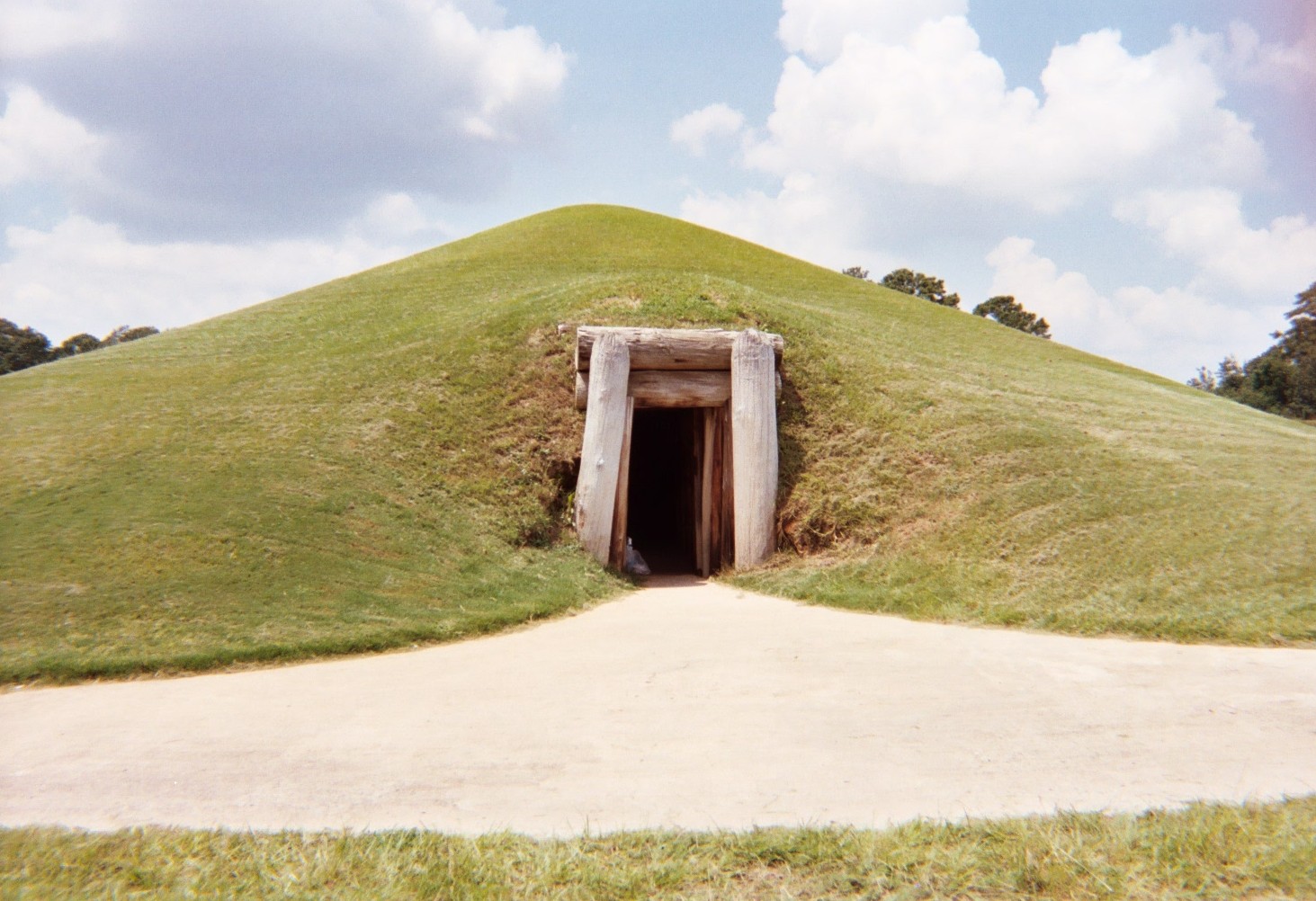
As impressive as the previously discussed Kolomoki Mounds complex is, the NativeAmerican Mound Builders of Georgia would outdo themselves at the next site in our story: Ocmulgee Mounds. Located in Macon, this ancient civilization consists of seven Indian mounds and associated plazas.

The Great Temple Mound at Ocmulgee was built atop the Macon Plateau and rises 56 feet high from the surface of the plateau. Yet because the mound was ingeniously constructed on the edge of the plateau and the plateau itself was terraced and clay fill added to match the angle of the Temple Mound, the mound rises an impressive 90 feet from the river bank below. It was this imposing view that most visitors to Ocmulgee Indian Mounds saw in prehistoric times since most trade and travel was conducted by dugout canoes along the Ocmulgee river.


View larger map
Map of Ocmulgee Mounds. Zoom in to see individual mounds and other features. Click on the blue tabs  to learn more about each feature. Explore the site in 3D with the Google Earth plugin.

Due to its ingenious construction, the top of the Great Temple Mound is significantly higher than the surrounding tree line thus enabling anyone standing here to have a commanding view of the countryside for miles and miles around as well as an unobstructed view of the entire sky dome for astronomical observations.(View QTVR) From here one could easily see signal fires or smoke signals from outlying villages warning of invaders or other trouble. Likewise traders could light signal fires atop the Great Temple Mound to announce the arrival of new trade goods. As its name suggests the Great Temple Mound was also home to a large temple which likely doubled as the Chief Priest’s home. Here he kept a perpetual fire burning which was an important element of their religion and myths.

This giant ground sloth on display at the University of Georgia was unearthed in Brunswick, GA during construction of I-95.
Giant ground sloth found in southeast Georgia on view at UGA.

The Ocmulgee Mounds site has been occupied for 12,000 years as evidenced by the Clovis spear point found during excavations. (View Image Gallery) The Clovis people lived during the last Ice Age and used these spear points to hunt mastadons, wooly mammoths, giant ground sloths and other giant animals that once roamed Georgia. Around 2000 B.C., the same time period as the Sapelo Shell Rings, the first small shell mounds were constructed at the site but it wasn’t until 900 A.D. that the monumental constructions began.

Who Built Ocmulgee Mounds?

At this time newcomers arrived in the region and brought with them corn agriculture, a new style of pottery, new types of arrowheads and a more complex economic, religious and political system. It is thought that these were Muskogean speakers who later were called Creek Indians by Europeans. According to Creek Indian tradition, Ocmulgee Mounds was the site where they “first sat down” after their long migration from the west. Other traditions hold that they originated near “the backbone of the earth” which was their name for the Rocky Mountains. In fact, as we’ll see below, they could have originated as far away as west Mexico and later migrated into the desert southwest before finally arriving at Ocmulgee.

Popocateptl Volcano erupting at nightOne tribe of Creek Indians, the Cussitaw (Cusseta/Kasihta), have a migration legend which might relate to the settlement of Ocmulgee Mounds. It tells how they originated in a place much farther west, a place where the earth would occasionally open up and swallow their children (a possible reference to earthquakes). Part of their tribe decided to leave this place and began an eastward migration in order to find where the sun rose. On their journey they came to a mountain that thundered and had red smoke coming from its summit which they later discovered was actually fire (a possible reference to a volcano.) Here they decided to settle down after meeting people from three nations (Chickasaws, Atilamas, & Obikaws) who taught them about herbs and “many other things.”

From these references one can speculate that these people migrated from Mexico which is west of Georgia and has both earthquakes and active volcanoes. (For a more in-depth analysis of the Creek migration legend, read “Were Georgia’s Muskogee Creek Indians from West Mexico?“) Mexico is also the birthplace of corn agriculture, a defining characteristic of these newcomers. It is also in Mexico where we find cities consisting of flat-topped pyramid mounds arranged around open plazas which is the most noticeable feature of town planning at Ocmulgee.

Archaeologists use the term “Mississippian” to refer to these cultural traits. Mississippian does not refer to a single tribe or people and, in fact, many different tribes across the Southeast and Midwest eventually adopted various aspects of Mississippian culture. “Mississippian” culture is similar to the term “Western” culture in that it describes traits which were shared by many different peoples and cultures speaking many different languages. Just as cultures from Asia to South America have become “westernized,” so did cultures all over the eastern U.S. become “Mississippianized.”

Other evidence also suggests a Mexican origin for the Creek Indians. For instance, the type of tobacco grown in the southeast by the Creek Indians has been shown to have its origins in Central America.

Creek Indian Steeh-tcha-ko-me-co by George Catlin
“Steeh-tcha-ko-me-co” by George Catlin, 1834.
Chontal sculpture from Guerrero, Mexico
Chontal sculpture from Guerrero, Mexico.

Also, an artifact from the Chontal culture discovered in the state of Guerrero in west Mexico reveals a similar dress styles as a Creek Indian chief painted by artist George Catlin in 1834 named Steeh-tcha-ko-me-co. The Chontal are also noted for portable stone human effigy statues that were part of a complex funerary practice. Similar stone human effigy statues were used by Mississippian era Creek Indians such as at the next site in our story: Etowah Mounds. Also, a stela from Guerrero featured a bird-man design similar to a design on a copper breastplate found at Etowah.

Additionally, the Muskogean language spoken by the Creek Indians is believed by some linguists to be distantly related to the Hokan family. This language family has its origin in western Mexico and the western U.S. where the Yuman group is still spoken in western Arizona, southern California, and northwestern Mexico.

Interestingly, the Yumans also constructed earth lodges which is another feature of the Ocmulgee site (discussed below). More specifically, the Yumans were known for constructing square earth lodges. Not far from Ocmulgee at a site known as Brown’s Mount, archaeologists unearthed the remains of a square earth lodge that dates to the same time period as the round earth lodges at Ocmulgee. Thus an idea present in the West was also present in the East and believed to have been built by the same people as those who constructed Ocmulgee Mounds.

It is also appears that Brown’s Mount played a part in the Creek migration legend. The legend states:

They always have, on their journeys, two scouts who go before the main body. These scouts ascended a high mountain and saw a town…Then the Cussitaws became angry, and determined to attack the town, and each one have a house when it was captured. They threw stones into the river until they could cross it, and took the town (the people had flattened heads), and killed all but two persons.

Thus it seems from the legend that the scouts climbed Brown’s Mount (which is down river from Ocmulgee Mounds) and planned the assault on the town. This also reveals that the Ocmulgee Mounds site was already inhabited when the Cussitaws showed up and these inhabitants practiced cranial deformation which resulted in “flattened heads.”

Ocmulgee Mounds Bibb Plain Mississippian pottery
The newcomers arrived at Ocmulgee Mounds with a different style of pottery featuring shouldered bowls with smooth, undecorated surfaces similar to that found among the tribes of the desert Southwest.

The archaeological evidence actually supports this part of the migration legend. The original pottery unearthed by archaeologists at the site is known as Swift Creek pottery and is noticeably different than the style (called Bibb plain) brought by the newcomers. Also, early explorer C. C. Jones, Jr. from Savannah visited the Ocmulgee site in the late 1800s when the Central of Georgia Railroad was cutting a trail through the site. They cut through the burial mound and Mr. Jones noted in his book Antiquities of the Southern Indians Especially the Georgia Tribes that a skull from the lowest part of the mound, thus the oldest part, exhibited cranial deformation giving it a flattened appearance while the later burials in the upper part of the mound did not. All of this evidence suggests two completely different people inhabited the Ocmulgee Mounds site, one replaced (or massacred) by the other.

As noted in the previous article on Kolomoki Mounds, Swift Creek pottery appears to be associated with the Hitchiti-speaking tribes. At least one Hitchiti migration legend suggests they migrated north into Georgia after having first arrived by boat in the Lake Okeechobee area of Florida. It is in this area where archaeologists have found the earliest evidence of corn agriculture, a native crop of Mexico, although this was a much smaller variety of corn than that brought later by the newcomers at Ocmulgee Mounds.

Mayan Cranial Deformation
A Maya skull and statue both showing cranial deformation.

Curiously the Hitchiti language has several Mayan words in it and Mesoamerican symbols have been found on Swift Creek pottery. The Maya were also known for head flattening. Thus all of this evidence suggests the Hitchiti (or at least some portion of them) were possibly descended from the Maya.

It is likely that the Hitchiti/Swift Creek built the first stage of the funeral mound since the skeletons with cranial deformation were found there. Did they also build the first stages of the Greater and Lesser temple mounds? According to another version of the Creek Migration Legend, the first structure the newcomers built upon arrival was “a mound [with a] great chamber in the center” where the warriors could gather– a clear reference to an earth lodge. Yet the legend mentions nothing about constructing the temple mounds and, in fact, their descendants would later tell European settlers they did not know who constructed the mounds.

Ocmulgee Mounds

This artwork is available on a variety of merchandise in our Gift Shop including t-shirts, mugs, posters, stickers, mousepads and more. All proceeds help fund future exhibits. Shop Now to help support LostWorlds.org.

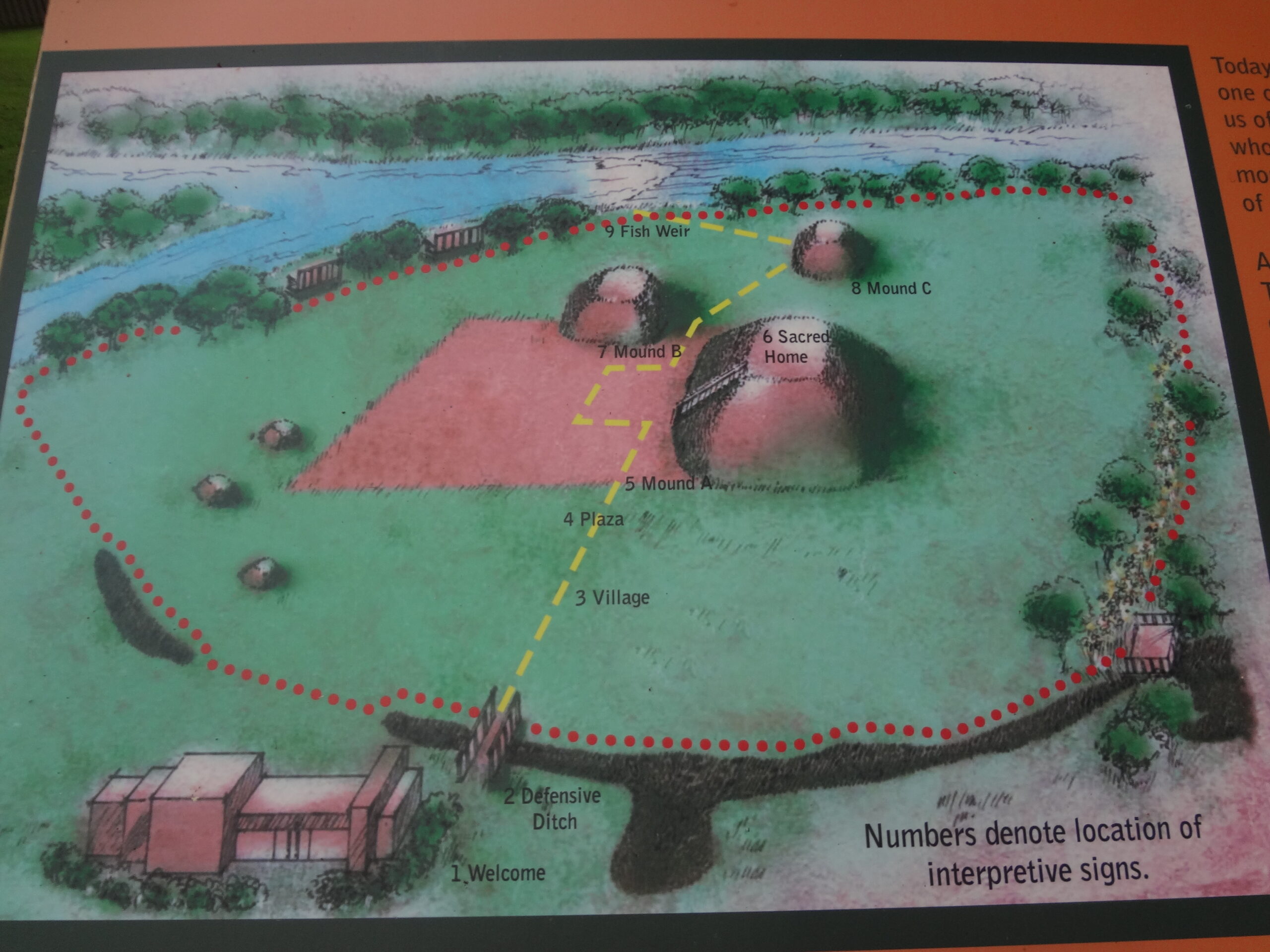
The main features of the Ocmulgee Mounds’ site plan are two truncated pyramidal earthen mounds, one larger than the other, flanking and defining an open plaza area. This site plan does not match previous known Swift Creek site plans such as at Kolomoki Mounds. The site plan does match other Mississippian site plans west of Ocmulgee Mounds such as that at Cahokia near St. Louis. Thus this evidence favors the newcomers as the builders of the Greater and Lesser Temple Mounds and central plaza as well as the Earth Lodge, as previously mentioned.

Also as previously mentioned, the migration legend tells how the Cussitaws would always have scouts ahead of the main group.  Ocmulgee is located on the Ocmulgee River which flows into the Altamaha River which flows into the Atlantic Ocean just south of Sapelo Island for a distance of 300 miles. It is about a three week journey from Ocmulgee to the coast by dugout canoe. Thus as the main group rested at Ocmulgee the scouts would have reached the Atlantic Ocean and realized that their journey had ended. They could go no further east and had discovered that the sun rose from a great ocean each morning. They would return and tell the others about their discovery. Ocmulgee thus became the logical place for a permanent settlement. It truly is where they finally “sat down.” Continues….

Etowah Mounds (1250 AD)

Etowah Mounds is one of the final and perhaps the finest accomplishments of the ancient NativeAmerican moundbuilders of Georgia. This is one of the four most important Mississippian sites along with Moundville in Alabama, Spiro in Oklahoma, and Cahokia in Illinois.

Above: Watch a short excerpt from the Lost Worlds: Georgia DVD. Sign up for our free newsletter to get a free password to watch a longer excerpt. Become a member or buy the DVD to watch the entire video.

The Etowah Mounds complex consists of six earthen Indian mounds all in the traditional Mississippian truncated pyramid shape. These Indian mounds were built between 950 A.D. and 1450 A.D. although major construction didn’t truly begin until around A.D. 1250. The Etowah Indian Mounds site is surrounded by a deep moat on three sides and the Etowah River on the fourth. A palisade wall stood just inside the moat adding further protection to the site. Just like our previous site, Ocmulgee Indian Mounds, the major structures are believed to have been built by Muskogee Creek Indians. Also like Ocmulgee Mounds, the site appears to have been inhabited by another group of people first who were later displaced. It is possible that after the massacre at Ocmulgee Mounds mentioned in the previous article, the surrounding Hitchiti Creek Indian tribes moved further north and inhabited the Etowah region before once again being forced out. (Watch Video)

The largest structure at the Etowah Mounds site was the Great Temple Mound and it has the distinction of being the tallest Indian mound in Georgia. It rose 67 feet high (over seven stories tall) and was oriented to the cardinal points (as were the other Indian mounds at the site.) (View QTVR)

Etowah Mounds aerial view

The temple mound was probed with ground penetrating radar but nothing worth investigating was found and thus this Indian mound has never been fully excavated. Archaeologists did find evidence of at least one large structure on top of the Great Temple Mound. A log wall or fence surrounded the summit. Curiously, the summit is pentagonal in form.

The Lesser Temple Mound, or Mound B, is a more circular or oval Indian mound. It is possible this temple mound was originally square and later plowing by farmers in the 1800′s and 1900′s softened the edges to create the current rounded form. It also appears to have had a large structure on top. This Indian mound is approximately 30 feet tall.

The Funeral Mound, on the other hand, has been completely excavated and some of North America’s most important Shell gorgets from the Etowah Mounds site in Georgia.NativeAmerican and Mississippian artifacts have been discovered there. (View 3D Animation) Among these were ceremonial copper axes, copper-covered earspools, necklaces and pendants of shell and engraved shell gorgets. These shell gorgets were circular medallions worn around the neck made from large seashells and inscribed or carved with various designs.

Many of these shell gorget designs belong to a complex known as the Southeastern Ceremonial Complex, once referred to as the Southern Cult or Southern Death Cult. It has been repeatedly noted that many of these Southeastern Ceremonial Complex designs have strong Mesoamerican influences such as the Long Etowah Mounds Bird Man copper plateNosed God and the Bird Man or Eagle Warrior. It should be remembered that if the Creek Indian Migration Legend is correct, the Muskogee Indian tribe did have its origin in west Mexico. Yet by the time of the major construction period at Etowah Mounds these people had not lived in Mexico for over 300 years. The original Mesoamerican ideas would have evolved in that amount of time and would have been influenced by the people they had come into contact with in the eastern woodlands. Thus ideas such as the Feathered Serpent remained but evolved into their own unique expression. Likewise for the Long Nosed God and the Bird Man/Eagle Warrior.

Native American dance demonstrationThese symbols were also portrayed on copper breastplates worn by high status individuals. One such copper breastplate was found buried with an individual in Mound C, the burial mound. It shows a Bird Man or Eagle Warrior dancing. Amazingly, dancers at modern powwows can be seen performing dances that look remarkably similar to the dances portrayed in these copper designs.

Marble human effigy statues from Etowah Mounds in Georgia.The most important artifacts discovered at the Etowah Mounds site are undoubtedly the two carved marble statues of a man and woman. They are each about two feet tall and are in sitting positions. Early Spanish explorers noted that similar statues were part of an ancestor worship cult and were housed in Funerary Temples where offerings were made to them. These particular statues were discovered buried in their own grave at the base of Mound C. It appears that they were hastily buried without a lot of care since they were broken into pieces when discovered.

This hasty burial corresponds with another piece of archaeological evidence: the palisade wall appears to have burned down. Often times Native Americans would bury important objects when they came under attack in order to keep the items out of the hands of their enemies. It is probable that an attack serious enough to burn down the major defensive work of the massive Etowah Mounds site would have been the inspiration for such a hasty burial of these important objects. It is also possible that the attackers smashed the statues, thereby ritually killing them, and buried them to prevent them from ever being used again.

Who Built Etowah Mounds?

Human Effigy Pair from Nayarit MexicoAs stated in the previous discussion on Ocmulgee Mounds, it appears that the Muskogee Creek Indian tribe migrated from western Mexico into the southwestern U.S.. From here they ended up at the Spiro Indian Mounds site in Oklahoma and the Cahokia Indian Mounds site in Missouri and Illinois. Many artifacts discovered at Etowah Mounds were from either Cahokia or Spiro and many of these were very similar to artifacts from the Shaft Tomb Tradition in west Mexico such as ancestor pair statues, dog effigy pots and tree of life symbolism. For a more thorough and in-depth analysis of the evidence linking Etowah to the west Mexico shaft tomb tradition please visit our exhibit entitled “Were Georgia’s Muskogee Creek Indians from West Mexcio?” But here’s a quick overview of the evidence.

Tableau featuring cedar tree with birds from west Mexico shaft tomb tradition Tree of Life with Birds from Spiro Mounds
Tableau from shaft tomb in Nayarit, Mexico Shell engraving from Spiro Mounds, Oklahoma features similar tree with birds

As just mentioned, archaeologists have noted that the elite at Etowah Mounds had a trading relationship with another important NativeAmerican Mississippian town known as Spiro Mounds in Oklahoma. Spiro Mounds is known for the amazing cache of artifacts that were unearthed in one of its prominent Indian mounds known as Craig Mound. One such artifact, an engraved marine shell known as the Tree of Life with Birds, is identical to a sculpture by the Nayarit people of west Mexico. (The Nayarit are also responsible for the aforementioned Ancestor Pair statues.)

Why did the elites at Etowah Mounds have contact with the elites at Spiro Mounds in Oklahoma, a distance of over 700 miles? Was this simply a trading relationship or was it something much deeper? Could Spiro Mounds have been ruled over by elites related to the elites at Etowah? There are oral traditions all over the southeast of tribes being ruled over by foreigners and these foreigners seem to be related to each other in some way. Could Spiro have been one of the first places the NativeAmerican Mississippians established themselves before continuing their migration east?

Bull Creek Dog Effigy Pot from Muscogee County, Georgia chihuahua
This side-by-side comparison shows the dog effigy pot found near Bull Creek in Muskogee County, Georgia and a modern Chihuahua. This pot is currently on display at The Columbus Museum in Columbus, Georgia and dates from around 1350 AD. The pot also features a whirlwind design which likely represents the Wind Clan, one of the oldest and most revered clans of the Muskogee-Creek Indians.

Elsewhere in Georgia archaeologists uncovered another piece of evidence which seems to link these immigrants to west Mexico: dog effigy pots. The dog effigy pot to the left is just one of many such pots discovered throughout Georgia and Tennessee. What is most intriguing is the breed of dog the pot appears to represent: a Chihuahua. Note its short, upturned snout, bulbous forehead, and arching tail. No other dog breed except the Chihuahua has these particular combination of traits. Yet Chihuahuas are a breed that originated in the western Mexico state of Chihuahua so why do they show up on pots in Georgia? Similar pots from west Mexico also appear to show fattened Chihuahuas. Known as Colima Dog Pots, many of these pots also served as vessels with pouring spouts although not all did. The Colima dog pots are thought to represent the original Techichi breed from which modern Chihuahuas are derived. These little dogs were mute and kept fat to be eaten by the elite.

Colima dog pot w/ spout Colima dog pot
Two of the famous Colima Dog Pots found in a shaft tomb in  western Mexico. The dogs are thought to represent the Techichi breed, a small, mute dog from which the modern Chihuahua is derived.

These three facts are important clues that further support a Mexican origin for the Muskogee Creek Indians. Why? Because when the first Spanish explorers with the De Soto expedition traveled through Florida, Georgia and Tennessee in the early 1500s they noted that the chiefs in this region would often offer them “little dogs” to eat which had been fattened up for that very purpose. The Spanish also noted that these dogs could not bark. This, along with the Bull Creek Dog Effigy Pot, would seem to support the fact that Indian tribes in this area were raising Chihuahuas. [Continues...]

More early dwellings at Ocmulgee monument site, archaeologist finds

greater and lesser temple mounds at Ocmulgee Mounds

An ancient civilization of mound builders who lived near the Ocmulgee River just northeast of what is now downtown Macon may have been home to more native people than originally thought.
Though the research, much of it done with a ground-scanning instrument to roughly map underground shapes and forms, is still under way, early analysis seems to indicate more unearthed dwellings at the site than were previously known to have existed.

Dan Bigman, an archaeologist and doctoral candidate at the University of Georgia, has charted 25 or so acres of the Ocmulgee National Monument grounds since the summer.
Passing back and forth across grid sections while holding a 5-foot-wide sensor, Bigman and his assistants have made underground scans without disturbing the surface.
“It seems like we are seeing (evidence of) a lot more structures … than I expected,” Bigman said Monday. “I was pretty blown away.”
He plans to wrap up his survey later this week with hopes of returning later with other ground-scanning equipment to further verify and, perhaps, enhance the imaging data he has already gathered.
He said a major excavation of the site in the 1930s examined just 17 percent of the property. Bigman’s scans have covered much more area of what is considered one of the largest native Mississippian-period settlements in the eastern U.S. The Macon mounds date back about 1,000 years.
Bigman, 31, set out to pinpoint where exactly the mounds-era inhabitants lived and how their dwellings were situated in relation to one another.
“You can map, in some cases, the cultural remains that are underneath the ground,” Bigman said as he took a break from charting a grassy stretch of Drakes Field, a rarely visited patch on the western edge of the grounds, about half a mile from the Macon Coliseum. “The things that we’re seeing mostly are house structures, house walls.”
The scanning device he uses can also detect long-buried fire pits or hearths, other signs of early dwellings. Once it is determined how densely populated spots are, Bigman said, “You can start looking at questions like what was the social structure, how was the community organized?”
Bigman said the area has “a very complicated occupational history,” which includes Creek occupation in the late 1600s, but he is more interested in the Mississippian culture seven or so centuries earlier.
“Was it continuous occupation or was there space between communities?” Bigman wonders. “How did people identify themselves? Were they part of a larger town or did they have sort of like neighborhoods they were affiliated with?”
His geophysical survey is something of an EKG of the underground. He can plot contour maps or gray-scale images of specks of post holes or rotted wood, pockets in the earth where water accumulates. Because organic material holds water well, Bigman’s ground scanner, which seeks out areas of electrical conductivity, can paint a sketchy picture of possible dwelling foundations, buildings’ footprints still detectable down the ages.
“From the excavations done in the ’30s, we know that they were square (dwellings), we know they were rectangular and we know the range of the sizes that they were. So you can go back and say, ‘Look, here’s a square that’s within the range,’ ” he said of deciphering what the data suggests to help in determining the distribution of people and how large their communities were.
“We just know so little about the site,” Bigman said, “and some of the basic things that you need to answer archaeological questions about communities or about political systems or about how people lived or organized themselves spatially or socially or economically. Where did they live and how did that change over time? Did the site expand over time? Did it contract over time?”
Such questions can be answered or best-guessed, he said, “If we know where they lived.”
“But until I work out the chronology, it’s going to be difficult to say. I can say where the people were, but the question is when,” Bigman said.
The Creeks, who lived there 400 or so years ago, had houses that “were pretty square, too,” he said, so it might be hard to tell which period the underground readings denote.
“The hope,” he said, “is to squeeze data out of here without destroying any more of the ground.”
Read more: http://www.macon.com/2010/12/07/1367701/more-early-dwellings-at-ocmulgee.html