A composite photograph of the front and back of the jade gouge shown with a centimeter scale. CREDIT: Les O’Neil, University of Otago

Origin of Ancient Jade Tool Baffles Scientists

A composite photograph of the front and back of the jade gouge shown with a centimeter scale. CREDIT: Les O’Neil, University of Otago
An international team of archaeologists and geologists has found an extremely unusual example of jade in the Southwest Pacific, thousands of miles away from the nearest known geological source. The small green …

February 2, 2012
Sapelo Shell Ring Complex

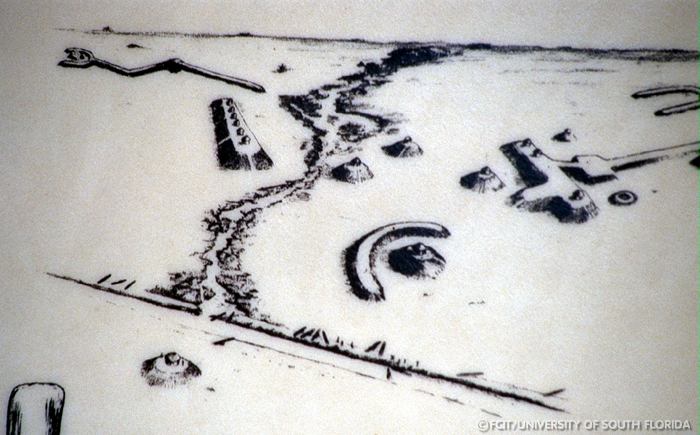
Ancient walled city, older than Egypt’s pyramids, unearthed off Georgia coast

Six hours southeast of Atlanta off the Georgia coast on Sapelo Island, archaeologists have unearthed the remains of an ancient walled city which predates the construction of Egypt’s pyramids. Known as the Sapelo Shell Ring Complex, this ancient city was constructed around 2300 B.C. and featured three neighborhoods each surrounded by circular walls twenty …

January 30, 2012
Some of the oldest known corn cobs, husks, stalks and tassels, dating from 6,700 to 3,000 years ago were discovered at Paredones and Huaca Prieta, two mound sites on Peru’s arid northern coast.  (Credit: Tom D. Dillehay)

Ancient popcorn discovered in Peru

Some of the oldest known corn cobs, husks, stalks and tassels, dating from 6,700 to 3,000 years ago were discovered at Paredones and Huaca Prieta, two mound sites on Peru’s arid northern coast. (Credit: Tom D. Dillehay)
People living along the coast of Peru were eating popcorn 1,000 years earlier than previously reported and before …

January 20, 2012
Fig. 1. Starfish thermonuclear detonation July 9, 1962, 400 km above Johnston Island. The photograph was taken from a Los Alamos KC-135 aircraft three minutes after initiation time. An artificial striated aurora has already formed from the plasma particles, spreading along the earth’s magnetic field.The brightest background object (mark) at the top, left-hand corner, is the star Antares, while the right-most object is ?  -Centauri. The burst point is two-thirds of the way up from the lowest plasma striation.

Super Solar Flare Recorded in Ancient Rock Art?

The discovery that objects from the Neolithic or Early Bronze Age carry patterns associated with high-current Z-pinches provides a possible insight into the origin and meaning of these ancient symbols produced by man. This paper directly compares the graphical and radiation data from high-current Z-pinches to these patterns. The paper focuses primarily, but not …

January 17, 2012
Example of the rock-art found at 40 sites in northeastern Guanajuato, Mexico. Image: Carlos Viramontes / INAH

Forty New Rock Art Sites in Mexico

Rock-art has been discovered and recorded in forty sites in northeastern Guanajuato, Mexico, as part of an ongoing project carried out by researchers from the National Institute of Anthropology and History. The majority of the images were created by hunter-gatherers who occupied the area during the 1-5 centuries AD, but religious iconography and inscriptions …

January 17, 2012
amazon-geoglyphs-brazil

Carvings in Land Attest to Amazon’s Lost World

The earliest explorers of the Amazon recorded that it was filled with villages and towns. After European diseases swept the area and wiped out its inhabitants, the jungle regrew and hid all evidence of these civilizations. Later explorers would find no evidence of such civilizations and the archaeological community, in all their brilliance and …

January 15, 2012
yupaha-brasstown-bald

Possible Mayan Site Discovered in Georgia Mountains?

Architect and scholar Richard Thornton has published his findings about an archaeological site on the side of Georgia’s highest mountain peak, Brasstown Bald. His conclusion, that the site was built by the Maya, could rock the archaeological community who have insisted for decades that no evidence existed for the presence of people from Mexico …

December 22, 2011
moundville-wedding-party

Moundville Native American Festival Celebrates Ancient Culture

Ancient rulers and thousands of their subjects thrived in a city behind huge wooden walls that once surrounded the Moundville site. These prehistoric Native Americans farmed, hunted and fished. Their society recognized nobles by birth and praised the feats of great artists, warriors and holy people. Each year, descendants of this vibrant culture return, celebrating the …

October 6, 2011
Caral in Peru

Caral, oldest new world city, in new video

Recent research shows that the earliest phase of Andean Civilization took place simultaneously with earliest stages of civilization on the Old World.  This remarkable phenomenon and its manifestation at the ancient city of Caral in Peru are described in Caral Supe: The Oldest Civilization in the Americas. (Watch both parts below.)

Recent research shows that cities …

August 15, 2011
spiro conch baldwins small

Spiro started upward spiral in 700 A.D.

This engraved conch shell was unearthed in Craig Mound at Spiro Mounds in Oklahoma.
LeFlore County, often referred to as “Little Dixie,” was once home to a thriving national center of commerce. This lively metropolis enjoyed its heyday not in recent memory, but between 700 and 1400 A.D.

According to Dennis Peterson, archaeologist and site manager of …

August 12, 2011
Solar_flare_(TRACE)

Did A Massive Solar Proton Event Fry The Earth

Close to the end of the last ice age there was a sudden disappearance of many mammalian species which some paleontologists say was the most severe since the disappearance of the dinosaurs 65 million years ago. In North America 95 percent of the megafauna became extinct, these being predominantly mammals having body weights greater …

August 11, 2011
serpent mound

New Serpent Mound could be world’s largest

To the untrained eye, there’s nothing special about the earthen hump that runs for hundreds of feet alongside picturesque Miami Bluff Drive and curves down along the edge of the woods toward the Mariemont Swimming Pool.

At certain points, it’s undetectable from the road because trees, honeysuckle and weeds grow on parts of it.

But to …

August 11, 2011
saluda_river_artifacts_knives

Saluda River artifacts going on display

COLUMBIA — Fans of the Saluda River now have a new place to learn about the area’s Native American history.

Officials from South Carolina Electric & Gas and the Saluda Shoals Park are holding a ribbon-cutting ceremony on Wednesday to open a new display at the Saluda Shoals Environmental Education Center in Columbia. The center …

July 28, 2011
Etowah Mounds Bird Man copper plate

Researchers reveal how prehistoric Native Americans of Cahokia made copper artifacts

EVANSTON, Ill. — Northwestern University researchers ditched many of their high-tech tools and turned to large stones, fire and some old-fashioned elbow grease to recreate techniques used by Native American coppersmiths who lived more than 600 years ago.

This prehistoric approach to metalworking was part of a metallurgical analysis of copper artifacts left behind by …

June 13, 2011
The carved serpent head found at the base of Vista Alegre’s temple structure. The carved serpent head most likely was one of a pair that would have been placed at the base of the balustrades flanking the main set of stairs leading to the top of the main temple structure. Team members found the serpent head in 2002 during the first visit to the site.(Credit: Image courtesy of Proyecto Costa Escondida Maritime Maya 2011 Expedition, NOAA-OER)

The Hidden World of the Maritime Maya

Ancient port site was used periodically between 800 B.C. and 1521 A.D.
Explorers sit atop the ancient Maya pyramid at Vista Alegre. The pyramid stands 35-feet tall and may have been used by Maya lookouts to monitor approaching and departing canoes. (Credit: Image courtesy of Proyecto Costa Escondida Maritime Maya 2011 Expedition, NOAA-OER.)
NOAA-sponsored explorers are …

May 18, 2011

Peru: Tomb believed to be older than “Señor de Sipan” found in northern Peru

A team of archaeologists, led by Walter Alva, have discovered the wooden tomb of another member of the Mochica culture’s elite – older than the “Señor de Sipan” (Lord of Sipan).

These findings belong to the Moche civilization, which ruled the northern coast of Peru from the time of Christ to 800 AD, centuries prior …

February 3, 2011 0

Earliest-known Evidence of Peanut, Cotton and Squash Farming Found

Anthropologists working on the slopes of the Andes in northern Peru have discovered the earliest-known evidence of peanut, cotton and squash farming dating back 5,000 to 9,000 years. Their findings provide long-sought-after evidence that some of the early development of agriculture in the New World took place at farming settlements in the Andes.

February 3, 2011 0

Polynesians beat Columbus to the Americas

Prehistoric Polynesians beat Europeans to the Americas, according to a new analysis of chicken bones.

The work provides the first firm evidence that ancient Polynesians voyaged as far as South America, and also strongly suggests that they were responsible for the introduction of chickens to the continent – a question that has been hotly debated …

February 3, 2011 0

Earliest Known American Settlers Harvested Seaweed

People living in the earliest known settlement in the Americas harvested seaweed and other marine plants from a coastline more than 50 miles (80 kilometers) away, new research shows. Scientists discovered several species of seaweed and marine algae dating back more than 14,000 years at the Monte Verde archaeological site in south-central Chile.

February 3, 2011 0
Nasca Decapitation Vessel

Recently Excavated Headless Skeleton Expands Understanding Of Ancient Andean Rituals

Images of disembodied heads are widespread in the art of Nasca, a culture based on the southern coast of Peru from AD 1 to AD 750. But despite this evidence and large numbers of trophy heads in the region’s archaeological record, only eight headless bodies have been recovered with evidence of decapitation, explains Christina …

February 3, 2011 0

Rare skeleton, jewels found in Bolivia pyramid

Archeologists have uncovered the 1,300-year-old skeleton of a ruler or priest of the ancient Tiwanaku civilization together with precious jewels inside a much-looted pyramid in western Bolivia.

February 3, 2011 0
Page 1 of 512345»