Ysa, Issa, Esaw, and Iswa
Reconsidering a Supposed Catawban Ethnonym
Abstract
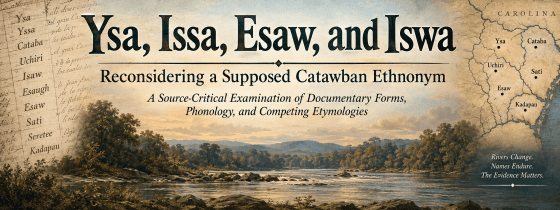
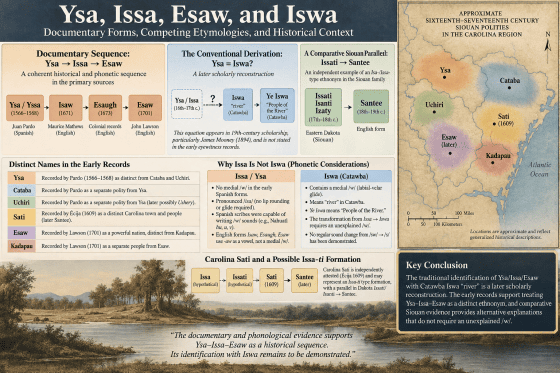
The identification of the sixteenth-century Ysa/Yssa, later Issa and Esaw, with the Catawba expression Iswa “river” has become conventional in the literature on the Carolina Siouans. Yet a review of the primary accounts and the history of that interpretation reveals that the equation is considerably less secure than repeated citation makes it appear. Spanish records from the Juan Pardo expeditions distinguish Ysa/Yssa from Cataba and from Uchiri as separate political communities. Seventeenth-century English sources subsequently record forms such as Isaw, Esaugh, and Esaw, while John Lawson still distinguishes the powerful Esaw nation from the Kadapau in 1701. The form Iswa, by contrast, belongs to Catawba linguistic material in which Iswa denotes “river,” while the fuller self-designation Ye Iswa means “People of the River.” The familiar equation Ysa/Issa/Esaw = Iswa appears not in the early eyewitness records but as a later ethnological reconstruction, particularly in the work of James Mooney, and was subsequently repeated with diminishing acknowledgment of its hypothetical status. This paper reexamines the documentary and phonological basis of that reconstruction and argues that the historical sequence Ysa/Yssa–Issa/Isaw–Esaugh–Esaw is considerably better supported than the subsequent equation of those forms with Iswa. Comparative evidence from Dakota Issati/Isanti and the independently documented Carolina Sati further demonstrates that an Issa/Isa-type ethnonym need not be derived from Catawba Iswa.
Introduction
Few things become more difficult to question than an etymology that has been repeated for generations. Once an interpretation passes from an initial scholarly proposal into handbooks, encyclopedias, archaeological syntheses, and modern reference works, the distinction between primary evidence and later inference can disappear. A proposed identification eventually becomes an established “fact,” while early sources that contradict it are reinterpreted to conform to the accepted explanation.
The historical Ysa provide a useful example of this process. Juan Pardo’s sixteenth-century records contain a population called Ysa or Yssa in the Carolina Piedmont. Later English documents contain forms including Isaw, Esaugh, and Esaw. Beginning in the nineteenth century, these forms were increasingly equated with the Catawba word Iswa, “river,” and interpreted as referring to the Catawba themselves as “River People.” James Mooney consolidated this interpretation in his influential 1894 The Siouan Tribes of the East, grouping Spanish Issa, Lederer’s Ushery, Lawson’s Esaw, and Catawba iswa into a single historical identity.
The difficulty is that the early records themselves do not give us such a simple equation. They repeatedly distinguish Ysa from Cataba, Ysa from Uchiri, and Esaw from Kadapau. Moreover, the spellings Ysa, Yssa, Isaw, Esaugh, and Esaw form a reasonably coherent phonetic and orthographic series in their own right, whereas identifying them with Iswa requires a medial /w/ that none of the early forms clearly represents. The conventional interpretation may ultimately prove correct, but its evidentiary foundation deserves to be separated from the authority it has acquired through repetition.
The purpose of this paper is therefore narrow. It does not attempt to establish a definitive new etymology for Ysa or Issa. Instead, it asks a more basic source-critical question: what do the earliest records actually call these people, and when did scholars begin identifying those names with Catawba *Iswa*?
Relationship to Previous Research.
This study follows an earlier examination of the Issa/Is? ethnonymic stem in Siouan-Catawban historical onomastics, which compared forms such as Dakota Issati, Isanti, and Izaty with later Santee and considered whether an older Issa/Isa-type ethnonym may have circulated more broadly within the Siouan-Catawban world (Daniels 2026). That study was comparative in scope and did not attempt to establish the ultimate origin or meaning of the Issa stem. The present paper addresses a narrower problem that bears directly on that inquiry: the conventional identification of the Carolina Ysa/Issa/Esaw with Catawba Iswa, “river.” By returning to the earliest Spanish and English records and separating their terminology from later ethnological reconstruction, this study tests whether that equation is actually supported by the documentary and phonological evidence. The distinction is important because accepting Ysa/Issa = Iswa in advance effectively determines the meaning and ethnic identity of the Carolina name before alternative Siouan comparisons can be evaluated. The present source audit therefore serves as a methodological companion to the earlier study: rather than proposing another origin for Issa, it asks whether the inherited “River People” explanation has ever been adequately demonstrated.
Ysa and Cataba in the Pardo Records
The earliest evidence belongs to the Juan Pardo expeditions of 1566–1568. Juan de la Bandera’s account of Pardo’s second expedition records leaders identified as Ysa/Yssa Orata and Cataba/Catapa Orata. The title orata was applied to local political leaders. The important point is not merely that both names occur in the same document, but that they occur as distinct political designations.
At Canos in September 1567, Bandera lists a Ysa leader and a Catapa leader separately. At Quinahaqui later that month, Ysa, Cataba, and Uchiri again appear as separate chiefs. Later references include Ysa Chiquito, “Little Ysa,” suggesting that Ysa may have designated a settlement cluster or political community extending beyond a single village. Whatever the exact political relationship among these groups, the documentary structure is difficult to reconcile with the proposition that Ysa was simply another name for Cataba.
The same caution applies to Uchiri. Bandera records an Uchiri leader alongside Ysa and Cataba. If the later identification of Uchiri with Lederer’s Ushery is correct, then the earliest Spanish evidence would actually demonstrate that Ysa and Uchiri were distinct groups, contrary to later attempts to make Ushery another spelling of Ysa, Esaw, or Iswa. The primary records therefore require these names to be kept analytically separate unless independent evidence demonstrates otherwise.
The Seventeenth-Century Documentary Sequence
The seventeenth-century records provide a remarkably coherent sequence of forms that can be examined independently of the later Iswa interpretation. A Carolina description associated with Maurice Mathews in 1671 records Isaw. Colonial records from 1673 refer to the Esaugh Indians and to returning “from Esaugh.” By 1701, John Lawson consistently uses Esaw or Esaws.
Placed beside the earlier Spanish forms, the documentary sequence is therefore:
Ysa / Yssa ? Isaw ? Esaugh ? Esaw
No single colonial spelling can reproduce an Indigenous pronunciation with certainty, and the writers involved belonged to different linguistic and orthographic traditions. Even so, the sequence is striking because it preserves a stable Isa-/Esa- structure across more than a century. The phonetic continuity among these forms is much easier to account for than a transformation from Ysa/Issa into Iswa, which requires an additional consonantal glide.
This distinction becomes especially important because the visual similarity of ISAW and ISWA can be misleading. The letters are nearly identical but occur in a different order and perform different phonetic functions. A spelling such as Isaw does not automatically represent the consonantal sequence /sw/.
Lawson’s Esaw and Kadapau
John Lawson’s 1701 account is especially important because he was an eyewitness traveling among the communities in question. Lawson says that his party hired a guide to take them to the “Esaw Indians, a very large Nation containing many thousand People.” He later describes himself as being among the “powerful Nation of Esaws.” After moving farther through numerous Sugeree settlements, Lawson reaches the “Kadapau King’s House” and subsequently explains that his host was “King of the Kadapau Indians.”
Lawson therefore uses Esaw and Kadapau as different names in a geographic and political sequence. He does not write Iswa, nor does he tell his readers that Esaw and Kadapau are synonyms. The simplest reading of his account is that he believed himself to have passed through territories or settlements associated with the Esaw, Sugeree, and Kadapau as distinguishable peoples or political communities.
Later Bureau of American Ethnology writers recognized the difficulty created by Lawson’s account but sometimes resolved it by asserting that Lawson simply did not realize that Esaw and Kadapau were synonyms. Such reasoning reverses the normal hierarchy of evidence. Rather than allowing the eyewitness account to constrain the reconstruction, the reconstruction is used to explain why the eyewitness must have misunderstood the political distinctions he actually recorded.
This problem is even more striking when Lawson is placed beside Pardo. In the 1560s, Ysa/Yssa and Cataba/Catapa appear as distinct political names. In 1701, Esaw and Kadapau are again distinguished. The possibility that these represent historically related pairs deserves considerably more weight than later attempts to collapse both names into a single Catawba identity.
Ushery Is Not Ysa by Default
The form Ushery should likewise be removed from the Ysa–Issa–Esaw sequence unless independent evidence establishes the connection. John Lederer visited a polity he called Ushery in 1670 and described a large and populous town associated with a king whose dominions were extensive. He repeatedly calls the population Ushery or Usheryes and discusses their political relationships, canoe travel, and trade with neighboring peoples such as the Sara.
Lederer does not call these people Ysa, Issa, Esaw, Iswa, or Catawba. More importantly, the earlier Pardo record contains Uchiri as a distinct political designation appearing alongside Ysa and Cataba. If Uchiri and Ushery are historically related forms—and that relationship itself deserves to be demonstrated—then the evidence points toward a separate sequence:
Uchiri ? Ushery
rather than:
Ysa ? Ushery ? Esaw.
The persistent -ri/-ree element in Ushery and other regional ethnonyms may itself have linguistic significance. Whatever its meaning, it should not simply be discarded in order to make Ushery resemble Iswa. The primary-source distinction deserves priority over later similarity-based harmonization.
Gatschet and the Earlier “Deer” Etymology
The instability of nineteenth-century interpretations provides an important reminder that the modern Iswa explanation was never self-evident. Albert S. Gatschet, while discussing southeastern ethnonyms and the names recorded in the Pardo material, proposed that Issa could be explained through a Creek term meaning “deer.” He rendered the comparison approximately as “Issa Cr. ídshu ‘deer.’”
There is no compelling reason to accept Gatschet’s Creek derivation. Its importance is historiographic rather than linguistic. A prominent nineteenth-century linguist examining the same historical form did not consider a derivation from Catawba Iswa “river” obvious. The existence of a competing contemporary interpretation shows that the now-familiar equation was a scholarly reconstruction, not a transparent fact inherent in the spelling.
Mooney and the Construction of the Standard Equation
The decisive harmonization appears in James Mooney’s 1894 The Siouan Tribes of the East. Mooney grouped the Spanish Issa, Lederer’s Ushery, Lawson’s Esaw, and Catawba iswa under a single historical interpretation. The reconstruction was attractive because Catawba unquestionably possesses a word resembling iswa meaning “river,” and the historic Catawba lived along the major river later bearing their name. It therefore supplied a seemingly elegant explanation for several confusing colonial ethnonyms.
The difficulty is that the reconstruction required several assumptions to be true at once. Ysa/Issa had to be equivalent to Esaw; Esaw had to be equivalent to Iswa; Ushery had to be another representation of the same term; and the historical Ysa had to be equivalent to Cataba/Catawba despite their separate treatment in the Spanish record. The primary sources complicate each of those steps. Pardo distinguishes Ysa from Cataba and Ysa from Uchiri, Lawson distinguishes Esaw from Kadapau, and Lederer never identifies Ushery as Ysa or Catawba.
Mooney’s interpretation therefore solved documentary inconsistency by collapsing the inconsistencies. Once the synthesis entered the influential Bureau of American Ethnology tradition, however, it acquired increasing authority. Later reference works frequently listed Ysa, Issa, Ushery, Esaw, Iswa, and Catawba as historical variants without making clear where eyewitness testimony ended and nineteenth-century reconstruction began.
The Phonological Problem: Issa Is Not Iswa
The phonological difficulty is more substantial than the visual resemblance of the spellings suggests. A form such as Ysa/Issa can be articulated without lip rounding or a medial glide. Catawba Iswa, by contrast, contains /w/, a labial-velar approximant produced through coordinated lip rounding and movement of the back of the tongue toward the velum. In structural terms, something approximating /isa/ and /iswa/ differs by a real consonantal articulation.
For the conventional derivation to stand, it must therefore explain why this medial glide is absent from the earliest Spanish Ysa/Yssa spellings. That absence cannot simply be attributed to Spanish incapacity to hear or represent /w/. Colonial Spanish scribes routinely encountered Indigenous languages containing such sounds. Nahuatl provides a particularly clear example: Spanish-derived orthographies represented Nahuatl /w/ through spellings such as hu, u, and v. Spanish writers were therefore entirely capable of finding orthographic solutions when they perceived a labial-velar glide. The absence of any comparable element in Ysa/Yssa requires explanation if the underlying form was actually Iswa.
The English evidence compounds the problem. In Isaw, Esaugh, and Esaw, the written w does not occur where the consonantal /w/ of Iswa would occur. In Iswa, the glide follows /s/ and precedes the final vowel. In Isaw, by contrast, -aw functions naturally as a final vowel spelling. English words such as saw, law, and draw illustrate the point: the written w is not pronounced as a separate consonantal /w/.
A modern Southern spelling such as dawg for a regional pronunciation of dog provides an intuitive analogy. The w signals a particular vowel quality rather than an independent consonant. Southern American English developed from multiple British and Irish colonial dialect inputs, and although the modern Southern vowel system should not be projected directly backward onto seventeenth-century speakers, the example illustrates an important orthographic principle. An English writer could readily use -aw to represent an Indigenous final vowel that a Spanish writer might render simply as -a. Thus Ysa/Yssa ? Isaw/Esaw requires only ordinary differences in Spanish and English representation of vowel quality.
The conventional Esaw = Iswa equation demands something different. It requires either a medial /w/ that the Spanish repeatedly failed to record, or a regular historical sound change in which /sw/ became /s/. Neither process has yet been demonstrated. The documentary sequence Ysa/Yssa ? Isaw ? Esaugh ? Esaw is therefore phonetically straightforward, whereas the transformation Ysa/Issa ? Iswa requires an additional evidentiary step.
Ye Iswa and the Missing Evidentiary Step
Frank G. Speck’s 1935 study is particularly important because he worked directly with Catawba linguistic material and surviving Catawba speakers. Speck documented a Catawba form approximately i-sw?, “river,” and the fuller expression y? i-sw?, “People of the River.” This establishes an important linguistic fact: “People of the River” is a genuine Catawba expression.
It does not, however, establish that Pardo’s Ysa was that expression. Speck himself characterized the fuller Catawba form as “probably” the source from which early historical names such as Esaw and Issa had been derived. His wording is significant because it reveals that the connection remained a historical-linguistic reconstruction rather than a translation preserved directly by Catawba informants.
The evidentiary distinctions should therefore remain clear. Catawba Iswa means “river.” Ye Iswa means “People of the River.” The proposition that Ysa/Issa/Esaw derives from Iswa remains a hypothesis. Later scholarship often compressed these separate propositions into a single statement—“Issa means River People”—but that formulation obscures both the missing “people” element and the unresolved historical relationship between the words.
A Comparative Siouan Caution: Dakota Issati, Izaty, Isanti, and Santee
A useful comparative caution comes from the eastern Dakota, another Siouan-speaking population. Historical sources preserve forms including Izatys, Issati, Isanyati, and Isanti for people who became widely known in English as the Santee. Dakota linguistic sources connect these forms with isan, “knife,” and with a locative or dwelling construction associated with the group’s former homeland around Knife Lake. Older analyses therefore do not support simply isolating -ti and glossing it as “people.”
The exact Dakota morphology is less important here than the historical pattern. The documentary record demonstrates that an Isa-/Issa-type form existed independently within another branch of the Siouan language family and participated historically in the development of the English ethnonym Santee. Consequently, the appearance of Carolina Ysa/Issa does not linguistically require derivation from Catawba Iswa merely because the two forms look similar on the page.
This comparison is especially relevant because it supplies a real Siouan precedent for an ethnonym in which an Issa-/Isa- element occurs with additional morphological material and later appears in English as Santee. It therefore broadens the range of plausible explanations for the Carolina name and cautions against treating the Catawba “river” etymology as the only available Siouan interpretation.
Carolina Sati and the Possibility of an Issa-ti Formation
The Carolina evidence makes the Dakota comparison more consequential. Francisco Fernández de Écija’s 1609 account explicitly records a Carolina town and people called Sati, a form later identified with the English Santee. Thus Sati is not a hypothetical intermediate invented to connect Issa with Santee; it is independently attested in an early seventeenth-century Spanish source.
The Carolina record consequently preserves two important sequences:
Ysa/Yssa ? Isaw ? Esaugh ? Esaw
and:
Sati ? Santee.
Placed beside the Dakota forms Issati/Isanti/Izaty ? Santee, this raises the possibility that Carolina Issa and Sati preserve related ethnonymic formations. One hypothetical development would be Issa + an additional -ti element ? Issati ? Sati ? Santee, with loss of an initial unstressed vowel or syllable through aphesis. The possibility is linguistically ordinary in form, although the precise grammatical function of the Carolina -ti element cannot presently be assumed to match Dakota morphology.
The significance of this comparison is therefore not that a new derivation has been proved. Rather, it demonstrates that Issa ? Issati-type formation ? Sati/Santee has a meaningful Siouan parallel and does not require the medial /w/ demanded by Iswa. This makes it a legitimate alternative hypothesis that should be weighed against the conventional “River People” interpretation rather than excluded by assumption.
Lawson’s later Seretee should not be inserted automatically into this sequence. If the eyewitness record treats Seretee as a distinct population, that distinction deserves priority unless independent evidence demonstrates synonymy. The independently documented Sati of 1609 already provides a historical antecedent for Santee without requiring Seretee to function as an intermediate form.
From Hypothesis to Received Fact
By the early twentieth century, the Mooney reconstruction had become increasingly difficult to distinguish from primary evidence. Reference works routinely presented Ysa, Issa, Esaw, Ushery, and Iswa as historical names of the Catawba, often without reproducing the political distinctions preserved in the early accounts. The evidentiary direction had effectively been reversed.
The early record had presented Ysa, Cataba, and Uchiri as distinct political designations and had later preserved Esaw and Kadapau as separate names in Lawson’s account. The received interpretation instead collapsed those distinctions into the equation Ysa = Issa = Ushery = Esaw = Iswa = Catawba.
When a source contradicted the reconstruction, the contradiction could then be attributed to confusion on the part of the historical observer. Lawson, for example, could be said not to have realized that Esaw and Kadapau were synonyms. This procedure insulated the hypothesis from falsification: evidence consistent with the theory confirmed it, while evidence inconsistent with it was explained away.
The central historiographic problem is therefore not that earlier scholars compared the forms. Such comparison was reasonable and remains necessary. The problem is that a plausible comparison gradually hardened into an ethnic identification and an etymological fact without the intervening phonological and documentary steps ever being fully demonstrated.
Conclusion
The conventional identification of Ysa/Issa/Esaw with Catawba Iswa “river” is considerably less secure than its long repetition suggests. The earliest Spanish records distinguish Ysa from Cataba and Ysa from Uchiri. Seventeenth-century English records preserve the coherent sequence Isaw–Esaugh–Esaw, while Lawson still distinguishes the powerful Esaw nation from the Kadapau in 1701. Lederer’s Ushery likewise belongs to a potentially separate Uchiri–Ushery sequence and should not be inserted into the Ysa line by default.
The documentary and phonological evidence therefore supports treating Ysa/Yssa, Issa/Isaw, Esaugh, and Esaw as historically related forms of an ethnonym far more readily than it supports identifying that ethnonym with Catawba Iswa. The former sequence requires only the kinds of vowel representation and orthographic variation routinely encountered when Spanish and English writers recorded unfamiliar Indigenous names. The latter requires an additional medial /w/—a perceptible labial-velar glide that the Spanish did not record and that the English -aw spellings do not represent in the required position. The conventional equation with Iswa consequently remains a later etymological hypothesis rather than a demonstrated reading of the early sources.
The independent Dakota sequence Issati/Isanti ? Santee, together with Écija’s Carolina Sati ? Santee, further demonstrates that an Issa/Isa-type ethnonym need not be explained through Catawba Iswa. Whether Carolina Ysa/Issa and Sati ultimately represent related forms remains to be established, but this alternative follows known Siouan ethnonymic patterns closely enough that it cannot be dismissed in favor of an Iswa derivation merely because ISAW and ISWA contain the same letters. The primary record should therefore govern the reconstruction: Ysa–Issa–Esaw is the historically and phonetically supported sequence; its supposed identity with Iswa remains to be proved.
References
Bandera, Juan de la. 1569. “Proceedings for the Account Which Captain Juan Pardo Gave of the Entrance Which He Made into the Land of the Floridas.” In The Juan Pardo Expeditions: Exploration of the Carolinas and Tennessee, 1566–1568, edited by Charles Hudson, translated by Paul E. Hoffman, 255–296. Washington, DC: Smithsonian Institution Press, 1990.
Daniels, Gary. 2026. “Before Santee: The Issa/Is? Ethnonymic Stem in Siouan-Catawban Historical Onomastics.” Academia.edu.
Écija, Francisco Fernández de. 1609. “The Relation of Francisco Fernández de Écija.” In The Spanish Crown and the Defense of the Caribbean, 1535–1585: Precedent, Patrimonialism, and Royal Parsimony, by Paul E. Hoffman. Baton Rouge: Louisiana State University Press.
Gatschet, Albert S. 1884. A Migration Legend of the Creek Indians. Vol. 1. Philadelphia: D. G. Brinton.
Hudson, Charles. 1990. The Juan Pardo Expeditions: Exploration of the Carolinas and Tennessee, 1566–1568. Washington, DC: Smithsonian Institution Press.
Lawson, John. 1709. A New Voyage to Carolina. London.
Lederer, John. 1672. The Discoveries of John Lederer. Translated and collected by William Talbot. London: J. C.
Mooney, James. 1894. The Siouan Tribes of the East. Bulletin 22. Washington, DC: Bureau of American Ethnology.
Riggs, Stephen R. 1852. Grammar and Dictionary of the Dakota Language. Smithsonian Contributions to Knowledge 4. Washington, DC: Smithsonian Institution.
Speck, Frank G. 1935. “Siouan Tribes of the Carolinas as Known from Catawba, Tutelo, and Documentary Sources.” American Anthropologist 37 (2): 201–225.