Santee Origins
Before Santee: The Issa–Isa Ethnonymic Stem in Siouan-Catawban Historical Onomastics
Abstract
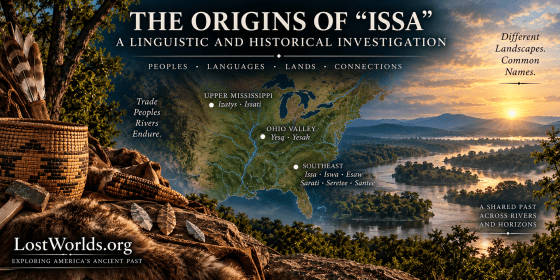
The ethnonym Santee presents an unusual historical-linguistic problem. In the Upper Mississippi Valley, the eastern Dakota were recorded by seventeenth-century French observers as Issati and Izatys and later became conventionally known as the Isanti or Santee. More than a thousand miles to the southeast, early colonial records preserve a cluster of Siouan-Catawban ethnonyms including Issa, Ysa, Iswa, Esaw, Sarati, Seretee, and Santee. Still farther north in the Virginia-Carolina Piedmont, nineteenth-century Tutelo speakers identified Yesang/Yesah, now normalized as Yesa, as their own national designation. Traditional scholarship has generally explained these names locally: Catawban Iswa through a term associated with “river,” southern Santee through a reconstructed Catawban river expression, and northern Isanti through Dakota isá?, “knife,” plus habitation morphology. This paper argues that such localized interpretations, although linguistically possible within their respective languages, may not exhaust the historical problem.
A chronological source audit reveals that an Issa/Isa/Yesa-like identity term appears repeatedly among geographically separated Siouan-Catawban populations before several later explanatory traditions were formalized. The Comparative Siouan Dictionary does not presently reconstruct these forms as a regular inherited cognate set, and established Tutelo-Dakota sound correspondences make simple Proto-Siouan inheritance problematic. However, the same comparative database documents widespread prehistoric lexical diffusion, irregular borrowing, subsequent morphological remodeling, and folk etymology among Siouan languages. These processes provide an alternative mechanism: an older ethnonymic stem may have circulated areally among already differentiated Siouan-Catawban communities and subsequently been accommodated to local vocabularies. The evidence does not establish the ultimate origin of the stem, but it suggests that the central historical question is no longer simply what Santee meant locally in Dakota or Catawban. It is why an Issa/Is?-like ethnonym appears repeatedly across the Siouan-Catawban world.
Introduction
Historical ethnonyms are among the most valuable and most dangerous forms of evidence available for reconstructing Indigenous North America. Early European observers recorded names through incompatible French, Spanish, and English orthographies; the same term could designate a village, a political community, a confederation, a geographic region, or a population known to outsiders under an entirely different name. Warfare, epidemic disease, migration, slave raiding, political amalgamation, and colonial administration subsequently altered both Indigenous political structures and the vocabulary Europeans used to describe them. A name documented in the nineteenth century may therefore preserve an authentic Indigenous linguistic analysis without necessarily preserving the original historical circumstances in which the ethnonym arose.
The name Santee illustrates this problem especially well. The eastern Dakota of Minnesota and the Upper Mississippi Valley have long been called Santee or Isanti. In South Carolina, a historically Siouan-speaking population was likewise known as Santee, with John Lawson explicitly recording the alternative form Seretee. Conventional scholarship has generally treated the resemblance as accidental. The northern name has been interpreted through Dakota isá?, “knife,” while the southern name has commonly been connected with Catawban iswa, “river,” and related constructions.
If only the modern English spellings were available, treating the resemblance cautiously would be entirely appropriate. But the earliest documentary record contains a much broader constellation of forms. Sixteenth- and seventeenth-century sources preserve Ysa/Issa in the Carolina Piedmont. Lawson recorded Esaw and distinguished this population from Kadapau, even though both later became encompassed within the historical Catawba Nation. He also wrote of the “Seretee or Santee Indians.” Horatio Hale’s Tutelo informants identified Yesang or Yesah as their proper national name. Meanwhile, Daniel Greysolon Du Luth recorded Izatys in 1679 among the eastern Dakota, and Louis Hennepin subsequently used Issati.
These forms do not constitute proof of a single cognate. They do, however, create an onomastic problem that deserves investigation before later local etymologies are projected backward. The central argument of this study is deliberately narrower than an assertion of proven common descent. It proposes that Issa/Isa/Yesa represents an older ethnonymic stem or ethnonymic complex whose history may precede some of the localized semantic interpretations later attached to related forms. Whether that stem was inherited from a remote linguistic ancestor, transmitted through prehistoric contact, repeatedly borrowed among neighboring populations, or partially reshaped through folk etymology remains unresolved. The first task is to establish the stem historically.
The Earliest Southeastern Evidence: Ysa, Issa, Iswa, and Esaw
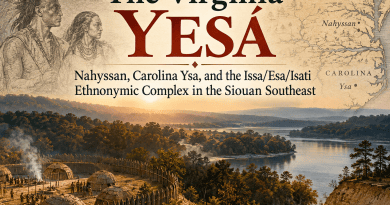
The southeastern evidence begins well before the eighteenth-century standardization of the name Catawba. Accounts associated with the Juan Pardo expeditions of 1566–1568 preserve a Carolina Piedmont population identified as Ysa or Issa. Modern archaeological and ethnohistorical syntheses treat the Ysa/Issa/Iswa encountered in the Pardo-era South Carolina interior as closely related to the population later known as Catawba. This early occurrence is significant because Issa appears as a population name rather than as a nineteenth-century linguistic reconstruction.
Subsequent English documentation reveals that the political landscape remained complex. When John Lawson traveled through the Carolina interior around 1701, he distinguished an Esaw population from the Kadapau. Later ethnographic literature tended to regard these as equivalent or component names within what became the Catawba Nation, but modern archaeological interpretation has increasingly emphasized that the early Catawba polity was the result of coalescence rather than a timeless homogeneous tribe. Lawson’s distinction suggests that Kadapau and Iswa/Esaw were distinguishable populations living near one another before merging with each other and with remnants of other Siouan-speaking communities.
This distinction matters because it demonstrates that the historical sequence was not simply Catawba to Iswa to “river people.” Instead, Issa/Ysa/Iswa/Esaw had an independent existence within the early documentary record, while the political label Catawba expanded through later consolidation.
James Mooney and subsequent ethnographers nevertheless interpreted these forms through Catawban iswa, “river.” Mooney connected the Spanish Issa, Lederer’s Ushery, and Lawson’s Esaw with Catawba iswa. Frank Speck later developed similar reasoning from Catawba linguistic material, analyzing historical Catawba designations through constructions involving iswa and the idea of people living along a river.
The point is not that this linguistic interpretation must be wrong. Catawban iswa is real, and the historical association of the Catawba with their river is undeniable. The methodological issue is chronological. The existence of an Indigenous word that can explain a historical ethnonym synchronically does not automatically establish the diachronic origin of the ethnonym. The sixteenth-century Issa/Ysa should therefore be treated first as an ethnonymic datum and only secondarily as a word whose historical meaning must be reconstructed.
The Catawba Case as a Model of Ethnonymic Coalescence
The formation of the historical Catawba Nation provides a particularly useful model for understanding how older ethnonyms can disappear without the disappearance of the populations that bore them. Colonial Carolina was transformed during the seventeenth and early eighteenth centuries by population loss, warfare, slave raiding, disease, migration, and political consolidation. Communities previously recorded under individual names increasingly assembled into larger defensible settlements. As these populations coalesced, European observers adopted encompassing political labels that could obscure earlier identities.
The Catawba case is unusually well documented. Lawson encountered Esaw and Kadapau as distinguishable communities, yet later writers increasingly treated the designations as referring to components of the same emerging polity. Modern archaeological synthesis similarly treats the historical Catawba as the product of the merger of Iswa and Catawba populations together with remnants of several neighboring Siouan groups. This history cautions against assuming that the dominant eighteenth-century ethnonym preserves the deepest layer of identity.
It also demonstrates a mechanism central to the present study: ethnonymic flattening. A name can disappear from later administrative records because the people carrying it have entered a broader political organization. Colonial documentation may therefore create the illusion that one population vanished and another replaced it when the actual process involved political absorption and renaming. This mechanism becomes particularly important when interpreting Issa/Iswa, Seretee/Santee, and related names.
Sarati, Seretee, and Santee
The historical relationship between Seretee and Santee is not hypothetical. Lawson explicitly used the two names interchangeably, writing of the “Seretee or Santee Indians.” Whatever the exact linguistic explanation, this establishes that Seretee and Santee were understood by an early English observer as alternative forms associated with the same people.
The more important discovery is that Seretee has a probable sixteenth-century antecedent. Robin Beck directly links Lawson’s observation to the Sarati or Saruti orata who met Juan Pardo at Gueça and Ylasi in 1567. The location of those encounters suggests a Piedmont setting for the people later recorded as Santee/Seretee. The chronological sequence—Sarati/Saruti in 1567, Seretee/Santee around 1701, and later standardized Santee—complicates a purely lower-river derivation of the ethnonym. If the identification is correct, a closely related name existed inland before the later Santee population became strongly associated in colonial geography with the river bearing that name.
The evidence does not by itself tell us how Sarati, Seretee, and Santee should be morphologically segmented. Attempts to remove -ree from Seretee or -ti from related names risk assuming the desired root in advance. A stronger method is to preserve the earliest forms intact and ask whether an Issa/Sa/Is?-like element can be independently established elsewhere.
Yesang, Yesah, and Yesa: An Indigenous Self-Designation
The Tutelo evidence introduces a particularly important third body of data. In 1883, Horatio Hale worked with Tutelo descendants and asked about the people’s own name. His informants distinguished their national designation from the externally imposed name Tutelo. Hale reported that the proper name used by the people themselves was Yesang or Yesah, with the final syllable carrying a faint nasal quality that could be barely audible. He further suggested that the form might underlie the historical name Nahyssan.
This evidence is important because Yesang/Yesah was identified by Indigenous speakers as their own national name, not inferred retrospectively from an English colonial label. Contemporary Tutelo-Saponi linguistic work normalizes the population name as Yes? and the language as Yesa:sah??. Recent language-reclamation scholarship refers to the “Yesa peoples” and describes Yesa:sah?? as their historical language. The language’s use around the major Occaneechi trading center also places the community within a multilingual interaction sphere rather than an isolated local environment.
Contemporary Yesa:sah?? specialists and community scholars gloss Yesáh/Yesa as “the people,” while the language name is commonly rendered “speech of the people.” This semantic evidence must nevertheless be handled carefully. The Comparative Siouan Dictionary does not currently reconstruct Yes? as the ordinary Proto-Siouan generic noun “people,” nor does it join Yesa to Catawba Iswa or Dakota Isá? in a recognized cognate set. The significance of Yesa is therefore not that it proves the other Issa-like forms mean “people.” Its importance is that an Issa/Isa-like phonological form is independently documented as an Indigenous national self-designation among another Eastern Siouan population.
The Problem of Assuming “River” as the Original Meaning
Once Yesa is introduced, the traditional Catawba explanation deserves reexamination. Speck’s Catawba material demonstrates that forms involving iswa could be interpreted through “river,” and Mooney similarly treated Issa/Esaw/Ushery as variants of a Catawban river designation. Yet comparative Siouan evidence does not reveal an inherited Proto-Siouan-Catawban iswa root meaning “river” that straightforwardly explains the broader ethnonymic distribution.
The Comparative Siouan Dictionary reconstructs the widespread Siouan word for “water” from a very different lexical set, with Dakota mní, Dhegiha n?, Tutelo man?/m?n??, and related forms. Another reconstructed set involving “lake/water” produces Dakota mdé, Tutelo yetáñi “sea,” and Catawba y? “water,” again without generating a simple Issa/Iswa ethnonymic reconstruction.
This does not invalidate the Catawba word iswa. It demonstrates only that the Catawba river interpretation cannot automatically be extended across the larger Siouan-Catawban family. Historical languages routinely remodel opaque names through familiar vocabulary. The relevant question is not whether Catawba speakers could interpret Iswa through their word for river. They clearly could. The question is whether that interpretation represents the oldest recoverable stage of the name. The documentary evidence does not currently settle that question.
The Northern Evidence: Izatys and Issati
The northern Santee problem begins with seventeenth-century French documentation rather than nineteenth-century missionary dictionaries. Daniel Greysolon Du Luth reported that on July 2, 1679, he displayed the French royal arms in the large Dakota village he called Izatys. Later examination of the manuscript tradition showed that Izatys had at one point been misread as Kathio, an error repeated in Minnesota historiography. The corrected reading is Izatys, which historical synthesis treats as an early form of Isanti/Issati. Hennepin’s accounts shortly afterward preserve Issati for the eastern Dakota population.
These attestations matter because they predate nineteenth-century lexical explanations by approximately 170 years. Any historical reconstruction of the name must explain Izatys/Issati, rather than beginning with later standardized Isanti and reasoning backward.
The traditional Dakota interpretation is nevertheless linguistically real. Dakota has isá?, “knife,” and Dakota grammatical material contains ati in the sense of pitching or establishing a camp. Riggs’s English-Dakota vocabulary gives ati among expressions for “pitch a tent.” Later Dakota ethnographic material consequently analyzes Isanati/Isanyati in relation to the Knife Lake tradition. The existence of these forms must not be dismissed. But a distinction is necessary between synchronic transparency and historical origin. If speakers at a later period can parse an ethnonym through familiar words in their language, that does not prove the name was originally coined from those words.
Nasalization and the Misleading Written N
Earlier discussions of Issati sometimes treated the absence of a written n in French sources as proof that later Isanti must contain an inserted consonant. That argument is too crude. Modern Dakota isá? contains a nasalized vowel represented orthographically with ?. The apparent “n” in older English-like renderings therefore does not necessarily represent a simple consonantal /n/ comparable to English n. A French observer’s spelling Issati without an explicit nasal marker cannot establish that nasalization was absent from the Indigenous pronunciation.
The relevant comparison is thus approximately Yes? : Isá?. Both contain a medial s and a final nasalized low vowel. That resemblance is noteworthy, but resemblance alone is not enough to establish cognacy.
Testing Direct Inheritance
If Tutelo Yes? and Dakota Isá?- descended regularly from the same Proto-Siouan lexical root, their sounds should generally follow established historical correspondences between Tutelo and Dakota. The Comparative Siouan Dictionary creates difficulties for that model. For example, Proto-Siouan wi-yá?pe “beaver” yields Tutelo y?op but Dakota ?hápa. An inherited Proto-Siouan y therefore does not normally produce a simple Dakota initial i- corresponding to Tutelo y-.
A straightforward reconstruction of Proto-Siouan Yes? yielding Tutelo Yes? and Dakota Isá? is consequently phonologically problematic. Nor does the current comparative record provide a recognized cognate set uniting the Catawba, Tutelo, and Dakota forms. The orthographic resemblance cannot be promoted into a regular inherited etymology without additional comparative work.
This negative result is important because it narrows the viable historical models. The recurrence of the stem may be accidental; it may reflect an inherited form altered by processes not yet demonstrated; or it may reflect diffusion after the relevant languages had already differentiated. The available evidence favors keeping all three possibilities open.
Borrowing, Diffusion, and Ethnonymic Remodeling
The failure of a simple inheritance model does not make historical relationship impossible. The Comparative Siouan Dictionary records extensive lexical diffusion among Siouan languages. Contact could transmit a name without preserving the regular sound correspondences expected of inherited vocabulary. Ethnonyms are especially susceptible to such circulation because they pass between speakers, neighbors, interpreters, traders, and colonial recorders.
A borrowed ethnonym may also be remodeled in the receiving language. Speakers can associate an unfamiliar inherited or borrowed name with familiar native words, producing a locally transparent analysis that obscures the name’s earlier history. In Catawban, an older name could become associated with iswa, “river.” In Dakota, a comparable form could become associated with isá?, “knife,” and with locative or habitation morphology. In Tutelo, the national name could be understood through a community-specific expression meaning “the people.” These interpretations need not be false at the level of later speakers. They may represent genuine Indigenous analyses of a name whose deeper origin had become opaque.
This model explains why local etymologies should be respected without being treated as mutually exclusive proofs of ultimate origin. It also fits the political history of coalescence, migration, and multilingual exchange documented across the Siouan-Catawban world.
An Ethnonymic Stem, Not a Proven Proto-Form
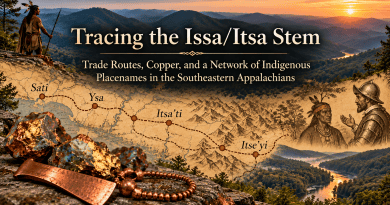
The evidence supports identifying an ethnonymic complex rather than reconstructing a single Proto-Siouan word. The southeastern series Ysa/Issa/Iswa/Esaw, the Tutelo Yesang/Yesah/Yes?, and the northern Izatys/Issati/Isanti share a conspicuous phonological profile and each functions as an identity term. The Sarati/Seretee/Santee series provides a possible additional bridge, although its morphological relationship to the other forms remains less secure.
The term “stem” is therefore used descriptively. It marks a recurrent element that merits historical explanation; it does not claim that every form descends regularly from a single reconstructable ancestor. The current evidence establishes distribution and recurrence more securely than it establishes transmission.
This distinction also clarifies what the paper does not claim. It does not show that Issa originally meant “river,” “knife,” or “people.” It does not demonstrate that northern and southern Santee communities formed a single historical population. It does not establish a Proto-Siouan-Catawban reconstruction. It argues instead that the repeated identity term predates, exceeds, or complicates the local semantic explanations commonly treated as complete etymologies.
Conclusion
The earliest records make Issa/Iswa itself the central historical problem. In the sixteenth-century Carolina Piedmont, Ysa/Issa appears as a population name before the consolidation of the historical Catawba polity. Around 1701, Lawson’s Esaw and Kadapau reveal political distinctions later flattened under the Catawba label, while his “Seretee or Santee” preserves instability within another ethnonymic series. In the nineteenth century, Tutelo speakers identified Yesang/Yesah—now written Yes?—as their own national designation. In the Upper Mississippi Valley, seventeenth-century French sources recorded Izatys and Issati long before later scholarly standardization of Isanti/Santee.
No single item proves a common origin. Together, however, they show that local “river” and “knife” etymologies do not exhaust the historical evidence. The recurrence of an Issa/Is?/Yes?-like identity term across geographically separated Siouan-Catawban populations is sufficiently early, sufficiently persistent, and sufficiently embedded in Indigenous self-designation to require explanation.
The most responsible conclusion is therefore neither identity nor coincidence, but a research program. Future work should assemble every dated primary spelling, distinguish self-designations from exonyms, test each proposed segmentation against language-specific morphology, and compare the forms under both inheritance and contact models. Until that work is completed, Issa/Is? should be treated as an older ethnonymic stem or complex whose circulation and remodeling may illuminate a neglected layer of Siouan-Catawban historical identity.
References
Beck, Robin A., Jr. 2013. Chiefdoms, Collapse, and Coalescence in the Early American South. Cambridge: Cambridge University Press.
DeMallie, Raymond J., ed. 2001. Handbook of North American Indians, Vol. 13: Plains. Washington, DC: Smithsonian Institution.
Du Luth, Daniel Greysolon. 1679. Account of the expedition to the Sioux country and the village recorded as Izatys. In published collections of documents relating to the exploration of New France and the Upper Mississippi Valley.
Hale, Horatio. 1883. “The Tutelo Tribe and Language.” Proceedings of the American Philosophical Society 21: 1–45.
Hennepin, Louis. 1698. A New Discovery of a Vast Country in America. London: M. Bentley, J. Tonson, H. Bonwick, T. Goodwin, and S. Manship.
Lawson, John. 1709. A New Voyage to Carolina. London.
Merrell, James H. 1989. The Indians’ New World: Catawbas and Their Neighbors from European Contact through the Era of Removal. Chapel Hill: University of North Carolina Press.
Mooney, James. 1894. The Siouan Tribes of the East. Bulletin 22. Washington, DC: Bureau of American Ethnology.
National Park Service. “Joara and the Juan Pardo Expeditions.” Archaeological and historical synthesis concerning Ysa/Issa/Iswa and the Carolina Piedmont.
Rankin, Robert L., et al. Comparative Siouan Dictionary. Online comparative lexical database, continually revised.
Richardson, Giulia R. M., and David V. Kaufman. Recent work on Yesa:sah?? language reclamation and the Yes? peoples.
Riggs, Stephen Return. 1852. Grammar and Dictionary of the Dakota Language. Smithsonian Contributions to Knowledge 4. Washington, DC: Smithsonian Institution.
Speck, Frank G. 1934. Catawba Texts. New York: Columbia University Press.
Swanton, John R. 1952. The Indian Tribes of North America. Bureau of American Ethnology Bulletin 145. Washington, DC: Government Printing Office.