Paquimé: Ancient America’s 9/11?
The Fall of North America’s Great Desert Trade City
Sometime during the first half of the fifteenth century, one of the most extraordinary cities in ancient North America ceased to exist as a functioning community. Paquimé, better known today as Casas Grandes, had risen from the Chihuahua Desert as a sprawling metropolis of multistory earthen buildings, plazas, markets, warehouses, ceremonial mounds and ballcourts. Its inhabitants engineered a sophisticated water system, accumulated millions of marine shells from distant coasts, imported copper from western Mexico, raised brilliantly colored tropical macaws hundreds of miles beyond their natural range and participated in an exchange network extending northward into the Pueblo world of what is now the United States and southward into Mesoamerica. UNESCO today recognizes precisely these commercial and cultural connections as one of the reasons Paquimé is of worldwide archaeological importance. (whc.unesco.org)
Then something happened.
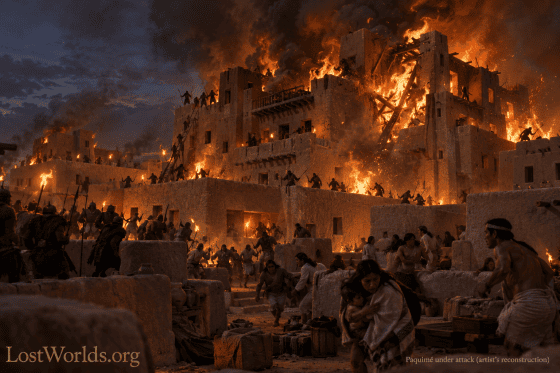
Buildings burned. Portions of the city collapsed. Human bodies appeared in unusual contexts rather than conventional graves. Sacred objects were broken and scattered. The economic system stopped functioning. The macaw industry vanished. Enormous stores of shell and other valuable materials remained behind, and by the time Spanish explorers reached Casas Grandes in 1565, the once-great city was already abandoned.
When archaeologist Charles C. Di Peso excavated Paquimé between 1958 and 1961, he believed he had discovered the aftermath of one of the most spectacular acts of destruction in ancient North America. Di Peso reconstructed a final assault in which enemies entered the city, killed its inhabitants, desecrated its sacred places and set fire to its great buildings. Because Paquimé’s massive earthen upper floors depended upon wooden beams and posts, he believed attackers deliberately ignited the structural timbers, allowing the enormous weight of the architecture above to collapse into the rooms beneath. Human remains recovered amid architectural debris seemed to confirm the terrifying scenario. (scholarsbank.uoregon.edu)
If Di Peso was right, what happened at Paquimé invites an uncomfortable modern comparison. This was not merely the burning of a village. His reconstruction envisioned attackers exploiting the structural vulnerability of some of the tallest inhabited buildings in the region so that the buildings themselves became instruments of destruction. Paquimé was also more than a residential settlement: it was an economic and ceremonial center whose influence reached far beyond its walls. In that limited sense, Di Peso had reconstructed something resembling an ancient Native American 9/11—a deliberate attack on monumental structures at the heart of a far-reaching economic system, followed by catastrophic collapse and the disappearance of the institutions those buildings represented.
There is only one problem.
Modern archaeology has reopened the case.
Skyscrapers of the Chihuahua Desert
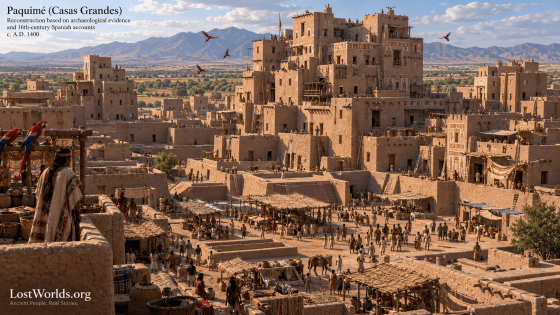
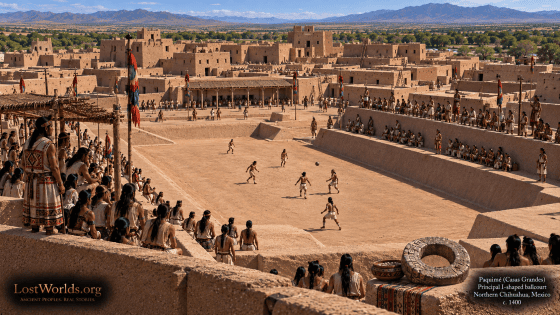
It is difficult to appreciate ancient Paquimé by looking at the ruins today. Centuries of rain and erosion have reduced its once-massive earthen architecture to rounded walls and low room outlines. During the city’s height, however, these were substantial multistory residential complexes incorporating apartments, storerooms, workshops, halls, internal courtyards and ceremonial spaces. INAH currently describes major residential units as reaching three or four floors, while UNESCO recognizes approximately 2,000 rooms grouped into residential, workshop and storage complexes. (lugares.inah.gob.mx)
The earliest European description suggests the skyline may have been even more impressive. Baltasar de Obregón accompanied the Ibarra expedition through northern Mexico in 1565, probably little more than a century after Paquimé’s abandonment. He described buildings of extraordinary size and strength, some rising six or seven stories, with towers, large paved courtyards, heavy wooden pillars and walls that had once been whitewashed and painted in multiple colors. Whatever deterioration had already occurred by 1565, Obregón saw considerably more of the original vertical architecture than survives today. (scholarsbank.uoregon.edu)
The six- and seven-story figure should not be treated as archaeologically proven across the city. Modern excavation can securely demonstrate several stories and INAH’s more conservative reconstructions generally emphasize three- and four-story buildings. Nevertheless, Obregón’s eyewitness testimony cannot simply be ignored. If even a portion of Paquimé reached the heights he described, its tallest buildings would have ranked among the most impressive inhabited residential structures in the ancient Greater Southwest.
These were not stone pyramids with temples perched on top. They were buildings containing rooms in which people lived, stored commodities and conducted daily activities on successive levels. Walls were made principally from molded or packed earth, while substantial wooden beams supported floors and roofs. Ramps and stairways connected elevations, courtyards organized the room blocks, and an elaborate system carried water through a city whose surrounding environment could hardly have been less forgiving. UNESCO considers the architecture an exceptional example of both North American earthen construction and the blending of northern and Mesoamerican techniques. (whc.unesco.org)
Calling them the “skyscrapers of the desert” is therefore an analogy, not an architectural classification. Yet it captures something important about Paquimé. Approaching this city across the Chihuahua landscape during the fourteenth century, a traveler would have seen an artificial skyline rising above the valley, its tallest structures advertising concentrated labor, political authority and wealth long before the visitor entered the marketplace.
And the marketplace was where Paquimé’s real power became visible.
A City Between Worlds
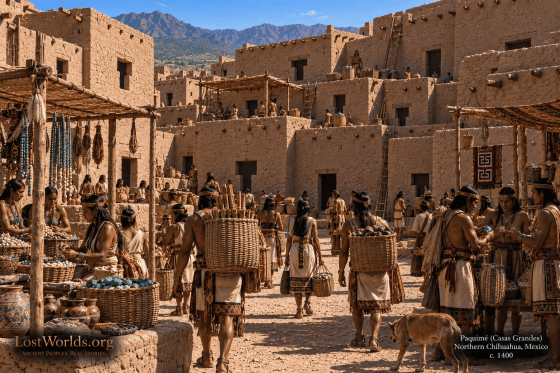
Paquimé occupied one of the most interesting cultural positions in ancient North America. To the north lay the Pueblo world of New Mexico, Arizona, Colorado and Utah. To the south and southwest lay the civilizations and exchange networks of Mexico. Between them stretched deserts, mountain ranges, river valleys and coastal routes that were barriers only if we imagine ancient people as isolated within the modern boundaries archaeologists later created for them.
The contents of Paquimé show that they were not isolated at all.
Marine shell arrived in enormous quantities from the Pacific and Gulf of California coasts. Copper objects and bells linked Paquimé with metallurgical traditions centered in western Mexico. Turquoise, obsidian and pottery connected the city with communities farther north and east. Exotic ceramics from what is now the American Southwest entered Paquimé, while Casas Grandes pottery and symbolism spread beyond the central valley. UNESCO consequently describes the city as a key point in commercial and cultural contact between the Pueblo world and Mesoamerica. (whc.unesco.org)
The mistake would be imagining a single Paquimé merchant walking from Guatemala to Colorado with a pack full of merchandise. Ancient exchange networks usually operated through overlapping routes. Goods could move from one community to another, changing hands repeatedly until an object traveled far beyond the lifetime range of any individual trader. Paquimé’s importance lay in its position within that system. Commodities originating in remarkably different ecological zones converged within the same desert city.
The spectacular scarlet macaw illustrates how far those relationships could reach. The natural range of these tropical birds lies at least a thousand kilometers southeast of Paquimé. Yet hundreds eventually appeared in the city, and modern isotope analysis has shown that Paquimé went beyond importing them. Twenty of twenty-nine tested scarlet macaws had been raised locally, demonstrating a large northern avicultural operation sustained outside the bird’s natural habitat. Nonlocal birds continued to enter the population from elsewhere, meaning Paquimé combined long-distance acquisition with local production. (sciencedirect.com)
Paquimé was not the first Southwestern society to possess such connections. Several centuries earlier, Chaco Canyon in New Mexico had already developed relationships with the Mesoamerican world. Scarlet macaws reached Pueblo Bonito by approximately A.D. 900–975, and chemical analysis of distinctive cylinder jars later detected cacao—the plant from which chocolate is made—being consumed there between roughly A.D. 1000 and 1125. Since cacao could not grow in Chaco’s climate, the ingredient had to travel north from Mesoamerica. Even more significantly, researchers concluded that knowledge concerning how cacao was prepared and consumed in ritual may have traveled with it. (pmc.ncbi.nlm.nih.gov)
That changes how we should think about ancient trade. The long-distance network was not simply moving pretty objects from one society to another. It was capable of carrying ritual knowledge.
Paquimé contains additional architectural hints that the same process continued. Its famous T-shaped doorways immediately recall T-shaped openings at Chaco Canyon and other Pueblo sites farther north. At Paquimé the form became extraordinarily prominent, appearing throughout domestic and ceremonial architecture and even in carved stone altars. INAH identifies the T-shaped doorway as one of the site’s defining architectural characteristics, while related Casas Grandes settlements throughout Chihuahua also reproduced the form. (smarthistory.org)
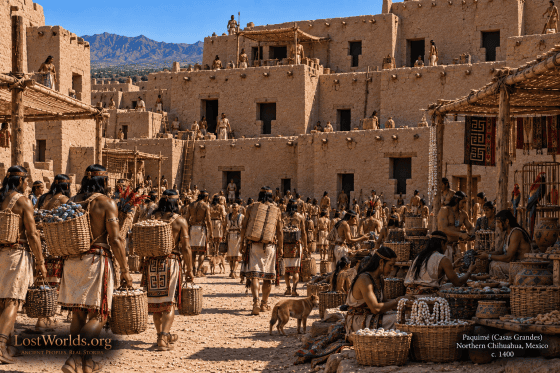
Yet when we turn from Paquimé’s doorways to its public ceremonial architecture, the compass points south. Two of its three monumental ballcourts were constructed in the classic I-shaped form strongly associated with Mesoamerican ballgames rather than the oval or basin-shaped ballcourts known from Hohokam Arizona. The third Paquimé court was a unique T-shaped ceremonial court. At least twenty-one courts are known throughout the greater Casas Grandes region, although Paquimé’s were by far the most elaborate. (mdpi.com)
None of this proves that a population from Chaco migrated to Paquimé or that Mesoamerican priests established a colony in Chihuahua. Those older migration and merchant-colony models remain controversial. The more defensible conclusion is also more interesting: Paquimé stood inside a network in which architectural forms, ceremonial practices and ideas moved along with commodities.
Macaws and cacao at Chaco show that Mesoamerican goods—and perhaps aspects of Mesoamerican ritual—had already penetrated deeply into the Pueblo Southwest centuries before Paquimé reached its height. T-shaped doorways at both Chaco and Paquimé point toward strong northern architectural relationships, while Paquimé’s I-shaped ballcourts point toward Mesoamerica. Together they suggest that the city did not merely occupy a geographical midpoint between two cultural worlds. Its inhabitants selectively combined elements of both, possibly incorporating foreign concepts into a distinctly Casas Grandes belief system.
Paquimé brought distant worlds together.
Nowhere is that more apparent than in the millions of objects stored inside its buildings.
Nearly Four Million Shells
The statistics almost sound like a typographical error.
More than 3.7 million perforated Nassarius shell beads were recovered at Paquimé. Approximately 1.5 tons of shell were present in total, much of it concentrated within a surprisingly small number of rooms. Rakita and Cruz calculate that 99.3 percent of Paquimé’s more than 3.7 million shell artifacts were beads, while Nassarius alone accounted for roughly 95 percent of the total shell assemblage. Michael Whalen describes Paquimé as containing the largest cache of marine shell ever discovered at an inland prehistoric site in North America or Mesoamerica.
The shells originated largely on the Pacific and Gulf of California coasts of Mexico. Someone had to gather them by the millions, select them, perforate them and move them hundreds of miles inland. They eventually accumulated within a desert city in quantities far beyond what we would expect from ordinary household ornamentation. Even after centuries of loss, destruction and excavation, the surviving numbers are staggering.
Charles Di Peso thought he knew how all that labor had been accomplished.
He explicitly identified two Paquimé rooms as shell-working “slave” workshops and proposed that low-status or corvée workers performed repetitive production under elite supervision. The hypothesis was not irrational. Paquimé was socially stratified, labor-intensive and capable of organizing enormous projects. Millions of tiny shells had been individually handled, and Di Peso imagined workers spending their lives performing the same monotonous task again and again.
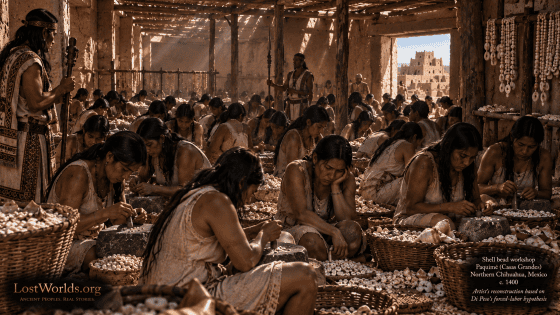
Later archaeological analysis badly weakened that specific interpretation.
If millions of shell beads were manufactured inside Paquimé, we should expect mass production to leave some archaeological signature. Yet only twenty unfinished shell objects and twenty-two pieces classified as worked shell were reported in the relevant inventory, and one supposed slave-workshop area contained surprisingly little shell-working equipment. Rakita and Cruz concluded that many finished shell objects were probably imported from elsewhere, while the millions of Nassarius shells may have arrived already perforated—perhaps even strung—after being processed closer to their coastal source.
The finding does not eliminate the labor mystery. It relocates it.
Someone still punched more than three million holes.
The perforation of an individual Nassarius shell was probably a relatively simple operation requiring little specialized skill, but repeating that operation millions of times represents an immense cumulative expenditure of human effort. Were coastal families producing beads seasonally? Were specialized communities manufacturing them for inland exchange? Did elites extract them as tribute? Were people obligated to perform corvée labor? Were captives or enslaved workers involved somewhere in the supply chain?
Archaeology currently cannot tell us.
The quantity of beads by itself cannot prove slavery, and there is no responsible way to identify the anonymous workers as slaves simply because their task appears monotonous to us. At the same time, the possibility of coerced labor should not be artificially excluded from a socially stratified world where warfare, sacrifice and hierarchical authority existed. Di Peso may have put the slaves in the wrong rooms—or slavery may have had nothing to do with bead production at all. The honest answer is that a vast labor system lies concealed behind those millions of tiny shells, and we do not yet know how it was organized.
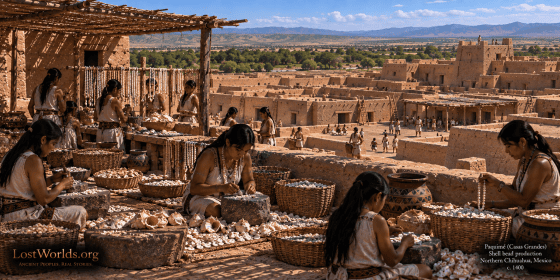
There is another possibility. Perhaps the shells were not merely commercial inventory.
Whalen has argued that Paquimé’s enormous shell concentrations make more sense if shell was understood as an animate or spiritually charged substance forming a reservoir of supernatural power. From a desert perspective, the connection is intriguing. These shells embodied a distant world of water, just as Paquimé’s hydraulic system brought water under human control within an arid environment. Commerce, prestige and religion need not have been separate categories for Paquimé’s inhabitants. The same shell could represent wealth, distant geography and sacred power simultaneously.
The Case for a Pre-Columbian Token Economy: Paquimé as a Central Bank
Rather than viewing the 1.5 metric tons of marine shells at Paquimé strictly as raw material or static ritual items, the cache can be interpreted as the institutional repository of an active token economy. Under this framework, the Nassarius shell beads functioned effectively as a standardized regional currency. For a currency to succeed, it requires widespread public trust and a mechanism to regulate supply. Paquimé likely operated as the “central bank” of the Greater Southwest, hoarding vast amounts of shell “bullion” in its centralized warehouses to control the supply and maintain the baseline value of the currency across its vast trade network with northern Puebloan societies.
This economic framework provides an elegant explanation for the abandonment of these massive stockpiles during the city’s 15th-century decline. When the institutional framework and trade routes of Paquimé collapsed, the regional network that backed the currency fractured entirely. Just as Confederate paper currency lost all value overnight following the fall of its governing institutions, the shells at Paquimé suffered a total devaluation. Because the value was derived from trust in the network rather than intrinsic utility, the millions of remaining beads instantly transformed from immense institutional wealth into useless, abandoned debris once the political system died.
It’s well known Native Americans on the East Coast used wampum made from shells as a form of wealth. The Spanish in Florida and the Georgia coast recorded chiefs being paid specifically with small marine snail shells:
“every year they all go with certain tributes of pearls and of other monies that they make out of snail shells (caracoles) and deerskins.”
Or it could simply be a warehouse full of shell without enough labor to process it into wearable goods. It could really be just that simple.
Whatever the explanation, the shells reveal a society capable of organizing exchange on an extraordinary scale.
The macaws reveal something even more complicated.
The Macaw City
Scarlet macaws should not have been living in Chihuahua.
These spectacular red, yellow and blue parrots belong to tropical environments far to the south and east. Yet Paquimé produced the remains of hundreds of them, along with specialized adobe facilities, stone entrance rings, plugs, eggshell and birds of different ages. The archaeological record became so distinctive that macaws are now one of the defining symbols of Casas Grandes culture.
At first this looked like another example of long-distance luxury trade. Tropical birds must have been carried north alive, probably through an exchange chain stretching from Mesoamerica toward the Southwest. The difficulty of moving a living macaw over hundreds of miles would itself have made the animal enormously valuable.
Modern science has revealed a more sophisticated operation.
Strontium-isotope analysis of twenty-nine scarlet macaws showed that twenty had been raised locally at Paquimé. Others came from outside the immediate area, demonstrating that new birds still entered the population. Rather than endlessly importing every macaw from the tropics, Paquimé had created a northern avicultural center capable of maintaining a large population close to potential consumers in the Southwest.
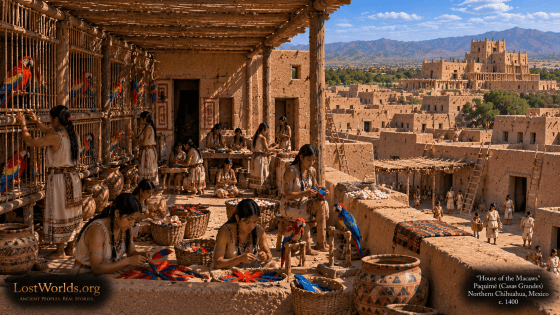
That achievement required more than possession of a few breeding birds. Macaws living in the Chihuahua Desert depended on people for food, water, shelter and protection from a climate radically different from their natural habitat. Their keepers needed practical knowledge passed from one generation to another. Maize and other locally available foods had to support them. Nesting and holding facilities had to be maintained. Valuable feathers could then enter ceremonial and exchange systems without importing a new bird every time.
The birds were not simply livestock. Large numbers received deliberate burials, demonstrating that Paquimé’s relationship with macaws extended far beyond straightforward commercial exploitation. Feathers may have circulated while the animals themselves retained ritual identities. The brilliant living birds would also have transformed the sensory character of the city. Anyone entering Paquimé’s plazas would have seen flashes of tropical red, blue and yellow and heard the calls of animals whose natural world lay far beyond the surrounding desert.
Imagine what that communicated to a visitor.
Paquimé could bring the tropics into Chihuahua.
Di Peso believed some of these valuable birds were still alive when the city was attacked and were abandoned to die after their keepers disappeared. That image—the empty city growing silent while captive macaws and turkeys remained enclosed—is one of the most haunting pieces of his reconstruction. Modern archaeology makes the story more complicated because many of the recovered birds were intentional ceremonial burials rather than animals that simply starved in cages. We therefore cannot claim that hundreds of macaws died after the final attack.
But the larger reality remains.
At some point the keepers stopped maintaining the system.
The breeding operation ended. The provisioning network ended. Whatever specialized knowledge had sustained a tropical bird industry in the Chihuahua Desert ceased to operate at Paquimé.
Like the shell warehouses, the empty bird facilities tell us that what disappeared was not simply a population.
It was an institution.
The Day Paquimé Died
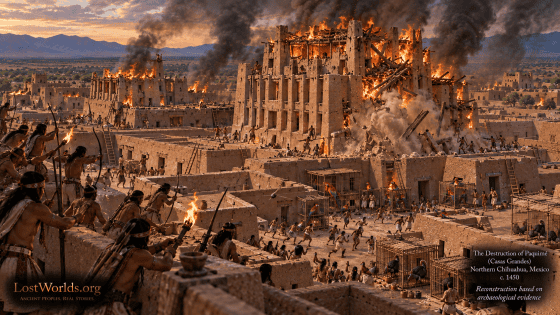
Charles Di Peso believed Paquimé met its end violently. His excavation produced more than one hundred human remains that he classified as lacking normal burial, along with burned architecture, collapsed rooms and apparently desecrated ceremonial contexts. To him, the pieces fit together naturally: invaders stormed the city, massacred the inhabitants, burned the buildings and left bodies beneath the wreckage.
Because only part of Paquimé had been excavated, the implications were terrifying. Later scholars pointed out that if the supposed victims represented only a sample of a citywide event, the death toll could have reached into the hundreds or even beyond a thousand. Casserino summarizes how Di Peso’s interpretation transformed Paquimé into a candidate for one of the largest prehistoric massacres known in the Americas. (scholarsbank.uoregon.edu)
The architecture made the scenario even more dramatic.
Earthen walls do not readily burn, but wooden beams do. Paquimé’s multistory floors and roofs depended upon large timbers. Di Peso therefore reconstructed an attack in which fire destroyed the wooden structural elements, allowing upper portions of the enormous adobe room blocks to collapse. People inside would then have faced not merely flames but tons of earth, timber and roofing material falling through the building.
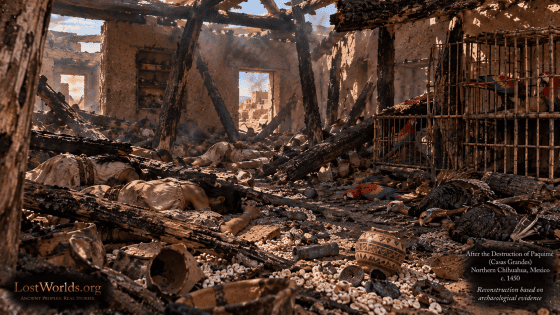
For the ancient 9/11 comparison, this is the central image: attackers using the vulnerability of monumental architecture to destroy the people inside it.
Unfortunately for such a clean narrative, Christopher Casserino later subjected the massacre hypothesis to forensic analysis.
His 2009 bioarchaeological study examined Paquimé’s human remains, patterns of skeletal trauma, mortuary context, radiocarbon evidence and structural burning. A population slaughtered in one enormous attack should produce recognizable patterns of violent trauma and chronological clustering. Instead, Casserino concluded that the supposedly unburied individuals accumulated across time rather than representing one simultaneous death event. The skeletal evidence did not support a final citywide massacre. (scholarsbank.uoregon.edu)
The fire evidence presented an equally serious problem for Di Peso.
Some Paquimé rooms had burned more than once. Di Peso’s own excavation records documented rooms that burned, were replastered and reoccupied, and later burned again. In one unit, rooms 4 and 17 had been burned, replastered and then burned a second time; another room contained multiple floors indicating renewed occupation after an earlier fire. Casserino concluded that at least some of the burning better fits Southwestern traditions of deliberate ritual closure than one terminal conflagration caused by attacking enemies. (scholarsbank.uoregon.edu)
That conclusion destroys the simplest version of the story.
It does not prove that Paquimé ended peacefully.
Human sacrifice and extreme ritual treatment of bodies occurred at the site. Some unusual deposits unquestionably reflect deliberate violence. Early Spanish testimony also preserves an intriguing Indigenous memory. When the Ibarra expedition reached the abandoned city in 1565, nearby people reportedly indicated that Paquimé’s former inhabitants had moved north after enemies from beyond the mountains forced them away. The account was recorded generations after the city’s collapse and cannot serve as an eyewitness description, but it shows that conflict remained associated with Paquimé’s abandonment in local historical memory. (unm.edu)
The chronology has changed as well. Di Peso placed the final destruction around A.D. 1340. David Phillips’ reassessment of tree-ring estimates, radiocarbon dating, pottery and other evidence instead places demonstrable construction into the 1430s and finds the strongest pattern supporting abandonment by about 1450. The broader Casas Grandes cultural system appears to have suffered a dramatic decline during roughly A.D. 1400–1450. (unm.edu)
Perhaps there never was a single “day Paquimé died.”
What looks archaeologically like one disaster may instead represent years or decades of breakdown compressed into the ruins. Buildings burned at different times. Some were repaired. Sections of the city became abandoned while others remained occupied. Ritual closure transformed obsolete spaces. Violence occurred. Communities moved. Trade relationships changed. Eventually the labor-intensive systems that maintained waterworks, buildings, exotic animals and long-distance exchange could no longer function.
Then Paquimé crossed a threshold.
It stopped being a city.
The Wealth Left Behind
One of the strangest features of Paquimé’s decline is how much material remained.
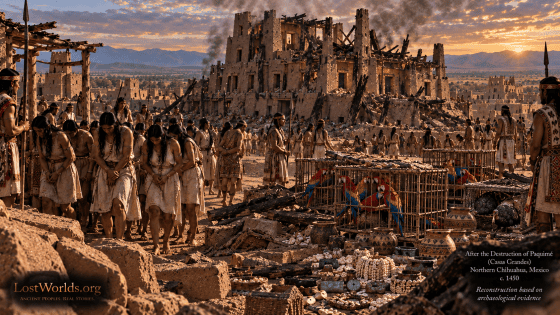
Millions of shell beads survived inside architectural spaces. Imported ceramics remained. Copper objects remained. Turquoise and other exotic materials remained. The remnants of the macaw industry remained. If invading warriors attacked one of the richest centers in the region simply to acquire its wealth, the archaeological result is peculiar.
We should not say that the attackers “stole nothing.” Archaeology cannot identify objects that disappeared. Portable copper, turquoise, textiles, food, feathers and finished ornaments could have been carried away in enormous quantities without leaving us a receipt documenting the theft.
But we can say something remarkable.
Paquimé was never stripped of all the material its inhabitants had once considered valuable.
That fact may make more sense if the city did not end through a single raid. Economic value is not inherent in an object. It depends on a functioning social system. Millions of shell beads are valuable only while people desire them, recognize the institutions controlling them and maintain the routes through which they circulate. A macaw breeding population is wealth only while someone can feed the birds, care for them and exchange their feathers or offspring. Monumental buildings are centers of power only while people remain willing and able to maintain them.
When a system collapses, wealth can remain while value disappears.
Paquimé may therefore preserve something more unusual than an ancient city that was robbed and burned. It may preserve the material remains of an economy whose rules stopped working.
And one of the objects left within that world was unlike anything else archaeologists found at the site.
It had not come from Mexico.
It had not come from the Southwest.
It had not come from Earth.
The Meteorite of Paquimé
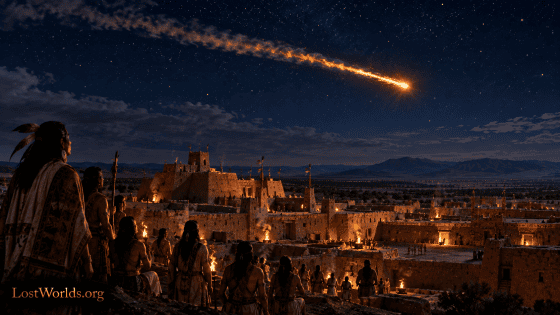
In the nineteenth century, investigators removed an enormous iron meteorite from the ruins of Casas Grandes. Smithsonian records preserve an extraordinary description of its discovery. The mass was reportedly found built into what observers described as a brick tomb or altar and was carefully wrapped in coarse cloth. It was not merely lying outside among ordinary rocks. Someone at Paquimé appears to have deliberately enclosed and protected it. (repository.si.edu)
Popular accounts frequently describe the meteorite as weighing approximately 5,000 pounds, but the Smithsonian actually weighed it before cutting. Its original measured weight was 3,407 pounds, or approximately 1,545 kilograms. That is roughly the weight of a small automobile. Smithsonian documentation classifies it as an iron meteorite and records the enormous dimensions of the original mass. (repository.si.edu)
We do not know where Paquimé’s inhabitants found it, nor do we know whether anyone saw it fall. Smithsonian records explicitly state that nothing is known about the date of its fall. We therefore should not imagine ancient residents watching a blazing meteor crash beside their city and then building a shrine around the impact.
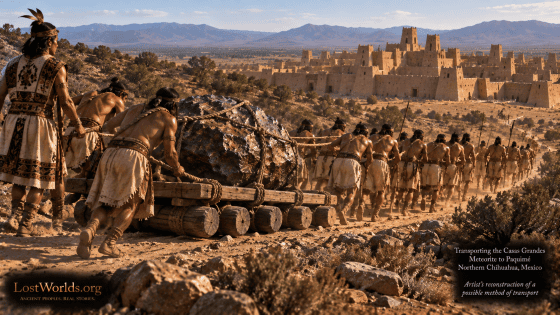
What matters is what they did after obtaining it.
An iron mass weighing more than a ton was moved into Paquimé and apparently placed within a specially prepared enclosure. Instead of breaking the meteorite apart as a convenient source of strange metal, its custodians largely preserved the object intact. Even more strikingly, they wrapped it in cloth. Early descriptions compared the treatment with the wrapping of the dead.
The Maya actually have a term the translates exactly as “stone wrapping”: k’altun or k’al tuun. During the Classic Period, Maya rulers performed the k?altun ceremony, wrapping or binding large stone monuments (stelae) in bands of cloth or ropes. [1, 2] To the Maya, stone monuments were not inanimate objects; they held a divine, soul-like essence. Wrapping a stone served to enclose its sacred power, shield it, or temporarily activate its presence within the ordinary world. [1, 2]
Thus the Paquime’s behavior strongly suggests curation rather than ordinary storage.
Precisely what the meteorite meant is unknowable. Paquimé left no written explanation telling us whether the object represented an ancestor, celestial power, sacred stone or something entirely different. We should resist borrowing beliefs about meteorites from unrelated Native societies and projecting them onto Casas Grandes.
Yet its treatment tells us something even without words.
This object mattered enough to preserve whole.
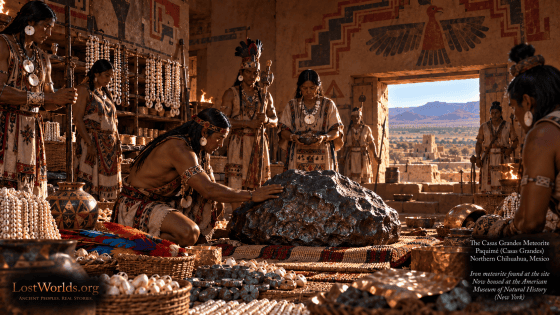
That distinction separates it from nearly every other exotic material found at Paquimé. Shell was transformed into beads. Copper became bells and ornaments. Turquoise was worked. Macaw feathers were removed and used. Obsidian became tools. The meteorite appears to have been valued in substantial part for simply being what it was—an immense mass of strange iron unlike anything routinely encountered in the surrounding landscape.
Its later history is almost as remarkable. The great mass eventually traveled north and became part of the Smithsonian’s meteorite collection, where portions remain cataloged principally under USNM 369. In 2026 INAH reported that an 18.3-kilogram slice of the Casas Grandes meteorite is exhibited at the Museo de las Culturas del Norte beside the archaeological zone of Paquimé, while the Smithsonian continues to hold substantial portions of the original meteorite. (collections.si.edu)
More than five centuries after Paquimé collapsed and more than a century after the meteorite was removed, part of the object has therefore returned to the city where someone once wrapped it in cloth.
There is something strangely appropriate about finding a meteorite at Paquimé.
This was a city built around bringing distant worlds close.
Ocean shells reached its desert warehouses. Tropical birds lived inside its adobe compounds. Western Mexican metallurgy reached its residents. Southwestern pottery entered its rooms. Architectural and ceremonial ideas moved between Pueblo and Mesoamerican worlds.
And among Paquimé’s extraordinary possessions was literally a piece of another world.
Was Paquimé Really an Ancient 9/11?
After examining the evidence, the answer depends entirely upon what we mean by the comparison.
If we mean that archaeologists have proven that enemy warriors deliberately burned Paquimé’s structural beams, collapsed its tallest buildings and killed hundreds of people beneath them during one coordinated attack, then no. Modern bioarchaeology does not support such certainty. The supposedly simultaneous victims accumulated over time, buildings burned during multiple episodes, and some fire appears better explained by ritual closure. Di Peso’s spectacular massacre remains a reconstruction, not an established forensic conclusion. (scholarsbank.uoregon.edu)
That is precisely why the question mark belongs in the title.
Di Peso nevertheless recognized something real. Paquimé underwent a catastrophic transformation. The greatest settlement of the Casas Grandes world ceased functioning. Its monumental architecture was abandoned. A sophisticated exchange economy fragmented. An extraordinary avicultural operation ended. Communities throughout the region declined or reorganized. By the time Spaniards arrived, the city was empty enough that even its former inhabitants had become the subject of stories told by other Native people.
The deeper parallel with 9/11 therefore may not lie in the literal mechanics of falling buildings.
It lies in the relationship between architecture and systems.
Paquimé’s multistory complexes were not impressive simply because they were tall. They contained and represented something larger: households, specialists, stored wealth, ceremonial authority, water management and exchange. The marketplaces functioned because people trusted routes leading outward from the city. Shell was valuable because communities participated in a cultural system that valued shell. Macaws mattered because religious and political institutions gave exotic feathers meaning. Monumental architecture mattered because a population continued investing labor in it.
Once those relationships broke, possessing the physical objects was no longer enough.
That may explain why so much remained behind.
Paquimé still had shell.
It still had copper.
It still had turquoise.
It still had pottery.
It still had its meteorite.
What it no longer had was the network of human relationships that made those things part of a functioning civilization.
The City That Never Recovered
Archaeology is especially good at recovering durable objects and notoriously bad at recovering the invisible relationships surrounding them. Paquimé illustrates that problem almost perfectly. We possess millions of shells but not the negotiations that brought them across the mountains. We possess macaw skeletons but not the conversations between generations of bird keepers. We possess ballcourts but do not know the words spoken before the game began. We possess T-shaped doors but not the complete symbolic system explaining why the shape mattered enough to repeat in architecture and stone altars.
We possess the meteorite but not the story explaining why someone wrapped it.
And we possess the ruins but not the final argument that convinced a family it was time to leave.
Charles Di Peso attempted to fill that silence with a dramatic story of invasion, massacre and fire. Modern archaeology has shown that the reality was more complicated. Some of the evidence he combined into one event belongs to different moments. Some of the dead were not massacre victims. Some of the fires preceded the city’s final abandonment. The destruction of sacred objects may sometimes have represented ritual closure rather than enemy desecration.
Yet removing Di Peso’s massacre does not solve Paquimé.
It creates a larger mystery.
How does a society capable of maintaining a continental exchange network, monumental architecture, sophisticated waterworks and exotic industries lose the institutional machinery necessary to keep them operating? Why do millions of valuable objects remain when the people who valued them disappear? Why does a regional center capable of drawing resources from distant oceans and tropical forests fail to regenerate after its political system collapses?
Perhaps that is why the ruins remain so haunting.
Civilizations do not always die because they run out of wealth.
Sometimes the wealth remains while the civilization disappears.
Paquimé left behind almost everything archaeology knows how to preserve: massive walls, pottery, copper, turquoise, millions of seashells, exotic animal bones and a 3,407-pound fragment of an ancient planetary body. What vanished were the beliefs, obligations, trade relationships, specialized knowledge and political arrangements that connected those things to one another.
The people of Paquimé had built a city capable of pulling distant worlds toward itself. Pueblo traditions from the north met influences from Mesoamerica. Shell came from the sea. Macaws came from the tropics. Copper came from western Mexico. Cacao and macaws had already demonstrated that ideas and ritual practices could travel astonishing distances into places such as Chaco Canyon. Paquimé’s T-shaped doors and Mesoamerican-style ballcourts suggest that architecture and perhaps cosmology traveled through those same networks.
For several centuries, Paquimé stood at the center of that exchange.
Then the connections broke.
Whether the final blow was warfare, environmental stress, political fragmentation, economic disruption, migration or some combination of them remains unresolved. The spectacular ancient 9/11 envisioned by Di Peso may never have occurred exactly as he imagined it.
But something happened at Paquimé that may ultimately have been more consequential than a single day of destruction.
A city that had learned how to bring an entire world to its doorstep lost the system that held that world together—and never recovered.
References
1. Casserino, Christopher M. 2009. Bioarchaeology of Violence and Site Abandonment at Casas Grandes, Chihuahua, Mexico. Ph.D. dissertation, University of Oregon.
2. Crown, Patricia L., and W. Jeffrey Hurst. 2009. “Evidence of Cacao Use in the Prehispanic American Southwest.” Proceedings of the National Academy of Sciences 106(7): 2110–2113.
3. Di Peso, Charles C. 1974. Casas Grandes: A Fallen Trading Center of the Gran Chichimeca. Amerind Foundation.
4. Hammond, George P., and Agapito Rey, trans. 1928. Obregón’s History of 16th Century Explorations in Western America.
5. Minnis, Paul E., and Michael E. Whalen, eds. 2015. Ancient Paquimé and the Casas Grandes World. University of Arizona Press.
6. Minnis, Paul E., and Michael E. Whalen. 2016. Discovering Paquimé. University of Arizona Press.
7. Phillips, David A., Jr. 2009. “The End of Casas Grandes.” Revised paper presented at the Society for American Archaeology annual meeting.
8. Rakita, Gordon F. M., and Rafael Cruz. 2015. “Organization of Production at Paquimé.” In Ancient Paquimé and the Casas Grandes World, edited by Paul E. Minnis and Michael E. Whalen.
9. Schwartz, Christopher W., et al. 2021. “Investigating Pre-Hispanic Scarlet Macaw Origins through Radiogenic Strontium Isotope Analysis at Paquimé in Chihuahua, Mexico.” Journal of Anthropological Archaeology 61: 101256.
10. Tassin, Wirt. 1902. “The Casas Grandes Meteorite.” Proceedings of the United States National Museum 25: 69–74.
11. Watson, Adam S., et al. 2015. “Early Procurement of Scarlet Macaws and the Emergence of Social Complexity in Chaco Canyon, NM.” Proceedings of the National Academy of Sciences 112.
12. Whalen, Michael E. 2013. “Wealth, Status, Ritual, and Marine Shell at Casas Grandes, Chihuahua, Mexico.” American Antiquity 78(4): 624–639.
13. GUALE TRIBUTE 1600. Archivo General de Indias, Seville. Simancas Seculares. Audiencia de Santo Domingo. Letters and
proceedings of Florida’s governors seen in the Council from the year of 1612 to 1671. Stand 54,
Box 5, Bundle 9 (Santo Domingo 224 in the modern system). Typed transcript of excerpts in the
Jeannette Thurber Connor Collection, reel 2. <https://ufdc.ufl.edu/AA00039634/00001/pdf/0>
14. UNESCO World Heritage Centre. “Archaeological Zone of Paquimé, Casas Grandes.”
15. Instituto Nacional de Antropología e Historia. “Zona Arqueológica de Paquimé (Casas Grandes)” and Museo de las Culturas del Norte resources.
16. VanPool, Christine S., Todd L. VanPool, and collaborators. 2023. “Bringing the Inert to Life: The Activation of Animate Beings.” Religions 14(1): 53.