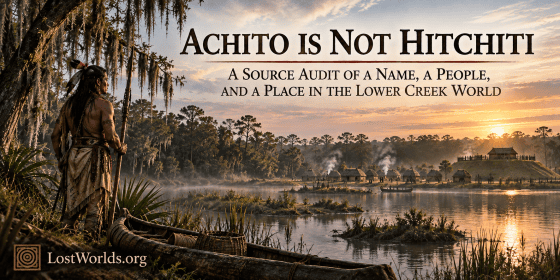
Achito Is Not Hitchiti
A Source and Linguistic Reassessment of Two Lower Creek Town Names
Abstract
The origin of the name Hitchiti has generally been reconstructed by linking a succession of colonial-era forms, including Ahachito, Achito, Ayjichiti, Echeta, and ultimately Hitchiti. Yet this sequence depends heavily on later scholarly normalization rather than on a demonstrated linguistic progression within the primary documents themselves. A chronological source audit reveals a different pattern. Ahachito rapidly stabilizes as Achito in Spanish records and remains recognizable under that form into the early eighteenth century. Independently, a second documentary series appears by 1725 with Echeetes, followed by Echetas, Echetee, and Echeta. By the late eighteenth century, William Bartram’s Echeta and Benjamin Hawkins’s Hitch-e-tee occupy strikingly similar political and geographic contexts, providing strong evidence that the Echeta and Hitchiti names refer to the same historical community. The earlier transition from Achito to Echeta, however, is far less securely demonstrated. The anomalous 1738 Spanish form Ayjichiti, long described as an “intermediate form,” is especially problematic: read according to contemporary Spanish orthography, its jichiti portion may already approximate a Hitchiti-like pronunciation. This study concludes that the documentary record strongly supports an Echeta–Hitchiti continuity but does not presently justify treating Achito and Echeta as stages in a single evolving name.
Introduction
Historical tribal names often appear deceptively fluid. A Spanish official writes one spelling, an English trader another, a mapmaker produces a third, and a nineteenth- or twentieth-century ethnographer attempts to reconcile them all. Once those reconciliations become embedded in the scholarly literature, reconstructed sequences can begin to look like primary evidence rather than interpretations imposed upon it.
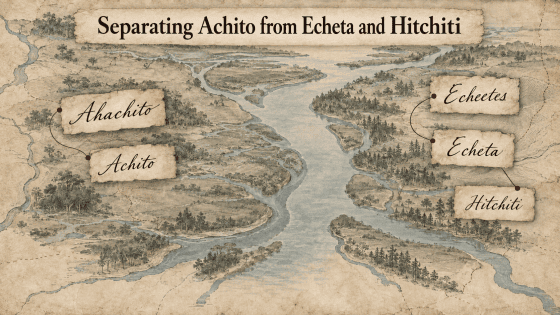
The Hitchiti provide a particularly revealing example. John R. Swanton’s influential Early History of the Creek Indians and Their Neighbors assembled several earlier names into a historical sequence leading toward the familiar ethnonym Hitchiti. Among those forms were Achito and the unusual Ayjichiti, which Swanton characterized as an “intermediate form.” Later summaries have consequently tended to treat the transformation from an earlier Achito-like name into Hitchiti as essentially established. Swanton’s work remains indispensable, but his sequence deserves to be taken apart and tested against the surviving documents rather than accepted as a unit. (Swanton 1922, 172–175).
When the spellings are restored to their individual dates and contexts, a significant problem appears. Achito does not gradually mutate through a succession of transitional spellings. It remains remarkably stable. Meanwhile, the Echete/Echeta family appears independently in the early eighteenth century and subsequently develops an exceptionally strong documentary relationship with the later Hitchiti name. The question, therefore, is not whether colonial writers spelled Indigenous names inconsistently—they unquestionably did—but whether the evidence actually demonstrates that Achito and Echeta were the same name.
This study approaches that question as a source audit. Rather than beginning with the assumption that all similar-looking names refer to one evolving ethnonym, each spelling is first treated as an independent historical datum. Continuity is then evaluated through chronology, geographic setting, political association, neighboring towns, and only secondarily through phonetic resemblance. This approach produces a considerably clearer result: the documentary bridge between Echeta and Hitchiti is strong, whereas the supposed bridge between Achito and Echeta remains unproven.
Recovering the Names Before Normalizing Them
A useful way to expose the problem is simply to place the principal documentary forms in chronological order without silently converting them into Hitchiti.
| Date | Recorded form | Source |
| 1675 | Ahachito | Spanish records summarized by Hann |
| 1685–1686 | Achito | Spanish records summarized by Hann |
| 1702 | Achito | Spanish account of the Chacato warning |
| 1716 | Achito | Diego Peña expedition records |
| 1725 | Echeetes | John Herbert map |
| 1733 | Echetas | Georgia conference account |
| 1734 | Achito | Spanish correspondence naming the cacique of Achito |
| 1738 | Ayjichiti | Spanish census, as transcribed by Swanton |
| 1755 | Echetee O.T. | John Mitchell map |
| 1770s/1791 | Echeta | William Bartram |
| 1798–1799 | Hitch-e-tee | Benjamin Hawkins |
| 1884 | Hitchiti / Echeta | Albert S. Gatschet’s historical-linguistic synthesis |
Presented this way, the supposed smooth evolution becomes difficult to see. Instead, two relatively coherent documentary patterns emerge. One is centered on Achito. The other is centered on Echete/Echeta and leads convincingly into Hitch-e-tee/Hitchiti.
That distinction matters because colonial orthographic variation cannot by itself establish historical identity. Similar spellings can result from attempts to represent the same Indigenous name, but they can also represent different names that happen to share sounds. The task is therefore to determine which transformations are independently supported by contextual evidence and which exist primarily because later scholars connected them.
The Ahachito–Achito Series
The earliest portion of the conventional sequence is internally quite clear. Spanish documentation records Ahachito in 1675 and the shorter Achito by 1685–1686. John Hann’s synthesis of the Spanish material preserves these forms within the history of Native communities west of Apalachee and along the Chattahoochee system (Hann 2006).
What is important here is not simply the disappearance of the initial Ah-, but the subsequent stability of what remains. The form Achito recurs rather than continuing to transform. An account associated with the 1702 crisis at St. Augustine refers to the village of Achito in connection with a baptized Chacato woman who learned of plans for an attack. Diego Peña’s 1716 expedition records again preserve Achito, and Spanish correspondence from 1734 refers to “Ysques, cacique de Achito”—Ysques, chief of Achito. The latter is especially significant because it shows the Achito form still functioning as a recognizable political place-name almost six decades after Ahachito first appeared.
The documentary evidence therefore provides its own internal reduction:
Ahachito –> Achito
There is no need to hypothesize a stem solely on linguistic grounds. The shorter form is independently and repeatedly attested.
Whether the initial Ah- represented Indigenous morphology, a phonetic feature imperfectly rendered by Spanish writers, or some other transcriptional circumstance cannot presently be established with confidence. What can be established is that Achito, not Ahachito, became the durable documentary form.
This creates an important chronological control. If Achito was supposedly in the process of evolving toward Echeta or Hitchiti, the historical record should ideally contain evidence of that transformation. Instead, Achito remains identifiable into the 1730s—at the same time that an independently recognizable Echeta-family name had already appeared elsewhere in the documentary record.
The Independent Appearance of Echeetes
The earliest securely verified Echete-family attestation presently identified is John Herbert’s 1725 map of South Carolina and the southeastern interior. The surviving map is George Hunter’s 1744 certified copy of Herbert’s original, and its catalog history explicitly identifies it as a copy of the 1725 map rather than a newly composed representation of Native settlement in 1744. On the Ocmulgee system it records a community as Echeetes. John Worth’s reconstruction of the Lower Creek towns likewise identifies Herbert’s 1725 entry as Echeetes.
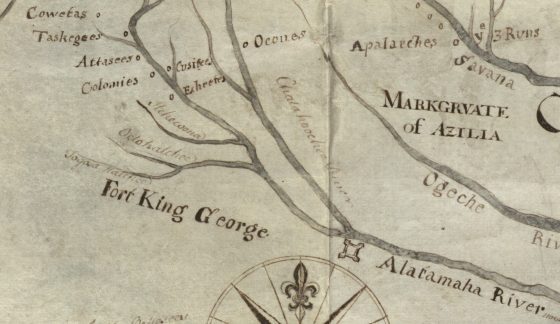
The geography deserves care. Older scholarship frequently associated the historical Hitchiti directly with the Macon Plateau archaeological site at Ocmulgee. Marvin T. Smith’s reanalysis of the documentary and archaeological evidence found that Herbert’s Echeetes were represented farther downstream on the western side of the Ocmulgee River, creating a conflict with the traditional identification of the Macon Plateau locality itself as the Hitchiti town. The safest formulation, therefore, is that the Echeetes belonged to the broader early eighteenth-century Ocmulgee/Ochese settlement complex; the surviving map does not justify simply equating the community with the archaeological Macon Plateau site. (Smith 1992).
This distinction does not weaken the name evidence. It strengthens the source audit by preventing a later archaeological identification from being smuggled backward into the documentary record. What Herbert actually gives us is a Native community called Echeetes in the Ocmulgee settlement world in 1725.
Eight years later, another source records essentially the same name.
The Echetas of 1733
A contemporary account of James Oglethorpe’s early dealings with Native leaders in Georgia identifies representatives “From the tribe Echetas”, including the war captains Chutabeeche and Robin together with attendants. The terminology of eighteenth-century colonial accounts must be handled cautiously—the same sources could use words such as tribe, town, and nation more flexibly than later ethnological classifications—but the critical point is the name itself. Echetas existed as a recognizable political community by 1733.
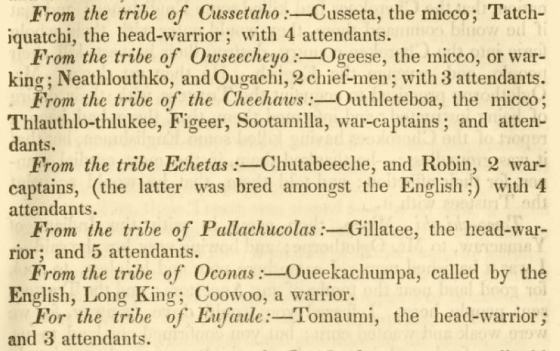
The 1733 reference is particularly important because it is independent of Herbert’s cartography. We are no longer dealing with an isolated spelling on one map. Within eight years, two separate English-language sources preserve closely related forms:
1725 — Echeetes
1733 — Echetas
These forms already contain the basic consonantal structure that persists through later Echetee and Echeta. More importantly, they occur while Spanish sources were still capable of referring to Achito under that stable name.
In 1734, just one year after the Echetas appear in the Georgia material, Spanish correspondence still refers explicitly to the cacique de Achito. This near-contemporaneity is difficult to reconcile with a simple model in which Achito had merely been respelled as Echeta. It does not make identity impossible—different colonial languages and informants could certainly preserve different forms—but it means identity must be demonstrated rather than presumed.
Echetee Old Town
John Mitchell’s enormously influential 1755 map adds another form: Echetee O.T. The abbreviation O.T. was commonly used on colonial maps for “Old Town,” marking a former or relocated Native settlement rather than necessarily an occupied town at the date of the map (Mitchell 1755).
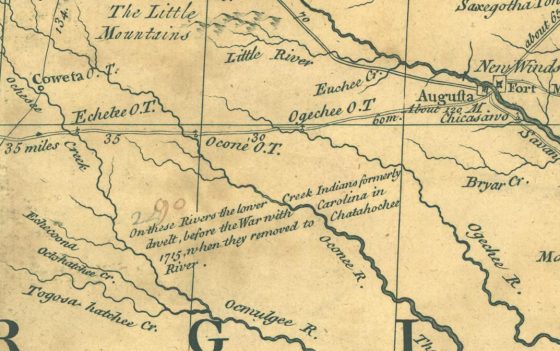
This is an important transitional piece of evidence because it demonstrates the persistence of the Echetee name upon the landscape even after settlement patterns changed. Native towns in the eighteenth-century Southeast moved repeatedly as political alliances, warfare, trade, and environmental circumstances altered. A community could relocate while its former location continued to be identified by the old town name.
Consequently, continuity need not be demonstrated by placing each successive spelling on precisely the same archaeological footprint. The historically meaningful unit was the community and its name, both of which could move while older geographic labels remained behind.
By the middle eighteenth century, then, Echeetes –> Echetas –> Echetee forms a coherent documentary sequence without requiring Achito to explain it.
Bartram’s Echeta
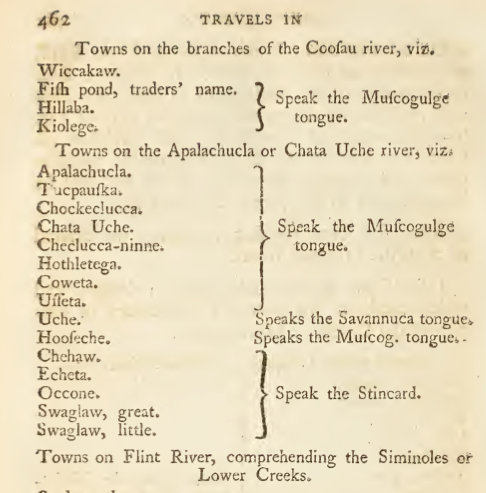
William Bartram supplies the next crucial link. During his travels through the Southeast in the 1770s, published in 1791, Bartram compiled a list of Creek towns grouped partly by speech. Among the towns he placed together under the language he called “Stincard” were Chehaw, Echeta, Occone, Swaglaw great, and Swaglaw little (Bartram 1791, 462–464).
Bartram’s Echeta is therefore not merely another spelling with superficial resemblance to Echeetes. It occurs within a specific political and linguistic cluster.
That cluster becomes exceptionally important when compared with Benjamin Hawkins only a few years later.
 |  |
From Echeta to Hitch-e-tee
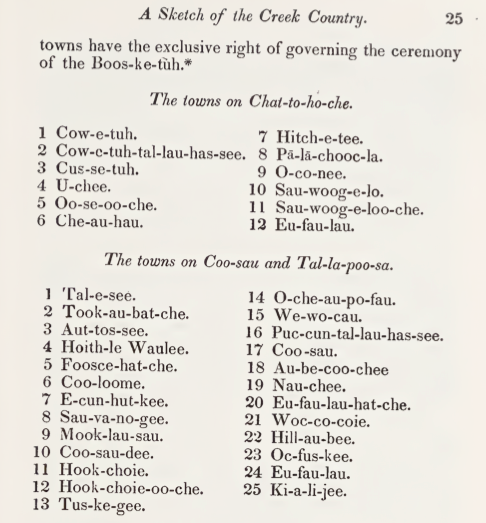
Benjamin Hawkins’s A Sketch of the Creek Country, in 1798 and 99 provides what may be the strongest single piece of evidence in the entire name history. Hawkins lists the towns of the Chattahoochee in sequence. Among them are:
Che-au-hau
Hitch-e-tee
Pa-la-chooc-la
O-co-nee
Sau-woog-e-lo
Sau-woog-e-loo-che
Eu-fau-lau
(Hawkins 1848, 25).
The correspondence with Bartram is difficult to dismiss. Bartram’s Chehaw, Echeta, Occone, Swaglaw great, Swaglaw little are followed within a generation by Hawkins’s Che-au-hau, Hitch-e-tee, O-co-nee, Sau-woog-e-lo, Sau-woog-e-loo-che in essentially the same Chattahoochee political setting.
This is much stronger evidence than simple phonetic resemblance. The surrounding towns act almost like historical coordinates. Echeta occupies a recognizable place within one documented cluster, and Hitch-e-tee occupies the corresponding place within the later cluster.
The Geographic Fingerprint of Echeta-Hitchiti
The strongest evidence connecting Echeta with Hitchiti is the persistence of its neighboring towns. Thus the recurring pattern is:
Chiaha/Che-au-hau –> Echeta/Hitch-e-tee –> Occone/O-co-nee –> Swaglaw great/Sau-woog-e-lo –> Swaglaw little/Sau-woog-e-loo-che
This geographic fingerprint is difficult to explain as coincidence. Towns certainly moved, divided, reunited, and established daughter settlements, but the continuing association of the same set of corporate communities provides evidence of historical continuity considerably stronger than superficial resemblance between names.
The linguistic evidence reinforces the geographic evidence. Chiaha, Echeta, Oconee, and Sawokli were repeatedly associated with Hitchiti or closely related speech. Gatschet’s nineteenth-century work identified Hitchiti and Mikasuki as effectively varieties of the same language, and modern scholarship continues to classify Hitchiti-Mikasuki separately from Muskogee within the Muskogean family.
Consequently, Echeta –> Hitchiti rests upon three mutually reinforcing observations: related forms of the name, continuity of geographic position, and continuity within a recognizable Hitchiti-speaking linguistic cluster.
The same cannot presently be said of Achito.
Albert S. Gatschet recognized this relationship in the nineteenth century. In A Migration Legend of the Creek Indians, he explicitly identified Bartram’s Echeta with the people subsequently known as Hitchiti. Gatschet’s linguistic and historical work contains speculative etymologies that should not all be accepted uncritically, but on this particular identification he was working with precisely the contextual evidence visible in Bartram and Hawkins. (Gatschet 1884, 77–79).
The documentary sequence from the early to late eighteenth century can therefore be summarized:
Echeetes –> Echetas –> Echetee –> Echeta –> Hitch-e-tee –> Hitchiti
Unlike the proposed Achito transition, this sequence is supported not only by spelling but by chronology, political geography, neighboring communities, and later linguistic identification.
Achito and Echeta Occupy Different Town Neighborhoods
The contrast between the two sequences becomes apparent when the geographic evidence is placed side by side.
The early Spanish Achito sequence repeatedly associates the town with:
Ocmulgee –> Achito –> Kasihta
The later Echeta-Hitchiti sequence repeatedly associates the town with:
Chiaha –> Echeta/Hitchiti –> Oconee –> Sawokli
These are not equivalent arrangements.
The difference is especially intriguing because the two neighborhoods have different linguistic profiles. Kasihta/Cusseta was one of the principal Muskogee-speaking towns of the Creek Confederacy. Ocmulgee, on the other hand, was remembered as belonging to the Hitchiti-related linguistic population. Achito therefore appears in the surviving town order near a linguistic boundary between major components of the developing Creek Confederacy.
The Echeta neighborhood is much more internally consistent. Chiaha and Oconee were closely associated with Hitchiti speech, while Sawokli, though not always appearing immediately adjacent geographically, belonged to Bartram’s same Stincard linguistic grouping.
Nevertheless, the overall contrast remains striking. Echeta is embedded within the historical Hitchiti linguistic network in a way that Achito cannot independently be shown to be.
Assigning a Hitchiti linguistic affiliation to Achito because Achito has already been identified as Hitchiti would be circular reasoning. Unless an independent colonial statement identifies the language of Achito, its linguistic affiliation must remain unknown.
The Phonological Problem
The traditional identification also faces a linguistic difficulty that has received surprisingly little attention. Achito and Echeta/Hitchiti resemble one another visually when printed on a page, but European orthographies must be evaluated according to the sound values of the languages in which they were written.
Spanish Achito naturally suggests a form structured approximately as a-CHI-to, with Spanish ch representing the affricate /tʃ/. The first vowel constitutes a separate syllable from the following chi. The recurring Spanish spellings Ahachito and Achito are readily intelligible as members of the same name family, especially if the longer form contains an initial prefix or unstressed element.
The English Echeta-Hitchiti forms present a different structure. Echeetes, Echetas, and later Hitchiti are more naturally compared with one another than with Spanish Achito. Hawkins’s attempted syllabification—variously Hitch-e-tee and Hit-che-tee—shows that he heard a multisyllabic form that English orthography represented quite differently from Spanish Achito.
The important point is not that we can reconstruct an exact eighteenth-century pronunciation from these spellings. We cannot. Rather, no demonstrated sound correspondence presently shows how a-CHI-to became Echeta or Hitchiti. An argument for identity therefore cannot simply cite visual similarity. It requires either a native-language form capable of generating both European spellings or documentary evidence showing unequivocally that Spanish and English observers were using different names for the same town.
At present neither requirement has been met.
From Echeta to Ichiti
Once Achito is removed from the equation, the Echeta-Hitchiti name can be reconsidered independently.
Historical Muskogean documentation contains forms with additional initial vowels or syllables attached to what appears to be a more stable -chiti/-hiti/-ichiti element. Muskogean languages are morphologically complex and make extensive use of prefixes. Gatschet, for example, proposed a connection between Hitchiti and Creek ahítchita, while another traditional name recorded for Hitchiti-speaking peoples was Atcik-hata. Modern Muskogean linguistics independently confirms that prefixation is structurally important throughout the family, although Gatschet’s specific nineteenth-century etymologies should not automatically be accepted as historical fact.
A useful working hypothesis is therefore to distinguish the lexical stem from possible prefixed forms. Under that approach, historical forms such as Ahhitchetee-type or Ayjichiti-type renderings need not imply that initial a-/ah- was necessarily part of the underlying place-name. The comparative target becomes approximately Ichiti/Itchiti.
Likewise, Ahachito can be analyzed provisionally as an expanded form built around Achito. The crucial result is not that both names contain prefixes. It is that removing potentially detachable initial material does not cause the two stems to converge:
Achito
versus
Ichiti / Itchiti
They remain different.
This provides a more linguistically disciplined way to frame the problem than the older sequence Ahachito –> Achito –> Hitchiti.
The 1738 Ayjichiti Problem
One form has long appeared to connect the two name families. Swanton reported that a Spanish census of 1738 contained the spelling Ayjichiti, citing a manuscript copy in the Ayer Collection of the Newberry Library. He described Ayjichiti as an “intermediate form,” thereby placing it conceptually between earlier Achito-like names and later Hitchiti. (Swanton 1922).
The difficulty is that “intermediate” is an interpretation, not a description supplied by the Spanish census. The spelling itself must first be read according to eighteenth-century Spanish orthography rather than modern English letter values.
By this period Spanish j represented the voiceless velar fricative /x/, with h-like realizations developing in varieties of American Spanish. Spanish ch, meanwhile, represented the affricate /tʃ/. Consequently, the sequence jichiti is phonetically compatible with something much closer to hichiti than a modern English reader might assume. The 1738 word may therefore already contain a recognizably Hitchiti-like core preceded by additional initial material.
This observation should not be overstated. The original 1738 manuscript has not been examined here, and Swanton’s published reading of the Ayer copy remains the immediate source. Nor can the exact Indigenous pronunciation be reconstructed from the Spanish spelling alone.
Nevertheless, the orthography creates a serious problem for treating Ayjichiti as self-evident evidence of a gradual Achito –> Hitchiti transformation. Read according to contemporary Spanish phonetics, Ayjichiti may already be substantially closer to Hitchiti than to Achito.
The Problem of Backward Normalization
This is where the source audit becomes methodologically important. Once a later community is securely known as Hitchiti, there is a natural temptation to search backward through the record for earlier spellings that resemble the familiar name. Geographic proximity then reinforces the identification, and eventually the earlier spelling may be presented as if it were merely an archaic version of Hitchiti.
Swanton’s scholarship frequently attempted precisely this kind of historical reconstruction, linking Native communities across Spanish, English, French, and archaeological records. His enormous contribution was to assemble sources that otherwise would be extraordinarily difficult to compare. But assembling names into a historical sequence and demonstrating that they represent a single evolving ethnonym are two different tasks.
In this case, the primary record provides an unusually useful control because the names overlap chronologically. Echeetes is documented by 1725. Echetas appears in 1733. Yet Achito remains recognizable in Spanish correspondence in 1734.
Thus the evidence does not look like a neat succession:
Achito –> Echeta –> Hitchiti
It looks instead like two documentary traditions that coexist for at least part of the early eighteenth century:
Ahachito –> Achito –> Achito –> Achito
and
Echeetes –> Echetas –> Echetee –> Echeta –> Hitch-e-tee –> Hitchiti
The second sequence displays the contextual continuity expected of an evolving colonial transcription. The first-to-second transition does not.
What the Evidence Establishes
The evidence does not demonstrate that Achito and Echeta were necessarily different peoples. Colonial Native communities could have multiple names. One name might be a self-designation, another an exonym, another a town name, and another a political label used by a particular European power. A community might also merge with another or adopt a new name.
Those possibilities, however, cannot themselves substitute for evidence.
What can presently be demonstrated is more limited and therefore more defensible. Achito possesses its own durable seventeenth- and early eighteenth-century documentary history. Echete/Echeta possesses an independently demonstrable documentary history by 1725. The latter name then continues through several closely related forms until it can be connected with considerable confidence to Hawkins’s Hitch-e-tee and the historically recognized Hitchiti.
The burden of proof therefore falls on the missing transition. If Achito and Echeta are to be treated as variants of one Indigenous name, a linguistic or documentary mechanism must explain why the relatively stable Achito form corresponds to the independently occurring Echete/Echeta family. Mere resemblance at the level of a few consonants is insufficient.
The 1738 Ayjichiti spelling does not presently solve that problem. Once the historical value of Spanish j is restored, the form appears at least as compatible with an already Hitchiti-like pronunciation as with a halfway stage descending from Achito.
Conclusion
The conventional history of the Hitchiti name becomes considerably less straightforward when the colonial spellings are restored to their original chronology.
The earliest records provide a coherent Ahachito–Achito series in which the shorter form Achito becomes remarkably stable. By 1725, however, another name family appears independently as Echeetes. It is followed by Echetas in 1733, Echetee in the mid-eighteenth century, and Bartram’s Echeta in the 1770s. Hawkins’s Hitch-e-tee at the end of the century occurs among essentially the same neighboring Chattahoochee towns that surround Bartram’s Echeta, providing powerful contextual evidence that these later forms represent the same historical community.
The resulting sequence:
Echeetes –> Echetas –> Echetee –> Echeta –> Hitch-e-tee –> Hitchiti
is supported by multiple independent sources and by political and geographic continuity.
No equivalently strong evidence presently demonstrates:
Achito –> Echeta
Indeed, Achito and Echeta-family names briefly overlap in the documentary record. Swanton’s 1738 Ayjichiti “intermediate form” cannot by itself repair the gap, particularly because eighteenth-century Spanish orthography allows its jichiti component to be read as something already approaching Hichiti/Hitchiti.
The safest conclusion is therefore not that Achito and Hitchiti were definitively unrelated, but that their supposed linguistic continuity has been assumed more often than demonstrated.
The proposed connection between the two sequences faces three independent difficulties. First, no convincing phonological derivation has demonstrated how Achito became Echeta or Hitchiti. Second, the towns occur in different recurring geographic arrangements. Third, the Echeta-Hitchiti community belongs demonstrably to a particular Hitchiti linguistic neighborhood, while Achito’s language cannot presently be established independently without circularly assuming the very identification under investigation.
The safer conclusion is therefore that Achito and Echeta/Hitchiti should be treated as separate historical town names unless direct evidence establishes their identity.
That distinction is more than an exercise in spelling. Historical names are evidence. When later normalization is stripped away and the original forms are restored to their dates, places, and political contexts, the record can reveal distinctions that conventional tribal histories have inadvertently concealed.
References
Bartram, William. 1791. Travels through North & South Carolina, Georgia, East & West Florida, the Cherokee Country, the Extensive Territories of the Muscogulges, or Creek Confederacy, and the Country of the Chactaws. Philadelphia: James & Johnson.
Boynton, Sylvia S. 1982. Mikasuki Grammar in Outline. Gainesville: University of Florida.
Gatschet, Albert S. 1884. A Migration Legend of the Creek Indians. Vol. 1: With a Linguistic, Historic and Ethnographic Introduction. Philadelphia: D. G. Brinton.
Hann, John H. 2006. The Native American World Beyond Apalachee: West Florida and the Chattahoochee Valley. Gainesville: University Press of Florida.
Hawkins, Benjamin. 1848. A Sketch of the Creek Country, in 1798 and 99. Collections of the Georgia Historical Society 3, pt. 1. Savannah: Georgia Historical Society.
Herbert, John. 1725. A New Mapp of His Majestys Flourishing Province of South Carolina Shewing ye Settlements of ye English, French and Indian Nation. Surviving as a certified 1744 copy by George Hunter. Hargrett Rare Book and Manuscript Library, University of Georgia.
Martin, Jack B., Margaret McKane Mauldin, and Juanita McGirt. 2011. A Grammar of Creek (Muskogee). Lincoln: University of Nebraska Press.
Mitchell, John. 1755. A Map of the British and French Dominions in North America, with the Roads, Distances, Limits, and Extent of the Settlements. London: Andrew Millar.
Smith, Marvin T. 1992. Historic Period Indian Archaeology of Northern Georgia. University of Georgia Laboratory of Archaeology Series, Report No. 30; Georgia Archaeological Research Design Paper No. 7. Athens: University of Georgia.
Swanton, John R. 1922. Early History of the Creek Indians and Their Neighbors. Bureau of American Ethnology Bulletin 73. Washington, D.C.: Government Printing Office.
Trustees for Establishing the Colony of Georgia in America. 1835. A Brief Account of the Establishment of the Colony of Georgia, under Gen. James Oglethorpe, February 1, 1733. Reprinted by Peter Force. Washington, D.C.
Worth, John E. 2000. “The Lower Creeks: Origins and Early History.” In Indians of the Greater Southeast: Historical Archaeology and Ethnohistory, edited by Bonnie G. McEwan, 265–298. Gainesville: University Press of Florida.