Paquimé: Ancient America’s First Central Bank?
When archaeologists excavated Paquimé in northern Chihuahua, they found the remains of one of the most extraordinary cities ever built in the ancient Southwest. Massive adobe compounds rose several stories high. Scarlet macaws were bred hundreds of miles from their tropical homeland. Copper bells, turquoise, imported ceramics and other exotic goods moved through the settlement. Water flowed through an engineered system of reservoirs and channels. Paquimé was not an isolated desert town. It sat at the center of a world connected by trade.
But among all the unusual things found there, one discovery stands apart simply because of its scale.
Shell.
Not a few necklaces. Not hundreds of ornaments. Not even tens of thousands of beads.
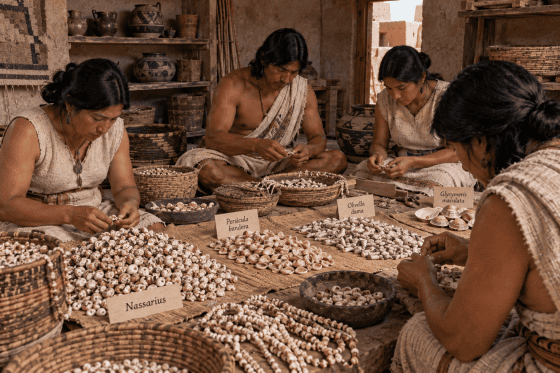
Archaeologists recovered nearly four million shell objects from the Medio-period settlement, including about 3.7 million tiny perforated Nassarius shells. More than 95 percent of Paquimé’s entire shell assemblage consisted of this one small form.
That raises an obvious question. What was Paquimé doing with millions of seashells in the middle of the desert? The usual answer is trade. Paquimé accumulated shell from the Gulf of California and redistributed it throughout the Southwest. That explanation is almost certainly correct. But perhaps it does not go far enough.
What if Paquimé was not simply trading shell? What if the shell was the money used to conduct the trade? And what if those enormous stores were not a merchant’s inventory at all, but something much closer to a monetary reserve?
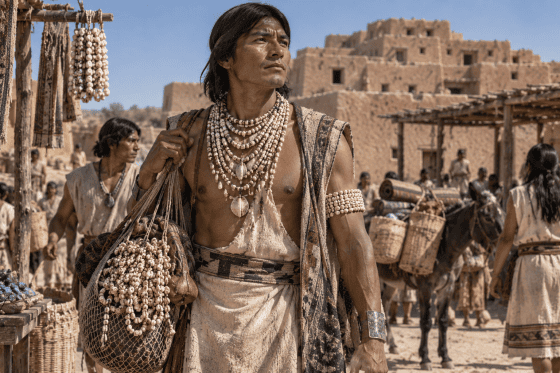
If so, Paquimé may have performed a role for the ancient Southwest astonishingly similar to that of a central bank.
Millions of Shells in the Desert
Paquimé’s obsession with shell developed during the Medio period, beginning around A.D. 1200. Earlier communities in the Casas Grandes region certainly possessed shell, but nothing approaching the quantities that later accumulated at Paquimé.
Then something changed.
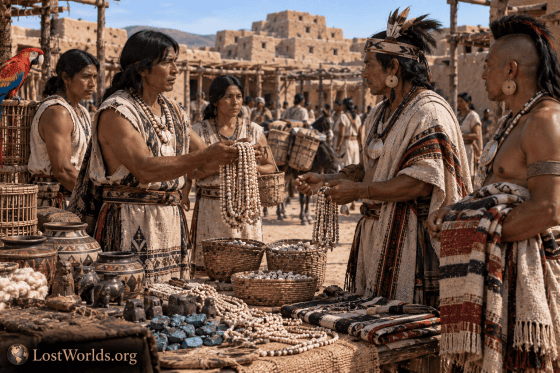
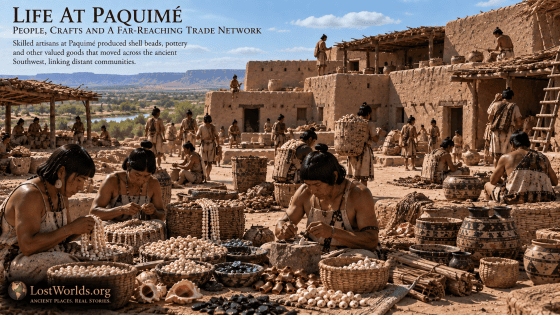
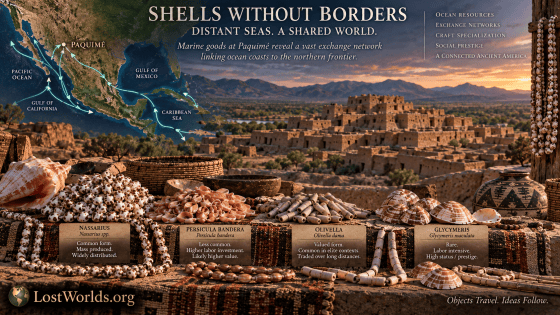
Marine shell began pouring into the city from the Gulf of California, hundreds of miles to the southwest. The overwhelming majority consisted of tiny Nassarius shells that had been perforated so they could be strung as beads.
The quantity is difficult to comprehend. About 3,725,000 Nassarius beads alone were recovered. At an estimated peak population of roughly 3,500 people, that works out to more than 1,000 beads for every person living at Paquimé.
And those were only the Nassarius.
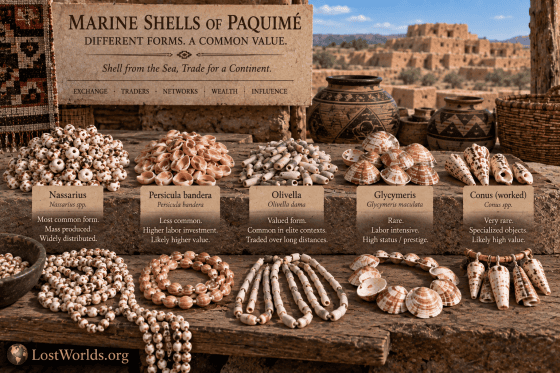
Paquimé also contained tens of thousands of Conus shells, thousands of Olivella, Persicula, Glycymeris and other marine species, along with elaborate pendants and worked shell forms.
If all of this material had simply been intended for personal adornment, Paquimé’s inhabitants were preparing to become the most heavily accessorized population in ancient North America.
But that is not where most of the shell was found.
The overwhelming majority came from rooms.
Storage rooms.
The Shell Treasury
The greatest concentrations occurred in Unit 8, particularly Rooms 15 and 18. Together these rooms held an extraordinary proportion of Paquimé’s shell wealth.
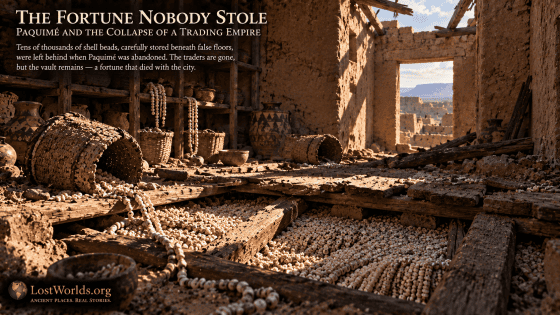
Room 15 is especially interesting because large quantities of shell were stored beneath a false wooden floor.
Think about that for a moment.
Someone deliberately created a concealed space beneath the floor and filled it with shell.
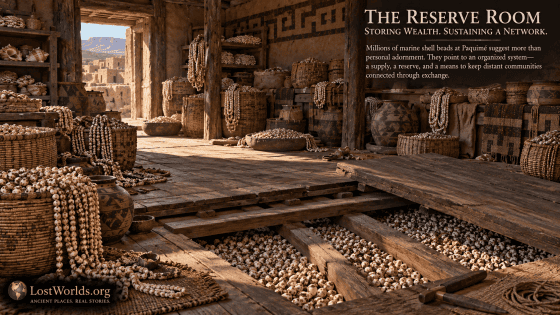
Today, when people distrust banks—or when no banks exist—they hide wealth in walls, beneath floorboards, inside mattresses or buried in the yard. The behavior is almost universal. Portable wealth has to be kept somewhere, and hidden storage protects it from thieves.
If Paquimé’s shell represented economic wealth, then the comparison is hard to ignore. They were literally putting it under the floor.
Nearby Room 18 contained enormous quantities of shell along with dozens of imported Gila Polychrome vessels. Unit 8 as a whole contained an extraordinary concentration of exotic and valuable materials, including turquoise, minerals, copper and other goods moving through Paquimé’s exchange system.
This was not somebody’s jewelry box. It looks much more like a warehouse.
Or perhaps a vault.
But Was Shell Really Money?
The idea sounds strange only because modern people are accustomed to money being made from paper, metal or digits on a computer screen.
Humans have made money out of almost everything imaginable.
Metal ingots. Copper axes. Cloth. Salt. Cacao beans. Feathers. Beads. Stones. Cowrie shells.
And marine shell was unquestionably used as money in North America.
The most famous example is wampum. Carefully manufactured white and purple shell beads became deeply embedded in diplomacy, political relationships, ceremony, status and exchange in eastern North America. The beads could be worn and displayed, but they could also represent measurable value.
Western North America had its own shell currencies. Historical accounts describe strings of marine-shell beads being used as conventional money among Pueblo peoples and other western groups. Nineteenth-century observers recorded shell strings purchasing blankets, buckskins and other goods.
Thousands of miles east of Paquimé, a Spanish document from 1600 provides an even more explicit example. Among the Guale people of coastal Georgia, annual tribute to the mico mayor included pearls, deerskins and what the English archival translation calls “monies that they make out of snail shells.”
So the real question is not whether Native Americans could use shell as money.
They did.
The question is whether Paquimé was doing something similar centuries earlier.
Money You Could Wear
One reason the possibility is easy to overlook is that archaeologists frequently classify shell beads as ornaments or prestige goods.
But that distinction may not mean very much.
Money can be ornament.
A gold necklace does not stop representing wealth because somebody hangs it around their neck. Quite the opposite: the person is publicly displaying stored economic value.
The same thing happens with cash. People pose for photographs holding bundles of currency precisely because everyone recognizes what those bundles represent.
In a society without banks, checks or electronic accounts, wearable money would actually make tremendous practical sense.
You could carry it. You could display it. You could protect it. You could divide it. And when necessary, you could spend it.
A trader traveling hundreds of miles across the Southwest would not need to haul sacks filled with heavy objects. Strings of tiny shell beads could be wrapped around the body, packed into a small pouch or carried as bundles.
Jewelry and money are therefore not competing explanations. They may be describing the same object from two different perspectives.
Ancient Proof of Work
There is another reason shell makes surprisingly good money.
You cannot simply pick up any random shell from the beach and expect everyone to treat it as currency.
Shell beads have to be made.
The shell must be collected, selected, transported, perforated, shaped and sometimes polished. In more elaborate shell currencies such as wampum, production could be extremely labor-intensive.
That creates something resembling an ancient proof-of-work system.
The comparison to Bitcoin is obviously modern, but the underlying principle is intriguing. A monetary unit works better when creating convincing new units requires effort. The raw material itself does not have to be terribly valuable. The paper in a hundred-dollar bill is worth almost nothing. What matters is that producing an acceptable hundred-dollar bill is difficult enough that everyone cannot casually manufacture one.
Shell money could operate the same way. A beach full of shells is not necessarily a beach full of money. A recognized, drilled, shaped and properly strung shell bead is something different.
And once communities throughout a trade network agree to recognize it, that tiny object becomes portable value.
Was Nassarius the Penny?
Paquimé’s shell assemblage also suggests that not every shell possessed the same value.
The numbers vary enormously. Nassarius occurs by the millions. Other shell types occur by the tens of thousands. Still others appear only by the hundreds or dozens. Archaeologist Ronna Bradley independently concluded that the extraordinarily common and expediently produced Nassarius probably represented relatively low-value shell compared with rarer and more elaborate forms.
That observation becomes extremely interesting if shell functioned as money.
Perhaps Paquimé had something resembling denominations. Not necessarily denominations stamped with numbers, of course. Value could have depended upon species, rarity, size, workmanship, color, strand length or some combination of these features.
Nassarius might have been small change. Rarer shell forms could have represented larger units of wealth.The system would not have looked like modern coins, but economically it could have accomplished the same thing.
A Strange Burial at Paquimé
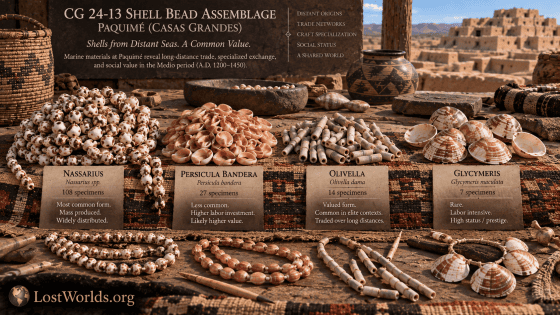
One burial provides a particularly tantalizing glimpse of how different shell types might have been combined.
Burial CG 24-13, belonging to a two-year-old child in Unit 13, contained:
108 Nassarius
27 Persicula bandera
14 Olivella dama
7 Glycymeris maculata
The numbers form a curious progression.
108 divided by 27 equals exactly four.
Twenty-seven is almost twice fourteen.
Fourteen is exactly twice seven.
Reduced approximately, the relationship looks remarkably like:
16 : 4 : 2 : 1
Perhaps it was simply a decorative pattern. Or perhaps somebody was assembling shell according to recognized units of value.
We do not know.
But this burial is not the only example of shells occurring in discrete numerical groups. Other Paquimé burials contained Nassarius totals of 220, 608, 875, 1,122, 157 and 390.
Those numbers do not reveal an obvious decimal or vigesimal system. But they may not need to. Historical shell currencies were often measured by strands, not by individually counting every bead.
Archaeologists today see 157 loose shells. The person who owned them may have seen one standard string. The unit disappeared when the cord rotted away.
How Much Jewelry Could One City Possibly Need?
The scale of the Paquimé reserve is easier to appreciate when compared with personal ornament.
At the roughly contemporary Yuma Wash site in Arizona, eight mortuary contexts containing Nassarius had only one to fourteen beads. Two burials were spectacular exceptions. One woman was buried with 1,411 Nassarius beads. An infant had 857 Nassarius along with hundreds of Olivella beads.
Those were extraordinary assemblages.
Yet Paquimé’s 3.7 million Nassarius could produce about 2,640 ornament sets equivalent to the richest 1,411-bead burial. Or more than 4,300 sets equivalent to the 857-bead burial.
In other words, Paquimé possessed enough Nassarius to cover essentially its entire population with the kind of shell display that elsewhere stands out as extraordinary.
And still most of the beads were sitting in rooms.
That is difficult to explain as ordinary jewelry demand.
It looks institutional.
Was Paquimé Ancient America’s First Central Bank?
Now we arrive at the most provocative possibility.
What if expanded trade did not simply cause Paquimé’s shell accumulation?
What if the shell accumulation helped make expanded trade possible?
Long-distance trade creates a problem. Imagine traveling hundreds of miles carrying pottery. You finally reach another community and find someone willing to trade—but he has turquoise and you want corn. The farmer with corn wants cotton. The cotton producer wants copper.
Suddenly everybody is trying to solve a complicated barter puzzle.
Money solves the problem.
Everyone agrees to accept something not because they personally need it, but because they know somebody else will accept it later.
Once that happens, trade becomes dramatically easier.
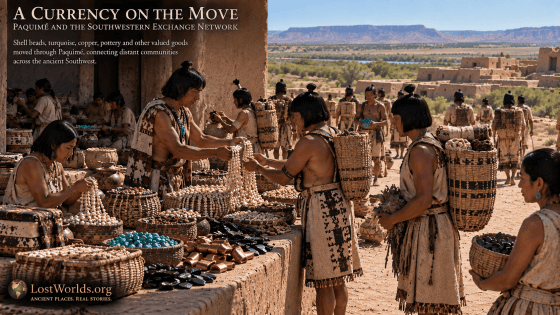
A shell-bead currency would have been particularly well suited to the ancient Southwest. Shell was portable, divisible, recognizable and already desirable. It could move enormous distances without spoiling. It could be worn as wealth and accumulated as savings.
But once a trade network begins using money, another problem appears.
There has to be enough money circulating.
People constantly remove currency from circulation. They save it. They bury it. They place it in graves. They lose it. They carry it to distant regions. Trade expands, but the available monetary supply does not necessarily expand with it.
Eventually somebody has to introduce more.
And this may be where Paquimé becomes really interesting.
The Reserve
Unlike turquoise or copper, shell has one crucial economic advantage.
It grows back.
Marine mollusks reproduce. Coastal communities could continually collect new shells, manufacture beads and send additional supplies inland.
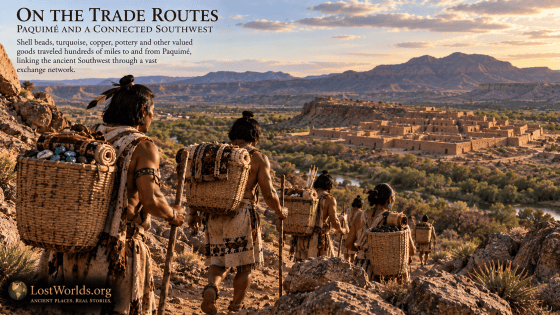
Paquimé sat between those coastal sources and an enormous network of inland consumers. Now reconsider the millions of shells stored in its rooms. Perhaps they were not simply waiting to be sold.
Perhaps they represented a reserve.
When trade expanded and more exchange media were needed, additional shell could be released. When plenty was already circulating, shell could accumulate in storage.
Nobody at Paquimé needed to understand modern monetary policy. They only needed to understand something merchants everywhere eventually learn: Trade works better when everyone has access to something everyone else will accept.
If Paquimé became the principal inland reservoir and distributor of that accepted medium, then its economic role starts looking remarkably familiar.
The coast supplied the raw material. Paquimé accumulated it. Paquimé stored it. Paquimé redistributed it throughout the trading world.
That sounds less like a jewelry shop.
It sounds like a central bank.
Who Controlled the Money Supply?
If this interpretation is correct, shell access becomes enormously important. Most of Paquimé’s Nassarius probably originated along the Gulf of California, particularly around the central gulf region of Sonora. Paquimé did not control the shoreline simply by sitting hundreds of miles away in Chihuahua.
But perhaps it did not need to.
The important position may have been farther up the supply chain. Coastal communities could collect shell. Specialists could perforate and prepare it. Traders could carry it inland. Paquimé’s power may have come from becoming the great reservoir and distributor of that material.
That distinction is important.
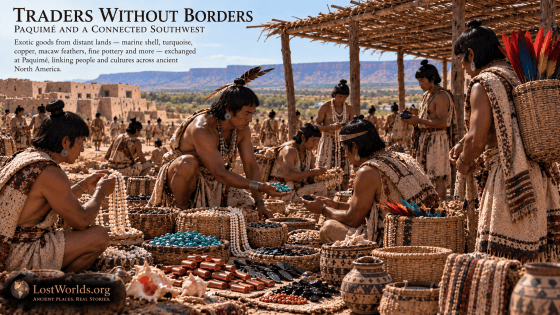
You do not have to own the gold mine to control the gold market. You do not have to manufacture every banknote to control how much currency reaches the economy. And Paquimé did not have to politically conquer the Gulf Coast to become the most important inland destination for shell. If millions of beads flowed through Paquimé before spreading through Puebloan and Mogollon exchange networks, the city occupied an extraordinarily powerful position.
It sat at the monetary bottleneck.
Sacred Money
There is another interpretation of Paquimé’s shell hoard.
Archaeologist Michael Whalen has argued that shell may have accumulated because it possessed supernatural or ritual power. In this view, Paquimé was collecting spiritually potent material rather than building an economic reserve.
But why choose?
Money and sacred power have lived together for thousands of years. Gold has been offered to gods and used to pay soldiers. Silver has filled temple treasuries and marketplace purses. Wampum carried enormous diplomatic and ceremonial meaning while simultaneously functioning as a medium of exchange. Objects become good money partly because people already value them.
A sacred object recognized across many communities might actually make an excellent currency. Paquimé’s shell could have been sacred. It could have represented prestige. It could have been worn. It could have been offered to the dead.
And it could still have been money.
Human societies rarely divide life into neat archaeological categories.
Then the Bank Failed
Around A.D. 1450, Paquimé’s world came apart. The city declined and was abandoned. Its political system disappeared. Its exchange network fractured. And millions of shells remained behind.
This may be the most important clue of all.
Portable wealth usually disappears when cities collapse. People flee with it. Invaders steal it. Looters carry it away.
Tiny shell beads would have been absurdly easy to transport. A person could carry thousands. Strings could be wrapped around the body. Bags could hold a fortune.
Yet vast quantities remained.
Why?
Maybe there simply wasn’t enough time. Maybe the city collapsed more gradually than we imagine. Or maybe the people abandoning Paquimé understood something archaeologists looking at the ruins centuries later could not immediately see.
The shell was no longer worth carrying.
Paquimé’s Confederate Money
The Confederate States of America once printed enormous quantities of currency. During the Civil War, people bought food, clothing and property with those notes.
Then the Confederacy disappeared.
Nothing physically happened to the paper. A hundred-dollar bill still looked like a hundred-dollar bill. But the economic system supporting it was gone. Almost overnight, the monetary value collapsed.
The paper survived.
The money did not.
Paquimé’s shell may have suffered the same fate. Imagine that a thousand Nassarius beads could once purchase food, pottery, cotton or turquoise because communities throughout the Southwest recognized their value. Then Paquimé collapses. The trade routes fragment. Merchants stop arriving. Regional alliances disappear. Communities withdraw into smaller local economies. Suddenly someone offers a string of shell for corn.
The farmer looks at it and says:
I don’t want shells. Give me something useful.
The shell itself has not changed. The economy has. Yesterday it was money. Today it is jewelry.
Tomorrow it is archaeology.
Paquimé’s 250-Year Economic Cycle
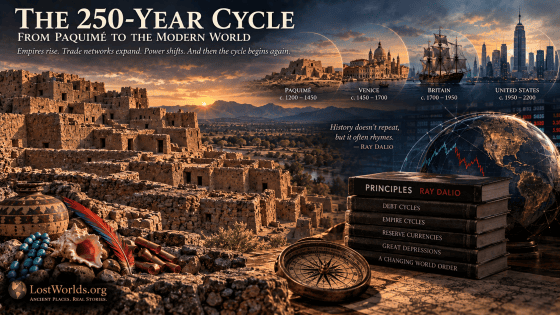
If Paquimé really was the central bank of a new economic order, then its lifespan becomes even more intriguing. Ray Dalio has argued that major economic and political systems tend to rise, mature and decline over long historical cycles of roughly 250 years. Paquimé’s great Medio-period expansion began around A.D. 1200, when its trade network, specialized production and enormous shell reserves took shape. By about 1450, the system had collapsed. That is almost exactly 250 years. If Paquimé was managing the monetary lifeblood of a regional economy, then its rise and fall followed Dalio’s long-cycle pattern to an almost uncomfortable degree.
The Fortune Nobody Stole
That may explain one of Paquimé’s strangest archaeological mysteries.
Why did nobody steal the millions of shells? Perhaps because there was nothing left to steal. The wealth had vanished without the objects going anywhere.
A room filled with 100,000 beads may once have represented enormous purchasing power. After Paquimé’s economic system collapsed, the same room may have contained nothing more than 100,000 tiny pieces of shell.
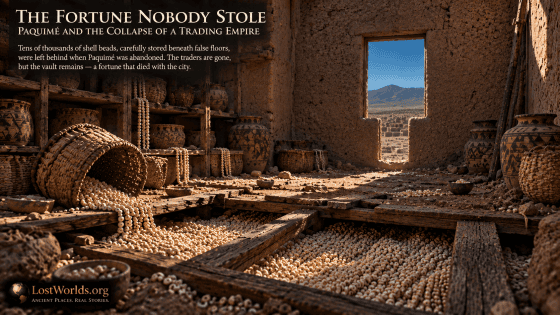
That is exactly what happens when monetary systems die.
The currency remains. The agreement disappears. And perhaps that is what archaeologists eventually uncovered beneath Paquimé’s floors. Not simply a warehouse filled with ornaments.
A vault filled with dead money.
An Ancient Monetary Experiment?
We may never find an ancient accountant’s ledger telling us how many Nassarius beads purchased a basket of corn. We may never recover a standard Paquimé shell string intact. But archaeology rarely hands us an instruction manual.
Instead, it leaves patterns.
Millions of nearly identical portable shell beads. Long-distance acquisition from coastal sources. Concentrated storage. A concealed cache beneath a floor. Evidence that much of the shell was destined for distribution rather than local consumption. Different shell forms that appear to carry different levels of value. Historical evidence that Native peoples later used marine-shell beads as currency. A regional exchange system centered upon a city that flourished for roughly 250 years.
And then a collapse in which the supposedly valuable shell remained behind.
Put those pieces together and another version of Paquimé begins to emerge. Perhaps the city did more than dominate trade.
Perhaps it helped make trade possible.
Perhaps its millions of shell beads formed the circulating medium that connected producers, merchants and communities from the deserts of northern Mexico deep into the American Southwest.
Perhaps the rooms beneath Paquimé’s adobe walls held reserves that could replenish that economy whenever more exchange media were needed.
And perhaps when Paquimé fell, those reserves became worthless almost overnight.
If so, archaeologists may have spent decades excavating something extraordinary without quite realizing what they were looking at.
Not merely the remains of an ancient marketplace. Not simply a shell workshop. Not just a warehouse.
But the vault of ancient America’s first central bank.
And when the bank failed, the money died with it.
References
Bradley, Ronna J. 1993. “Mesoamerican Shell Exchange in Northwest Mexico and the Southwest.” In The American Southwest and Mesoamerica: Systems of Prehistoric Exchange, edited by Jonathon E. Ericson and Timothy G. Baugh. Plenum Press.
Bradley, Ronna J. 1999. “Shell Exchange within the Southwest: The Casas Grandes Interaction Sphere.” In The Casas Grandes World, edited by Curtis F. Schaafsma and Carroll L. Riley. University of Utah Press.
Di Peso, Charles C., John B. Rinaldo, and Gloria J. Fenner. 1974. Casas Grandes: A Fallen Trading Center of the Gran Chichimeca. Amerind Foundation and Northland Press.
Fauvelle, Mikael. Shell Money: A Comparative Study. Cambridge University Press.
Florida colonial records in translation. Miscellaneous Translations, 1574–1716. P. K. Yonge Library of Florida History, University of Florida Digital Collections. See the 1600 Guale account describing tribute that included “monies that they make out of snail shells.”
Instituto Nacional de Antropología e Historia. “Zona Arqueológica de Paquimé (Casas Grandes).”
Rakita, Gordon F. M., and Rafael Cruz. “Organization of Production at Paquimé.” In Ancient Paquimé and the Casas Grandes World. University of Arizona Press.
Ravesloot, John C. 1988. Mortuary Practices and Social Differentiation at Casas Grandes, Chihuahua, Mexico. University of Arizona Press.
University of Arizona, Arizona State Museum. “Ancient Shell.” Ancient to Modern: Continuity and Innovation in Southwest Native Jewelry.
University of Arizona, Arizona State Museum. “Paquimé Shell.” Ancient to Modern: Continuity and Innovation in Southwest Native Jewelry.
Vokes, Arthur W., and Jenny L. Adams. “Ornaments among Mortuary Contexts, Yuma Wash Site.”
Whalen, Michael E. 2013. “Wealth, Status, Ritual, and Marine Shell at Casas Grandes, Chihuahua, Mexico.” American Antiquity 78(4): 624–639.
Whalen, Michael E., and Paul E. Minnis. 2001. Casas Grandes and Its Hinterland: Prehistoric Regional Organization in Northwest Mexico. University of Arizona Press.