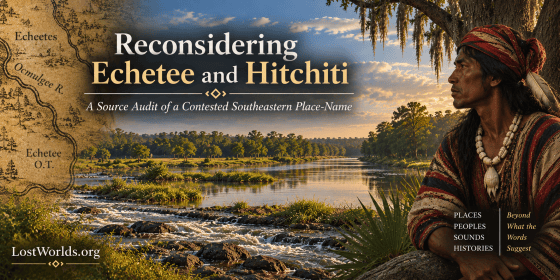
Reconsidering Echetee and Hitchiti
A Source Audit of a Contested Southeastern Place-Name
Abstract
The origin of the southeastern Indigenous name Echetee, later standardized as Hitchiti, is less secure than its conventional etymology suggests. Albert S. Gatschet derived the name from Muskogee ahítchita, “to look up” a stream, an interpretation supported by genuine Muskogee vocabulary involving looking and seeing. The historical record, however, complicates that derivation. The Herbert-Hunter map preserves Echeetes among former Lower Creek towns on the Ocmulgee; a 1733 account lists Echetas among eight Lower Creek “tribes or towns”; and John Mitchell’s 1755 map records Echetee O.T., or Old Town. Gatschet and John R. Swanton also preserved Atchík’hade/Atci-há’ta as an older designation associated with the people later known as Hitchiti, while one origin tradition explicitly describes the Hitchiti name as acquired.
These records reopen the question of whether Echetee originated as an ancestral ethnonym or as a geographical name that subsequently became attached to a population. A possible alternative is suggested by Sati, documented on South Carolina’s Santee River in the early seventeenth century, and by James Mooney’s Itsa’ti, which he recorded in Cherokee usage but said had lost its meaning and was commonly written Echota, Chota, and Chote. The independently documented history of the Eastern Dakota name Santee provides a further phonetic control: French writers recorded forms including Izatys and Issati, while Washington Matthews recorded Hidatsa i tsa’ti and explicitly identified it as the Hidatsa pronunciation of the Dakota name.
These correspondences do not establish a common etymology, but they demonstrate that Indigenous names transmitted across languages and orthographies could acquire written forms that appear much more different than the spoken names they represent. In that context, Echetee may preserve an older Sati-/Isati-/Itsa’ti-type place-name, possibly Siouan in origin or transmitted through Siouan-speaking populations. Such an origin would not require the historical Hitchiti themselves to have been Siouan. It would require only that the Muskogean-speaking population later known as Hitchiti inherited or became associated with an older geographical name. The fundamental question is therefore not simply what Hitchiti can mean in Muskogee, but who originally named Echetee.
Introduction
The name Hitchiti appears firmly established in the ethnographic literature of the Southeast. It identifies an important Lower Creek people and a language now classified with Mikasuki within the Muskogean language family. Because the standardized name is familiar, its origin can easily appear equally settled.
Albert S. Gatschet supplied the explanation that became conventional. Writing in 1884, he stated that the Hitchiti obtained their name from Hitchiti Creek on the Chattahoochee and derived the creek name from Muskogee ahítchita, “to look up (the stream)” (Gatschet 1884:77). The explanation is not linguistically arbitrary. Nineteenth-century Muskogee dictionaries contain closely corresponding vocabulary for looking and looking upward.
The historical record nevertheless presents a more complicated sequence. Forms recognizable as Echetee occur before the familiar standardized spelling Hitchiti and appear as names attached to towns or political communities. Gatschet and Swanton also preserved another designation, Atchík’hade/Atci-há’ta, as an older name associated with the Hitchiti and related communities. Swanton specifically questioned Gatschet’s Chattahoochee Creek derivation because historical evidence indicated that the Hitchiti name was already attached to the people before their settlement on that river (Swanton 1922:172–173).
The problem is further obscured by writing itself. These names survive primarily as text, but they originated as sound. French, Spanish, English, and Indigenous speakers heard unfamiliar names and reproduced them through different phonological systems and different conventions for representing those sounds on a page.
For a moment, consider a name heard approximately as EET-shuh-tee or EET-shuh-tuh. This is not a proposed reconstruction of an original pronunciation. It is an auditory exercise. A French speaker, an English speaker, and speakers of different Indigenous languages attempting to reproduce such a name would not necessarily create spellings that looked alike. Forms such as Itsa’ti, Echota, and Echetee may therefore be more meaningfully compared as attempts to capture sound than as standardized words whose letters must correspond exactly.
That proposition can be tested against names whose historical identities are already known. Before making that comparison, however, the documentary history of Echetee itself establishes the problem that the linguistic evidence must explain.
Echetee in the Early Record
The earliest securely identified Echetee-family form considered here appears on the Herbert-Hunter map. The surviving map carries George Hunter’s 1744 certification that it was copied from an original by John Herbert, while the map’s own cartouche bears Herbert’s name and the date 1725. Marvin T. Smith concluded that the Native town locations of interest belong to Herbert’s earlier work and argued that the map preserves the approximate locations of Lower Creek towns on the Ocmulgee around the end of their occupation there in 1715 (Smith 1992:40–42).
This distinction is important because the Lower Creek towns had already left the Ocmulgee after the Yamasee War when the map was drafted. Herbert’s map therefore does not document Echeetes as an occupied Ocmulgee settlement in 1725. Rather, it preserves an earlier settlement geography. Smith regarded Herbert as a knowledgeable first-hand source and concluded that his town locations could plausibly reflect the Lower Creek settlement pattern around 1715.
Among those former Ocmulgee towns Herbert recorded Echeetes. Smith identifies the name with Hitchiti and places Herbert’s Echeetes farther downstream on the western side of the Ocmulgee than the Macon Plateau site. His proposed archaeological correlation is tentative, and he explicitly cautions against claiming complete accuracy for such reconstructions (Smith 1992:43–44). The value of the map for the present inquiry lies not in assigning Echeetes to a particular archaeological site but in documenting the name within the early Lower Creek settlement landscape.
A second source records essentially the same name in 1733. A Brief Account of the Establishment of the Colony of Georgia, compiled from contemporary newspaper accounts and printed by Peter Force in 1835, states that the Lower Creeks had formerly consisted of ten but were then reduced to eight “tribes or towns.” It enumerates representatives from Coweta, Cusseta, Owseecheyo, Chehaw, Echetas, Pallachucola, Ocona, and Eufaula. Echetas was represented by the war captains Chutabeeche and Robin and four attendants (Brief Account 1835:10–11).
The colonial terminology need not be forced into later ethnological categories. The document itself shows what matters: Echetas functioned as one of the named constituent political communities represented at the conference. Gatschet later cited the same delegation, identified Chutabeeche and Robin as Echeta war chiefs, and noted that William Bartram continued to use the form Echetas later in the eighteenth century (Gatschet 1884:78).
John Mitchell’s 1755 map preserves a third form: Echetee O.T. Smith identifies “O.T.” as “Old Town” and notes that Mitchell places Echetee Old Town and Coweta Old Town on Ochesee Creek, the upper Ocmulgee, as locations belonging to the pre-Yamasee War settlement pattern (Smith 1992:37).
The documentary sequence therefore preserves three closely related forms:
Echeetes — Echetas — Echetee
The sources do not establish the original meaning of the name, nor do they prove that it was exclusively geographical and never applied simultaneously to the people occupying the town. They do establish something more fundamental: in the earliest records examined here, the Echetee-family name is embedded in the naming of a town, community, and old town.
The traditions concerning the people themselves make the distinction between community-name and ancestral self-name still more significant.
Atchík’hade and the Acquisition of the Hitchiti Name
Gatschet recorded several different traditions concerning Hitchiti origins. Some Hitchiti traced their beginnings to a fall from the sky. His informants Chicote and G. W. Stidham gave another account in which their ancestors emerged from a canebrake near the seacoast, dried their children in the sun for four days, traveled inland, encountered a lake that some mistook for the sea, continued along a stream, and eventually settled permanently. Gatschet also recorded a tradition that these people had been the first to settle at ancient Okmulgi (Gatschet 1884:77–78).
The traditions cannot be combined into a single literal migration history. Their importance lies partly in demonstrating that Hitchiti historical memory preserved several different explanations of origin. More directly relevant to the name is Gatschet’s statement that there was a “popular saying among the Creeks” that the ancient name of the people was Atchík’hade, which he glossed as “white heap (of ashes)” (Gatschet 1884:77).
Swanton later recorded a closely related form, Atci-há’ta, and applied it more broadly to Hitchiti and several related Lower Creek communities whose languages differed from Muskogee. He reported that these people called themselves by this designation, although he expressed doubt about Gatschet’s proposed “white heap” interpretation (Swanton 1922:172).
An origin narrative obtained by Swanton from Jackson Lewis makes the distinction between the names explicit. The story begins by identifying A’tcik ha’ta as the people’s “true name.” It then recounts an eastward journey to the Atlantic to discover where the sun came from. After the people’s later alliance with the Muskogee, the account says, they received the name Hitciti because the Muskogee word was understood to mean “to see.” Their name, according to the tradition, had therefore changed from A’tcik-ha’ta (Swanton 1922:173).
Swanton did not accept the story as a literal explanation of the ethnonym. He considered the association between Hitchiti and the journey to “see” the source of the sun probably an ex post facto explanation created to account for an already existing name. Yet the story remains valuable independently of its folk etymology. It preserves a tradition in which Hitchiti was not the original designation.
The early documentary record and the traditional accounts therefore converge on an important possibility. Echetee/Hitchiti need not have originated as an ancestral ethnonym carried unchanged by the same people from remote antiquity. The name could have been acquired through association with a town, locality, or earlier political community.
That possibility places the conventional Muskogee etymology in a different light.
The Muskogee “Look” Etymology
Gatschet’s explanation rests on genuine Muskogee vocabulary. R. M. Loughridge and David M. Hodge’s 1890 English and Muskokee Dictionary gives Hécetv for “to look” and Ahécetv for “to look up.” In the Muskogee-to-English portion of the dictionary, Ahécetv receives the broader gloss “to look this way, after or behind or up” (Loughridge and Hodge 1890:47, 103).
The lexical resemblance is therefore real. A Muskogee interpretation of the name cannot be rejected simply because another hypothesis exists.
The difficulty is historical rather than lexical. Gatschet’s explanation requires a sequence in which a creek acquired a Muskogee descriptive name, the settlement took the name of that creek, and the people then became known from the settlement. Swanton recognized the weakness in this reconstruction. He observed that Gatschet’s interpretation would otherwise deserve considerable respect, but “history shows that the name belonged to the tribe before it settled upon the Chattahoochee” (Swanton 1922:172).
The alternative “see the sun” tradition creates a second problem. One explanation connects the name with looking upstream; another connects it with traveling east to see where the sun originated. Both make sense of Hitchiti through Muskogee vocabulary involving seeing or looking, but they attach that vocabulary to different historical circumstances. Rather than independently corroborating one another, the stories may preserve separate attempts to explain an inherited name through words familiar to Muskogee speakers.
Such reinterpretation would be a conventional example of folk etymology: an opaque or borrowed name becoming associated with a familiar word of similar sound. Swanton’s own description of the sun explanation as probably ex post facto points toward precisely such a process.
The conventional etymology therefore possesses genuine lexical support but an uncertain historical pathway. That distinction leaves open a different possibility: the Muskogee look/see vocabulary may explain how later speakers understood the name without necessarily explaining how the name originated.
Evidence for an alternative naming tradition appears first not in Minnesota or the northern Plains, but in South Carolina.
Sati on the Santee River
John R. Swanton’s 1916 examination of Spanish records from the Carolina coast preserves an early form of the name later written Santee. During Francisco Fernández de Écija’s 1605 expedition, the Spanish encountered an Indigenous interpreter named Alonso whose father-in-law, Panto, was head chief of the town of Sati, sometimes written Hati. When Écija returned in 1609, he heard of a Frenchman living at Sati (Swanton 1916:611).
Swanton identified the Spanish River Jordan in these accounts with the Santee River and concluded from the geography and documentary continuity that there was little doubt Écija’s Sati was the population later known to the English as Santee (Swanton 1916:611–612). In his broader 1922 treatment of the region, Swanton quoted evidence that communication there occurred in the “language of Sati” and used it in distinguishing Santee speech from the language spoken farther south around Santa Elena (Swanton 1922:17).
Swanton placed the Santee among the eastern Siouan peoples of the Carolinas, a classification retained in later treatments of the historic South Carolina Santee. The importance of this evidence is geographical as well as linguistic. A Sati name was present in a Siouan-speaking context on the South Carolina coastal plain at the beginning of the seventeenth century.
This evidence does not make the Carolina Santee and the Eastern Dakota Santee the same people, nor does the resemblance of their names establish that the two names share an etymology. The Carolina evidence matters because it places a Sati-type name inside the Southeast itself, immediately east of Georgia, long before the eighteenth-century Echetee records.
A second southeastern place-name brings the phonetic problem still closer.
Itsa’ti and Echota
James Mooney recorded Itsa’ti as a place-name used by Cherokee speakers. In his historical discussion of the Cherokee he identifies the important Little Tennessee settlement as “Itsâti, or Echota.” His glossary is even more useful: Itsa’ti, he wrote, was commonly spelled Echota, Chota, Chote, and other variants; the name occurred at several locations in the old Cherokee country; and its “meaning is lost” (Mooney 1900:14, 537).
Mooney’s statement does not establish that Itsa’ti originated outside Cherokee. A word can become opaque within the language that created it. It does establish that Cherokee use alone cannot supply a secure etymology for the name. Itsa’ti functioned within Cherokee geography while its meaning was no longer recoverable to Mooney’s informants or through his analysis.
The documented relationship between its spellings is more revealing:
Itsa’ti — Echota
The shorter Chota and Chote belong to the same recorded spelling series but are best considered separately because they omit the initial material retained by Itsa’ti and Echota.
This is not a speculative comparison. Mooney explicitly identifies these as renderings of the same place-name. A form written with ts could therefore appear in English historical usage with ch, while its vowels and even its initial syllable could vary substantially.
The significance for Echetee is methodological before it is etymological. Itsa’ti and Echota look considerably less alike than their historical identity would suggest. Their known relationship demonstrates why unfamiliar Indigenous names cannot be evaluated solely by comparing standardized spellings.
The Eastern Dakota Santee name provides a second and entirely independent control.
Hearing the Name: Independent Historical Controls
Raymond J. DeMallie’s study of the Sioux before 1850 documents the historical forms of the name conventionally anglicized as Santee. Among the early French spellings are Izatys in 1678 and Issati in 1698. DeMallie identifies these forms as renditions of the same Sioux name later represented in English as Santee and in other sources as Isanti and related spellings (DeMallie 2001:751).
The differences are substantial. One French rendering uses z, another ss, while later English forms introduce other vowel and consonant conventions. Yet there is no question that Izatys and Issati in this context belong to the documented history of the Eastern Dakota name.
The name also passed directly between Indigenous languages. DeMallie records borrowings into Arikara, Mandan, and Hidatsa, demonstrating that the name circulated through neighboring Native speech communities and was reshaped according to their phonologies (DeMallie 2001:751). The Mandan borrowing, cited by DeMallie from Douglas R. Parks, is particularly relevant as another independent Native rendering, while the Hidatsa evidence survives in a form whose identification is explicit.
Washington Matthews’s 1877 Hidatsa dictionary records:
i tsa’ti — “the Isanti or Santee Dakotas.”
Matthews immediately explains that the form is simply the Hidatsa pronunciation of the Dakota word (Matthews 1877:161). No argument from resemblance is required. The relationship is stated directly by the nineteenth-century linguist recording the language:
Isanti/Santee ? Hidatsa i tsa’ti
The southeastern evidence supplies another independently known relationship:
Itsa’ti ? Echota
The historical forms can therefore be placed beside one another without pretending that all have already been proven cognate:
Izatys — Issati — Isanti/Santee — i tsa’ti
Itsa’ti — Echota
Echetee
The first line belongs to the independently documented history and transmission of the Eastern Dakota name. The second is Mooney’s independently documented southeastern place-name relationship. The third is the name whose origin remains under investigation.
What these controls establish is not common ancestry but phonetic and orthographic possibility. A known Indigenous name could appear as Izatys, Issati, Isanti/Santee, and Hidatsa i tsa’ti. Another known southeastern name could appear as Itsa’ti and Echota, with Chota and Chote as additional shorter spellings. Differences involving z, s, ts, and ch, as well as substantial variation in vowels and initial syllables, therefore occur in historical names whose identities are independently established.
The auditory exercise introduced at the beginning can now be reconsidered against actual evidence. A rough sequence such as EET-shuh-tee / EET-shuh-tuh was not intended to impose one reconstructed pronunciation on all of these names. Its purpose was to expose the limitation of visual comparison. The historical forms show that listeners using different languages and orthographies could turn related spoken material into written forms that appear surprisingly unlike one another.
This does not make every similar-sounding name related. It removes a weaker objection: that Itsa’ti, Echota, and Echetee cannot be compared because their English spellings do not look sufficiently alike.
Once that obstacle is removed, their historical and geographical contexts become more important.
An Older Sati-/Isati-/Itsa’ti-Type Name?
Several independent strands of evidence now intersect. Echeetes, Echetas, and Echetee Old Town establish an early town- or community-name in the Lower Creek world. Gatschet and Swanton preserve Atchík’hade/Atci-há’ta as another older designation associated with the people later called Hitchiti, while Jackson Lewis’s tradition explicitly describes the Hitchiti name as acquired. The conventional Muskogee explanation has genuine lexical support but a historical sequence that Swanton himself found problematic.
Outside that etymology, early seventeenth-century Sati occurs in a South Carolina Siouan context. Mooney’s Itsa’ti/Echota series provides a southeastern example of substantial variation in the written representation of an Indigenous place-name. The independently documented Eastern Dakota name supplies still stronger controls through French Izatys and Issati, Indigenous borrowings into neighboring languages, and Matthews’s Hidatsa i tsa’ti.
Together, these observations raise a different historical possibility: Echetee may preserve an older Sati-/Isati-/Itsa’ti-type geographical name, potentially Siouan in origin or transmitted through Siouan-speaking populations.
The proposal remains a hypothesis. No surviving source examined here explicitly calls Echetee a Siouan word. No comparative linguistic reconstruction has demonstrated that Sati, Itsa’ti, and Echetee descend from one ancestral form, and no documentary trail connects the three names step by step.
Yet the hypothesis rests on more than a superficial resemblance between spellings. It begins with the historical status of Echetee as a settlement or community name, the tradition of a different earlier designation for the people, the weakness in the conventional historical derivation, a geographically nearby Sati name in the Carolina Siouan world, and independently documented examples showing that the relevant sounds could be represented in markedly different ways.
At this stage a distinction becomes essential. The proposed origin of the name and the linguistic identity of the people later bearing the name are separate historical questions.
The Name and the Hitchiti People
Modern linguistic classification places Hitchiti-Mikasuki firmly within the Muskogean language family (Martin 2017). Nothing in the preceding comparison changes that classification.
An older Siouan or Siouan-transmitted origin for Echetee would instead imply that a Muskogean-speaking community became associated with a geographical or political name that originated in another linguistic setting. Such processes are commonplace. Populations move, communities merge, settlements are abandoned and reoccupied, and older place-names continue in use after the language of the inhabitants has changed.
The Cherokee use of Itsa’ti illustrates why the distinction matters. The name belonged to Cherokee geography and was used for major Cherokee settlements, yet Mooney could no longer recover its meaning. Its historical use by Cherokee speakers does not by itself identify the language in which the name was first coined.
The same reasoning applies to Echetee. The fact that the historical Hitchiti spoke a Muskogean language demonstrates the linguistic identity of the community known by that name in the historic period. It does not independently establish the linguistic origin of every geographical name inherited or adopted by that community.
The traditional evidence makes this possibility particularly relevant because Atci-há’ta survived beside a narrative in which the Hitchiti designation itself was acquired. If the people could acquire an ethnonym, association with a town or place offers a straightforward mechanism for doing so.
The geography of the Ocmulgee settlement world provides the setting in which such transmission could have occurred.
Echetee and the Ocmulgee Landscape
The Herbert-Hunter map places Echeetes within the former Lower Creek settlement system on the Ocmulgee. Smith’s reconstruction locates the community farther downstream on the western bank rather than at Macon Plateau and tentatively associates nearby archaeological sites with the group. He also concludes from the Herbert-Hunter and Barnwell maps that older attempts to identify the historic Hitchiti town directly with Macon Plateau are not supported by the cartographic evidence (Smith 1992:43–44).
Mitchell’s later Echetee O.T. reinforces the association with an older Ocmulgee geography without resolving the precise archaeological location. The designation “Old Town” is especially suggestive in a landscape whose Lower Creek communities had relocated after the Yamasee War. It preserves Echetee not merely as the name of a people on the Chattahoochee but as a remembered place in their former eastern settlement world.
Gatschet’s tradition that the Hitchiti had been the first to settle at ancient Okmulgi adds another layer to that association, although it cannot identify a particular archaeological occupation or prove continuity with the prehistoric mound builders. What it demonstrates is that Hitchiti tradition itself remembered an old connection with the Ocmulgee country (Gatschet 1884:78).
The broader setting also provided abundant opportunities for names to move between communities. Smith notes that Fall Line settlements on the Ocmulgee, Oconee, Savannah, Chattahoochee, and neighboring rivers occupied heads of navigation and important east-west crossings, making them natural nodes in regional trading networks (Smith 1992:6–7). Rivers and trails connected the South Carolina coast, the Savannah Valley, the southern Appalachians, central Georgia, and the Gulf-draining interior.
A name did not require the migration of an entire ethnic population to move through such a landscape. Traders, interpreters, marriage partners, refugees, captives, political factions, and relocating towns could transmit names across linguistic boundaries. Alternatively, the name might not have moved at all: successive populations could simply have inherited a name attached to an established place.
This provides a plausible historical mechanism linking the linguistic problem to the geography without requiring a direct migration of Dakota Santee people from Minnesota to Georgia. The northern evidence is valuable because it demonstrates how an Isanti/Santee name actually changed when represented by different speakers. The southeastern Sati evidence supplies the geographically relevant Siouan context.
Reconsidering Echetee
The conventional Muskogee interpretation possesses a clear strength. Historical Muskogee vocabulary confirms the semantic field on which Gatschet’s explanation depends. Hécetv means “to look,” and Ahécetv includes looking upward. The resemblance between that vocabulary and the later Hitchiti name is therefore genuine.
Its weakness lies in chronology and transmission. The historical evidence does not demonstrate a sequence from Muskogee descriptive phrase to Hitchiti Creek to town to ethnonym. Swanton specifically noted that the name belonged to the population before its settlement on the Chattahoochee. The alternative tradition explaining Hitchiti through a journey eastward to “see” the source of the sun invokes the same Muskogee semantic field in an entirely different story, and Swanton regarded that explanation as secondary.
The alternative interpretation has a different evidentiary profile. It begins with early Echetee-family town names, a remembered older designation for the people, an early Sati in the Carolina Siouan world, Mooney’s documented Itsa’ti/Echota equivalence, and independent northern controls showing how the same Santee name could become Izatys, Issati, and Hidatsa i tsa’ti. Geography supplies a credible environment for transmission or inheritance.
Its limitation is equally important. No source yet identifies Echetee explicitly as Siouan, supplies its original meaning, or proves that the southeastern names share an etymological ancestor. The evidence supports a testable alternative, not a completed linguistic derivation.
The source audit consequently changes the status of the problem rather than replacing one certainty with another. The Muskogee interpretation remains possible, but it can no longer be treated as established merely because a similar Muskogee word exists and the historical Hitchiti spoke a Muskogean language. The possibility of an inherited Sati-/Isati-/Itsa’ti-type place-name must also be considered.
Conclusion
The history of the Hitchiti name has usually been approached from its familiar late form. A Muskogean-speaking people were known as Hitchiti; Muskogee contained words involving seeing and looking; and Gatschet connected those words to Hitchiti Creek. Reversing the chronology produces a different problem.
The earlier record contains Echeetes, Echetas, and Echetee Old Town. These forms occur in the context of towns and political communities. Historical traditions preserve Atchík’hade/Atci-há’ta as another older designation, and one tradition explicitly remembers the later Hitchiti name as acquired. Swanton himself recognized that the chronology created difficulties for a derivation beginning with Hitchiti Creek on the Chattahoochee.
Once Echetee is treated first as an older geographical and political name, evidence elsewhere in the Southeast acquires new relevance. Spanish records preserve Sati on South Carolina’s Santee River within the eastern Siouan world. Mooney records Itsa’ti as Echota, with shorter Chota and Chote variants, while noting that the meaning of the name had been lost. Farther north, the independently known Eastern Dakota Santee name appears historically as Izatys, Issati, Isanti/Santee, in Mandan and other Indigenous borrowings, and in Hidatsa as i tsa’ti.
These forms do not prove that Echetee derives from the same word. They demonstrate something necessary before that question can be evaluated fairly: the written forms of Indigenous names could change dramatically as those names crossed linguistic and orthographic boundaries. The visual difference between Itsa’ti and Echetee is therefore not sufficient to dismiss a possible relationship.
The evidence supports reconsidering Echetee as a potentially inherited place-name belonging to an older Sati-/Isati-/Itsa’ti naming tradition, possibly Siouan in origin or transmitted through Siouan-speaking populations. Such a history would leave the Muskogean identity of the historical Hitchiti entirely intact. The people need not have originated the name in order to inherit it, live at the place it designated, or eventually become known by it.
The conventional question has been, What does Hitchiti mean? The earlier evidence suggests that an even more fundamental question must come first:
Who originally named Echetee?
References
DeMallie, Raymond J. 2001. “Sioux Until 1850.” In Handbook of North American Indians, Vol. 13, Plains, Part 2, edited by Raymond J. DeMallie, 718–760. William C. Sturtevant, general editor. Washington, D.C.: Smithsonian Institution.
Gatschet, Albert S. 1884. A Migration Legend of the Creek Indians. Vol. I: With a Linguistic, Historic and Ethnographic Introduction. Philadelphia: D. G. Brinton.
Herbert, John. 1725. A New Map of His Majesty’s Flourishing Province of South Carolina, Shewing ye Settlements of ye English, French and Indian Nation. Map bearing George Hunter’s 1744 certification. Hargrett Rare Book and Manuscript Library, University of Georgia Libraries.
Loughridge, R. M., and David M. Hodge. 1890. English and Muskokee Dictionary: Collected from Various Sources and Revised. St. Louis: J. T. Smith.
Martin, Jack B. 2017. “Muskogean Languages.” Oxford Research Encyclopedia of Linguistics. Oxford University Press.
Matthews, Washington. 1877. Ethnography and Philology of the Hidatsa Indians. Miscellaneous Publications of the United States Geological and Geographical Survey of the Territories, No. 7. Washington, D.C.: Government Printing Office.
Mitchell, John. 1755. A Map of the British and French Dominions in North America, with the Roads, Distances, Limits, and Extent of the Settlements. London: Andrew Millar.
Mooney, James. 1900. “Myths of the Cherokee.” Nineteenth Annual Report of the Bureau of American Ethnology, 1897–98, Part I. Washington, D.C.: Government Printing Office.
Smith, Marvin T. 1992. Historic Period Indian Archaeology of Northern Georgia. Laboratory of Archaeology Series Report No. 30; Georgia Archaeological Research Design Paper No. 7. Athens: University of Georgia.
Swanton, John R. 1916. “Some Information from Spanish Sources Regarding the Siouan Tribes of the East.” Journal of the Washington Academy of Sciences 6 (17): 609–612.
Swanton, John R. 1922. Early History of the Creek Indians and Their Neighbors. Bureau of American Ethnology Bulletin 73. Washington, D.C.: Government Printing Office.
Trustees for Establishing the Colony of Georgia in America. 1835. A Brief Account of the Establishment of the Colony of Georgia, under Gen. James Oglethorpe, February 1, 1733. Washington, D.C.: Peter Force.