Reconsidering Ogechie and Ogeechee
A Source Audit of a Proposed Siouan Hydronym
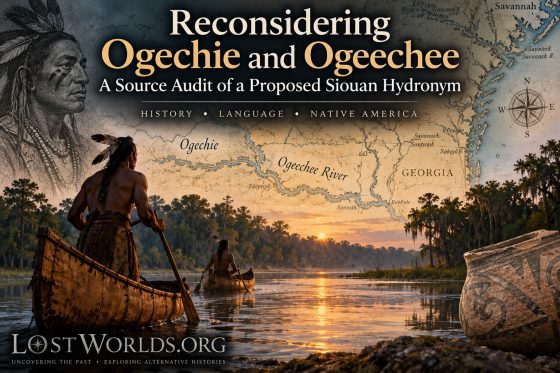
ABSTRACT: In Dakota Sioux Once Lived in Georgia, I proposed that the unusual correspondence between Ogechie Lake in Minnesota and the Ogeechee River in Georgia might represent evidence of a Siouan linguistic connection between the Upper Mississippi Valley and the Southeast. Ogechie Lake lies immediately below Mille Lacs within a landscape historically occupied by the Isanti and Mdewakanton Dakota, while the Ogeechee River lies within a region where early sources also preserve the ethnonyms Santee and Ogeechee. The similarity is striking, but similarity alone cannot establish linguistic relationship. The present study therefore subjects the proposed correspondence to a source audit.
The conventional explanations prove less straightforward than their repetition in modern secondary sources might suggest. Warren Upham attributed Minnesota’s Ogechie to an Ojibwe word meaning “intestinal worm,” supposedly describing the lake’s narrow, curved shape, yet his published account provides no morphological derivation of the proposed Ojibwe term and simultaneously reports that Joseph A. Gilfillan recorded a different Ojibwe name for the lake, Netumigumag, “First Lake.” On the Georgia side, historical Yuchi occupation of the Ogeechee basin is well established, but John R. Swanton characterized the identification of Ogeechee with Yuchi cautiously, while William Bartram explicitly described an Ogeechee “nation” associated with the river.
As an exploratory component of the present investigation, artificial intelligence was used to search for possible Dakota/Siouan phonetic alternatives to the conventional Minnesota etymology. This process generated several candidate forms associated with constriction, flowing or spreading water, and muddy or dark water. These proposed derivations are presented here as hypotheses requiring independent verification, not as established Dakota etymologies. The source audit therefore neither proves nor falsifies the Siouan hypothesis. Instead, it demonstrates that the Ogechie–Ogeechee correspondence remains an unresolved linguistic problem worthy of further investigation.
Introduction
The argument presented in Dakota Sioux Once Lived in Georgia (Paper 1) began with a collection of geographic and historical anomalies. Among the most provocative was an unusual pair of Native American place-names separated by more than a thousand miles: Ogechie Lake in Minnesota and the Ogeechee River in Georgia.
Ogechie Lake lies immediately south of Mille Lacs, within the historic landscape of the Isanti and Mdewakanton Dakota. The region preserves unmistakable evidence of this earlier Dakota occupation in names such as Isanti, Izatys, and Kathio. A Minnesota Historical Society discussion of regional place-names explicitly identifies Wahkon, Izatys, and Kathio as names inherited from the Sioux occupation preceding Ojibwe control. (Minnesota Historical Society, n.d.) The Georgia name, meanwhile, occurs in a region where historical records preserve Ogeechees and Santees among the Native populations displaced during the colonial period.
The resemblance between Ogechie and Ogeechee therefore seemed potentially significant. Paper 1 proposed that the correspondence might represent another surviving clue to the presence or movement of Siouan-speaking populations in the Southeast.
There is an obvious danger in such comparisons. Human languages contain accidental similarities, and European mapmakers frequently distorted Native names when attempting to represent unfamiliar sounds using English, French, or Spanish spelling conventions. Two words that appear virtually identical on maps can therefore have completely unrelated origins. A phonetic correspondence becomes meaningful only when supported by geography, chronology, linguistic structure, historical documentation, or some combination of these factors.
For this reason, the Ogechie–Ogeechee correspondence requires a separate investigation. Rather than simply repeating the proposal made in Paper 1, the present study asks whether the conventional explanations of the two names actually resolve the problem.
They do not.
What emerges instead is a surprisingly complicated history in which tentative nineteenth- and early twentieth-century interpretations became increasingly categorical through repetition, while contradictory primary evidence received considerably less attention. This does not establish that Ogechie and Ogeechee are Siouan cognates. It does mean, however, that the possibility cannot legitimately be rejected merely by invoking traditional etymologies without examining the evidence upon which those etymologies were constructed.
Ogechie Lake and the Dakota Landscape of Mille Lacs
The geographical context of Ogechie Lake is important. The lake is not located randomly somewhere within the enormous territory historically occupied by Siouan-speaking peoples. It lies directly below Mille Lacs, one of the most important documented centers of Dakota occupation in Minnesota.
The Dakota settlement remembered as Izatys was associated with the Isanti division of the Sioux. The later place-name Kathio itself developed from a European transcription of this same Dakota designation. Minnesota historical literature explicitly recognizes these names as survivals from the Sioux occupation that preceded Ojibwe control of the region. (Minnesota Historical Society, n.d.)
This history does not make every Native place-name around Mille Lacs Dakota. Ojibwe populations subsequently occupied the region and established their own names, while European surveyors introduced still others. It does establish, however, that a potentially Dakota hydronym at Ogechie Lake would be historically and geographically plausible.
Determining when the particular name Ogechie entered the documentary record therefore becomes essential.
Warren Upham’s Minnesota Geographic Names provides an unusually revealing sequence. The three lakes along the upper Rum River were called Rice Lakes by Daniel Stanchfield in 1847 because Ojibwe women were harvesting wild rice there. An 1850 Minnesota map instead labeled them Robert’s Lakes. Upham then reported that during the government survey conducted by Oscar E. Garrison the lakes received the names Ogechie, Nessawae, and Onamia. (Upham 1920)
The documentary sequence is therefore significant. Ogechie was not the only Native name recorded for the lake during the nineteenth century, nor does Upham establish that it represented the universally recognized Ojibwe name of the feature.
Indeed, his next statement introduces the central problem.
The “Intestinal Worm” Etymology
Upham wrote that Ogechie derived from an Ojibwe word for an “intestinal worm,” the name supposedly referring to the lake’s long, narrow, curved appearance. That explanation subsequently entered Minnesota place-name literature and has been repeated for generations. A later Minnesota Historical Society publication likewise stated that Ogechie Lake possessed “the Ojibway name for an intestinal worm.” (Minnesota Historical Society, n.d.)
At first glance this appears to settle the question. If Ogechie is demonstrably an Ojibwe word describing a worm-shaped lake, then its similarity to Georgia’s Ogeechee is almost certainly coincidental.
The difficulty is that Upham’s published explanation does not demonstrate the derivation.
He provides no morphological breakdown showing how the recorded form Ogechie corresponds to the alleged Ojibwe expression. He identifies no Native informant responsible for that particular translation. Nor does he explain how Garrison obtained the name during the government survey. The statement is presented as an etymological conclusion rather than as a linguistic argument that readers can independently evaluate.
The distinction matters because Upham immediately provides another piece of information that complicates the interpretation. According to Joseph A. Gilfillan, the name more commonly used by Ojibwe speakers for this same lake was Netumigumag, meaning “First Lake.” Upham similarly reported Ojibwe names meaning “Middle” and “Last Lake” for other lakes in the sequence. (Upham 1920)
Thus the same historical source commonly cited to establish the Ojibwe “worm” derivation also preserves evidence that Ojibwe speakers used a different geographic naming system for these lakes.
This does not prove that the worm interpretation is incorrect. A geographic feature can possess several indigenous names simultaneously. Different communities may use different names, and descriptive names can coexist with older geographic terms. Nevertheless, the evidence is insufficient to transform Upham’s statement into a demonstrated linguistic fact without further analysis.
The appropriate question is therefore not whether Upham wrote that Ogechie meant “intestinal worm.” He clearly did.
The question is how that derivation was established.
The source trail examined for this study has not yet answered that question.
An Inherited Etymology
This distinction illustrates a larger problem in Native American toponymy. Early surveyors, missionaries, ethnographers, and historians recorded enormous quantities of invaluable linguistic information, but they did so under widely varying conditions. Some names came directly from fluent Native speakers. Others were filtered through interpreters. Still others represented attempts by European observers to explain unfamiliar words according to the physical appearance of geographic features.
Once published in an authoritative reference work, an interpretation could subsequently be repeated without its evidentiary foundation being reexamined.
That appears to have happened, at least to some degree, with Ogechie. Upham’s interpretation was repeated in later Minnesota historical literature as an established meaning, even though the underlying linguistic derivation remained invisible. (Minnesota Historical Society, n.d.) The existence of that historiographic tradition demonstrates that the interpretation is old; it does not by itself demonstrate that the interpretation is correct.
For the purposes of the present investigation, the “intestinal worm” explanation should therefore be regarded as a historically attested etymology whose linguistic derivation requires independent verification.
That leaves open an obvious question: if the name is not securely explained through the published Ojibwe derivation, does Dakota provide an alternative?
An AI-Assisted Dakota/Siouan Analysis
To explore that question, an experimental linguistic search was undertaken with the assistance of a large-language-model artificial intelligence system. The AI was asked to treat Ogechie as an imperfect English phonetic transcription and search for possible Dakota or broader Siouan forms whose sounds and meanings might correspond both to the recorded name and to the physical characteristics of the lake.
This method requires an important qualification. Artificial intelligence is capable of identifying patterns across large bodies of linguistic material, but it can also generate plausible-looking reconstructions that are incorrect. The results presented below therefore are not claimed as established Dakota translations. They are exploratory candidates generated during hypothesis formation and are included so that they can be independently tested against historical dictionaries, archival language materials, and fluent Dakota speakers.
Three candidate interpretations emerged from that process.
The first involved a proposed Dakota form rendered by the AI analysis as o-gí-da / o-gí-ca, associated with choking, constriction, or a narrow passage. The proposed interpretation is geographically intriguing. Ogechie Lake is essentially an expansion of the Rum River immediately downstream from Mille Lacs. Rather than forming a large isolated basin, the waterway broadens and constricts as part of the river system. A geographic term describing constriction or a “choke point” would therefore make environmental sense.
The AI analysis further proposed that a Dakota c/?-type affricate could have been perceived by an English-speaking surveyor as a “ch” or “j” sound, producing a possible transcriptional progression toward Ogechie. The original AI analysis rendered the hypothetical form approximately as o-gí-ca and suggested that an English listener might have represented its final syllable as “chie.” (AI-assisted exploratory analysis; see Methodological Note)
A second candidate involved forms rendered o-ká-že / o-gá-že, which the AI analysis associated with water opening outward, entering a channel, or spreading across a shallow bed. This possibility is again interesting because of Ogechie Lake’s physical form. The lake functions as a shallow widening of the Rum River rather than as an isolated deep-water basin. The AI analysis suggested that a že/?e-type sound could potentially have been rendered by an English cartographer as “chee” or “chie.” (AI-assisted exploratory analysis; see Methodological Note)
A third proposed comparison involved a form written o-?í, interpreted by the AI analysis as relating to brown, rusty, muddy, or dull-colored conditions. The analysis proposed an expanded form approximating o-?í-?a, interpreted as a muddy or dark-colored place. Ogechie is a shallow lake with an organic bottom, making such an environmental description at least geographically plausible. (AI-assisted exploratory analysis; see Methodological Note)
None of these proposals should presently be regarded as the translation of Ogechie. Their importance is narrower but still potentially useful. They provide specific linguistic hypotheses that can be tested. Rather than asking vaguely whether Ogechie “sounds Sioux,” future research can ask whether the proposed Dakota forms actually exist with the stated meanings, whether their morphology permits the proposed constructions, whether comparable forms occur in documented Dakota place-names, and whether their historical pronunciation could plausibly have produced the spelling recorded by Garrison.
The distinction between discovery and verification is critical. AI has been used here as a tool for generating linguistic candidates, not as an authority capable of authenticating them.
The Georgia Ogeechee Problem
The Georgia half of the comparison presents a different problem. Here the conventional explanation does not involve Ojibwe but the Yuchi, also historically rendered Uchee, Euchee, Hughchee, and in other forms.
There is no serious question that Yuchi people lived in the Ogeechee region during the historic period. John R. Swanton documented Yuchi settlements on both the Savannah and Ogeechee rivers, and his later synthesis states that a Yuchi village on the Ogeechee bore the name of the stream. (Swanton 1922, 1952) The historical association is therefore real.
What is less certain is the direction of the relationship. Did the Ogeechee River receive its name from the Yuchi? Did a Yuchi settlement acquire the preexisting name of the river? Did Ogeechee and Yuchi develop from related forms without one being a literal translation of the other? Or did later historians conflate a geographic association with an etymological derivation?
Swanton’s own wording is revealing. In discussing the Yuchi village on the river, he wrote that it bore the name of the stream, although the river name was “perhaps one form of the name Yuchi.” (Swanton 1922, 1952)
The word perhaps matters. Swanton was advancing an interpretation, not reporting an established linguistic translation.
His earlier treatment provides the evidence behind that interpretation. Swanton noted that eighteenth-century maps sometimes labeled the waterway “Great Ogeechee or Huchchee River,” with Huchchee representing a spelling of Yuchi. He therefore had legitimate historical grounds for suspecting a connection between the two names. (Swanton 1922)
But association is not identical to derivation.
Modern summaries can obscure that distinction. Georgia’s own Rivers Alive educational material acknowledges that “the etymology of the Ogeechee River is debated,” while presenting competing explanations involving the Yuchi. (Georgia Rivers Alive, n.d.)
The evidence therefore supports a strong historical relationship between Yuchi people and the Ogeechee River but does not, by itself, establish the precise linguistic origin of the hydronym.
Bartram’s Ogeechee Nation
William Bartram introduces another complication.
In Travels, Bartram recounts a Creek historical tradition concerning the wars surrounding the establishment of Carolina. Among the Native populations identified in that account are the “Savannas, Ogeeches, Wapoos, Santees, Yamasees, Utinas, Icosans, Paticas, and others.” (Bartram 1791)
This passage is significant because Ogeeches and Santees appear as named populations rather than merely as rivers.
An even more explicit passage occurs during Bartram’s description of Amelia Island. On the Egmont estate he encountered several large Native American mounds that were locally known as the “Ogeeche mounts.” Bartram explained that they were named for a “nation of Indians” who had taken refuge there after being driven from settlements on the mainland near the Ogeechee River. (Bartram 1791)
Whatever their ultimate linguistic affiliation, Bartram therefore understood Ogeechee as an ethnonym.
Swanton was aware of this tradition and attempted to reconcile it with his reconstruction of Yuchi history. His discussion places Yuchi on the upper Ogeechee and cites eighteenth-century maps connecting Ogeechee and Huchchee, but the relationship remained sufficiently uncertain that his later synthesis retained the qualifier “perhaps.” (Swanton 1922)
Bartram does not prove that the Ogeechees were Siouan. His list contains peoples of different backgrounds, and appearing beside the Santees cannot establish linguistic affiliation.
What Bartram does demonstrate is that the historical evidence is more complicated than a simple equation:
Ogeechee = Yuchi = problem solved.
An Ogeechee population existed in eighteenth-century historical memory strongly enough for Bartram to call it a “nation of Indians.” Whether that population represented a distinct people, a Yuchi subdivision, inhabitants named for their geographic origin, or survivors of an older population remains unresolved.
Ogeechee and the Proposed Santee Connection
The significance of the Georgia name becomes clearer when viewed within the broader hypothesis developed in Paper 1. Ogeechee does not occur in isolation. The same southeastern landscape preserves names such as Santee, Satilla/Santila, Sautee, Santeetlah, and other forms investigated in the larger study as possible remnants of Sati/Santee movement and exchange. The argument is therefore not based upon a single pair of similar-looking words. Ogechie–Ogeechee represents one anomaly within a larger geographical pattern.
Bartram’s testimony is particularly interesting in this context because his historical account explicitly names Ogeeches and Santees among populations involved in the same regional conflicts. (Bartram 1791)
That association does not make the two peoples identical, but it establishes their simultaneous presence within the historical geography under investigation. The broader merchant-enclave hypothesis developed in the paper (The Santee Merchant Guild) following Dakota Sioux Once Lived in Georgia provides one possible mechanism through which such geographically dispersed names could have arisen. Mobile trading populations do not require territorial dominance to leave linguistic traces. Merchant communities operating at river junctions, portages, resource zones, or exchange centers could preserve ethnonyms and hydronyms even where the surrounding archaeological assemblage remained culturally dominated by other populations.
The present paper does not attempt to demonstrate that larger model. Its purpose is narrower: to determine whether the Ogechie–Ogeechee comparison introduced in Paper 1 survives closer scrutiny.
It does—but as a hypothesis rather than a conclusion.
Two Competing Explanations
At present there are two fundamentally different ways to explain the Minnesota–Georgia correspondence.
The conventional explanation treats the similarity as accidental. Under this model, Minnesota Ogechie derives from an Ojibwe expression associated with an intestinal worm, while Georgia Ogeechee derives directly or indirectly from the Yuchi. The nearly identical English spellings therefore represent a false cognate created by unrelated Native languages filtered through European orthography.
That explanation is entirely possible.
Its weakness is that the documentary evidence does not establish either derivation as cleanly as the modern shorthand implies. Upham states the Minnesota interpretation without showing its linguistic construction and simultaneously records a different Ojibwe name for the lake. Swanton establishes a substantial Yuchi association with Georgia’s Ogeechee but himself qualifies the etymological identification with “perhaps.”
The alternative hypothesis is that the similarity preserves an older linguistic relationship.
Under this model, Ogechie may represent a Dakota or related Siouan geographic term inherited from the period of Dakota occupation around Mille Lacs. A related term could have traveled through population movement or long-distance interaction into the Southeast, where it survived as Ogeechee. Alternatively, both names might descend from a broader Siouan geographic vocabulary rather than representing direct movement from Minnesota to Georgia. Multiple tribes in the Southeast speak Siouan languages. A Siouan tribe known as the Santee lived in South Carolina yet linguists believe they broke from the greater Siouan family 3,000 years ago and have no connection to modern-day Santee Dakota Sioux.
The AI-assisted Dakota comparisons presented above offer possible mechanisms for testing this idea. If one of the proposed roots can be independently authenticated, and if the same root provides a plausible semantic and phonological explanation for both geographic names, the case for common origin would become considerably stronger.
If those proposed roots fail linguistic verification, the Siouan hypothesis would correspondingly lose one potential line of support.
This makes the hypothesis falsifiable.
What Would Constitute Evidence?
Several discoveries could substantially clarify the question.
The most important would be an early transcription of Ogechie predating Garrison’s survey and identifying the Native speakers from whom the name was obtained. An early Dakota form would dramatically strengthen the Siouan hypothesis. Conversely, an early Ojibwe vocabulary explicitly documenting Ogechie or a close phonetic equivalent as a word for intestinal worm would strongly support the conventional interpretation.
Likewise, the Georgia problem could be clarified by earlier documentary forms of Ogeechee. A securely dated occurrence predating known Yuchi settlement of the river would weaken the simple proposition that the hydronym originated with that settlement. Conversely, evidence demonstrating that the river acquired the name only after a Yuchi community became established there would strengthen the conventional interpretation.
Linguistic verification is equally important. The Dakota candidates generated during the AI-assisted analysis must be checked against historical lexicons and contemporary Dakota usage. Similar-looking syllables are insufficient. The proposed forms must survive tests of morphology, pronunciation, semantic meaning, and historical plausibility.
The hypothesis therefore generates concrete research questions rather than requiring acceptance on faith.
Discussion
The history of Ogechie and Ogeechee illustrates a broader methodological problem in the reconstruction of Native American history. Place-names frequently survive populations, migrations, wars, epidemics, and political transformations. Their meanings can subsequently be reinterpreted by newcomers, translated into other languages, or distorted by European transcription.
This makes hydronyms particularly valuable but also particularly dangerous evidence.
The appropriate response is neither to accept traditional etymologies automatically nor to reject them merely because an alternative theory is attractive. Each proposed derivation must be traced back to its evidentiary foundation.
In the case of Minnesota Ogechie, the traditional “intestinal worm” explanation possesses genuine historical pedigree but an incompletely demonstrated linguistic foundation in the sources examined here. The same historical literature preserves Netumigumag, “First Lake,” as an Ojibwe name actually reported in use for the lake. The origin of Ogechie therefore remains worthy of investigation.
In Georgia, Yuchi occupation of the Ogeechee watershed is well supported, and any alternative explanation must account for that fact. Yet Swanton’s cautious language and Bartram’s explicit reference to an Ogeechee nation show that the relationship between ethnonym and hydronym is not as simple as later summaries sometimes imply.
The Siouan interpretation therefore remains possible, but it has not been demonstrated.
That is an important distinction from the original observation made in Paper 1. The resemblance between the two names initially constituted an anomaly. The present investigation has now transformed that anomaly into a set of competing, testable historical and linguistic hypotheses.
Conclusion
Dakota Sioux Once Lived in Georgia proposed that the correspondence between Minnesota’s Ogechie Lake and Georgia’s Ogeechee River might preserve evidence of a Siouan linguistic connection between the Upper Mississippi Valley and the Southeast. The present source audit finds that the hypothesis remains unresolved.
The conventional Minnesota explanation can be traced to Warren Upham, who identified Ogechie with an Ojibwe term for an intestinal worm because of the lake’s shape. Yet the published account does not demonstrate the morphology of that derivation, while Upham simultaneously reports through Gilfillan that Ojibwe speakers commonly called the lake Netumigumag, “First Lake.” The historical existence of the worm interpretation is therefore certain; its precise linguistic derivation requires further verification.
The Georgia evidence presents a different ambiguity. Yuchi settlement along the Ogeechee is historically well established, and Swanton reasonably suspected that the river name might be related to Yuchi. Nevertheless, Swanton himself described that relationship as only “perhaps” the explanation, while William Bartram preserved explicit historical memory of an Ogeechee “nation” associated with settlements near the river. (Swanton 1922)
An exploratory AI-assisted analysis conducted for this study identified several possible Dakota/Siouan comparisons for Ogechie, including proposed forms associated with constriction, spreading water, and muddy or dark water. These reconstructions are not presented as established Dakota etymologies. They represent hypotheses generated through artificial intelligence that must now be independently evaluated by Dakota linguistic specialists. (AI-assisted exploratory analysis; see Methodological Note)
The result is therefore neither confirmation nor rejection of the original hypothesis. It is something more useful: a clearer definition of what remains unknown.
The near identity of Ogechie and Ogeechee remains striking. One occurs in the former Dakota heartland at Mille Lacs; the other occurs within a southeastern landscape where Ogeechees and Santees appear together in eighteenth-century historical tradition. (Bartram 1791) The standard explanations for the two names provide plausible alternatives, but the evidence examined here does not yet justify treating the correspondence as a demonstrated false cognate.
Until the underlying linguistic questions are resolved, Ogechie–Ogeechee should therefore remain classified as a possible Siouan hydronymic correspondence: suggestive, testable, and unproven.
That is a narrower claim than the one originally proposed.
It is also a stronger one.
Methodological Note on Artificial Intelligence
Artificial intelligence was employed during the exploratory stage of this investigation to identify possible Dakota/Siouan lexical forms that might correspond phonetically and semantically with the recorded name Ogechie. Because generative AI can produce linguistically plausible but erroneous reconstructions, none of the AI-generated forms presented in this paper are treated as authoritative linguistic evidence. They are disclosed specifically so that the proposed forms and meanings can be independently tested against historical Dakota dictionaries, archival linguistic records, and contemporary Dakota-language expertise.
References
Bartram, William. 1791. Travels Through North & South Carolina, Georgia, East & West Florida, the Cherokee Country, the Extensive Territories of the Muscogulges, or Creek Confederacy, and the Country of the Chactaws. Philadelphia: James & Johnson.
Gilfillan, Joseph A. 1887. “Minnesota Geographical Names Derived from the Chippewa Language.” Collections of the Minnesota Historical Society.
Hawkins, Benjamin. 1848. A Sketch of the Creek Country in the Years 1798 and 1799. Collections of the Georgia Historical Society, Vol. III.
Riggs, Stephen Return. 1890. A Dakota-English Dictionary. Contributions to North American Ethnology, Vol. VII. Washington, D.C.: Government Printing Office.
Swanton, John R. 1922. Early History of the Creek Indians and Their Neighbors. Bureau of American Ethnology Bulletin 73. Washington, D.C.: Government Printing Office.
Swanton, John R. 1952. The Indian Tribes of North America. Bureau of American Ethnology Bulletin 145. Washington, D.C.: Government Printing Office.
Upham, Warren. 1920. Minnesota Geographic Names: Their Origin and Historic Significance. Minnesota Historical Society Collections, Vol. XVII.
Relationship to the Paper Series
This study is intended as a direct follow-up to Dakota Sioux Once Lived in Georgia. It addresses specifically the Ogechie–Ogeechee linguistic correspondence proposed in that study. The subsequent paper, The Santee Merchant Guild, examines a separate question: the economic and geographic mechanism by which proposed Sati/Santee communities could have operated within the pre-contact and protohistoric Southeast. The linguistic problem examined here is therefore separated deliberately from the merchant-enclave model so that the evidentiary strengths and weaknesses of each argument can be evaluated independently.