Ancient DNA Reveals Chocolate Was Consumed at Georgia’s Etowah Mounds 900 Years Ago
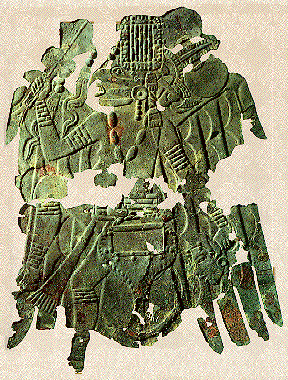 For more than a century, archaeologists have noticed intriguing similarities between the ancient civilizations of the southeastern United States and those of Mexico and Central America. Researchers have compared elements of Mississippian artwork with Mesoamerican imagery, noted similarities in ceremonial practices, and debated whether some religious concepts might have traveled between these distant regions. At Georgia’s Etowah Mounds, these comparisons have been particularly persistent. In 2012, on the premiere episode of History Channel’s America Unearthed series I discussed a Bird Man warrior embossed on a copper plate at Etowah and an identical image found carved on a wall at Chichen Itza. Yet whenever the possibility of contact between the Mississippian Southeast and Mesoamerica has been proposed, critics have raised the age-old objection: Where is the physical evidence of such contact? Apparently finding Mayan glyphs on pottery at the Crystal River site in Florida, as I discussed on the Science Channel’s Unexplained and Unexplored series and the History Channel’s Cities of the Underworld series, isn’t considered “physical evidence.”
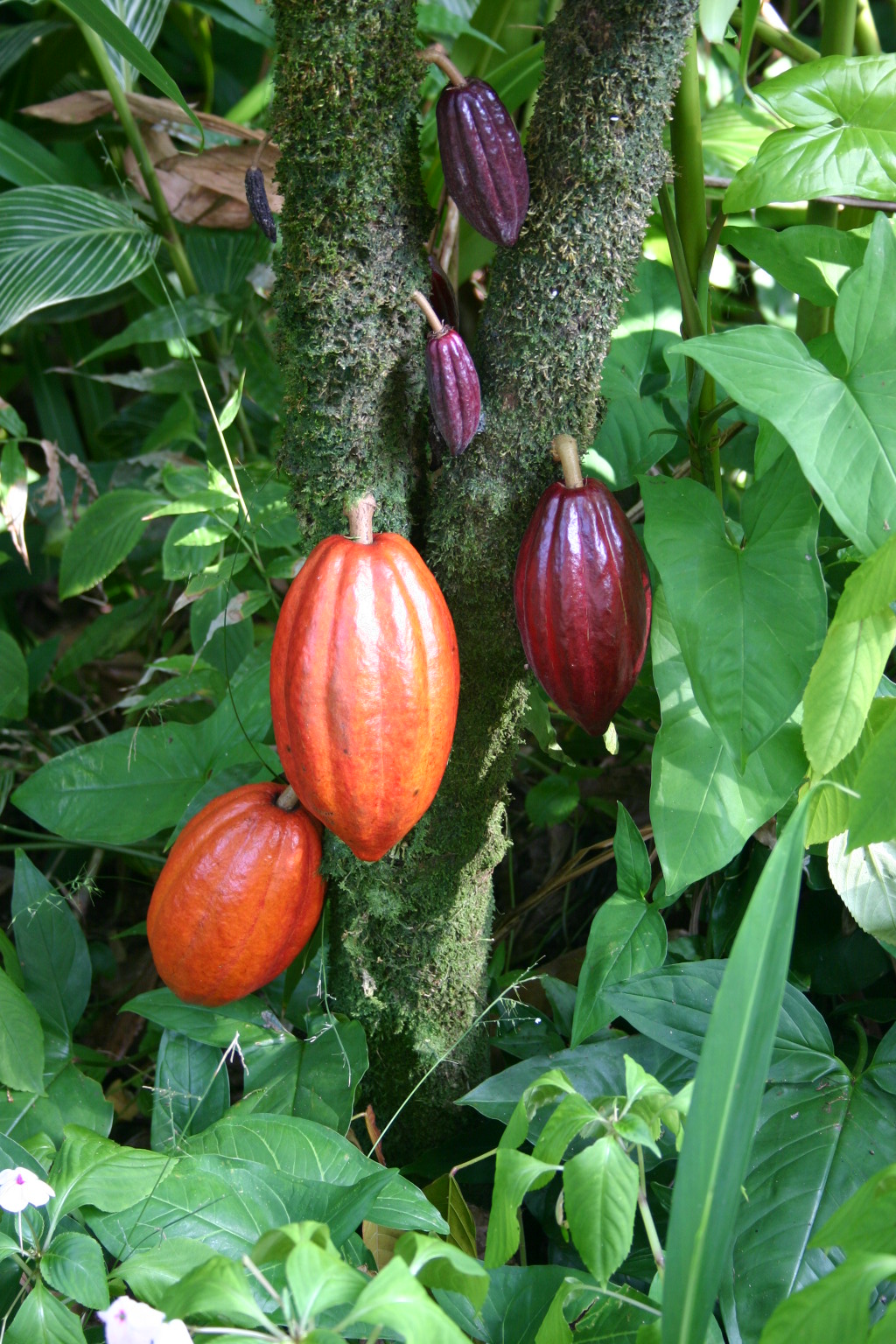 Yet a remarkable new discovery at Etowah may finally provide part of the answer. A peer-reviewed study published in PLOS ONE has identified ancient DNA from Theobroma cacao, the tropical plant from which chocolate is made, inside pottery excavated at the Etowah Mounds archaeological site near Cartersville, Georgia. The pottery dates to the eleventh and twelfth centuries A.D., indicating that approximately 900 years ago, while Etowah was developing into one of the great ceremonial centers of the Mississippian world, people there were consuming cacao.
What makes the discovery so significant is that the authors noted cacao cannot grow naturally in Georgia. Theobroma cacao is a tropical plant whose ancient cultivation was centered far to the south in Central and South America. (Although the authors didn’t mention that the 11th and 12th centuries were during the Medieval Warm Period and Florida could very well have been warm enough to grow it.) Unlike similarities in artwork, architecture, or mythology, the presence of cacao cannot be explained through independent invention. The plant, or a processed product made from it, had to be transported northward. Thus the discovery does not merely suggest that Etowah may have participated in extremely long-distance exchange. It demonstrates that a tropical American commodity somehow reached ancient Georgia centuries before European contact.
A Tropical Plant in Ancient Georgia
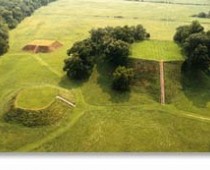 Etowah was one of the most important centers of the Mississippian civilization. Located along the Etowah River in northwestern Georgia, the ancient city eventually contained several massive earthen platform mounds arranged around a central plaza and surrounded by a defensive ditch and palisade. Its largest surviving mound rises more than sixty feet above the surrounding landscape. Etowah was not an isolated village but an important political and ceremonial center connected to the larger Mississippian world.
The newly discovered cacao comes from an early and particularly interesting period in Etowah’s development. During excavations conducted between 1954 and 1957, archaeologist Arthur Kelly and University of Georgia students uncovered large pits containing animal bones, broken pottery, and other remains apparently associated with enormous communal feasts. Soil from these deposits was connected with the construction of Etowah’s first platform mound. These weren’t simply piles of household garbage. They represented large-scale activities associated with the creation of the ceremonial center itself.
Decades later, researchers subjected pottery from these deposits to chemical analysis. Many samples contained caffeine, theobromine, theophylline, and related compounds that appeared to indicate the presence of cacao. Initially, this seemed like remarkable evidence that chocolate had reached Etowah. There was, however, another possible explanation. Native Americans of the Southeast brewed a highly caffeinated ceremonial beverage from yaupon holly (Ilex vomitoria), later known to Europeans as the Black Drink. Researchers discovered that yaupon contained many of the same chemical compounds previously used to identify cacao archaeologically.
Faced with two possibilities, researchers predictably adopted the more conventional interpretation. Since yaupon grew naturally in the Southeast while cacao grew far to the south, the chemical residues were interpreted primarily as evidence for the consumption of yaupon. Without some method of distinguishing the two plants, there was no convincing way to demonstrate that cacao had actually reached Etowah.
The new study changed that by searching for something far more specific than chemical compounds: the genetic signature of the cacao plant itself.
Ancient DNA Changes the Debate
 Researchers selected three pottery samples that had previously tested positive for chemical compounds associated with caffeinated beverages and attempted to recover ancient plant DNA absorbed into the ceramic material. Using archaeogenomic techniques, they extracted highly degraded genetic fragments and compared millions of sequences against reference genomes. After applying filters designed to eliminate contamination and genetic material belonging to unrelated organisms, the researchers identified sequences specific to Theobroma cacao in two of the three pottery samples.
The condition of the DNA was itself important. Ancient genetic material breaks down over time into increasingly small fragments, producing recognizable patterns of degradation. The cacao sequences recovered from the Etowah pottery displayed characteristics consistent with genuinely ancient DNA rather than modern contamination. On this basis, the researchers concluded that the inhabitants of Etowah had consumed cacao during the eleventh and twelfth centuries.
This represents a fundamentally different kind of evidence from the cultural comparisons that have dominated the Mesoamerican-contact debate. Artistic motifs can develop independently. Similar religious concepts can arise in unrelated societies. Monumental architecture can serve similar purposes in cultures that never encountered one another. Cacao, however, cannot independently appear in Georgia. If people at Etowah possessed cacao, then somewhere along the line people transported that tropical product northward.
The discovery therefore changes the nature of the debate. The question is no longer simply whether goods originating in tropical America could have reached the Mississippian Southeast. We now know that at least one did. The more interesting question is how cacao traveled such an enormous distance and what those exchange networks might tell us about connections between the civilizations of ancient North America and Mesoamerica.
Revisiting the Mesoamerican Connection
Possible connections between Etowah and Mesoamerica are hardly a new subject. As early as the early twentieth century, researchers compared Southeastern archaeological materials with objects and imagery from Mexico and Central America. Archaeologist Zelia Nuttall was among those who drew attention to similarities between artifacts from Etowah and Mesoamerican designs. Later researchers debated whether elements of what was once called the Southeastern Ceremonial Complex, and is now often described as the Mississippian Ideological Interaction Sphere, might preserve evidence of influences originating farther south.
Such theories eventually fell out of favor, partly for good reason. Early American archaeology was sometimes influenced by the mistaken assumption that Indigenous peoples north of Mexico could not have independently created sophisticated civilizations. Monumental earthworks, complex political systems, astronomical knowledge, and elaborate religious iconography were therefore occasionally attributed to migrants or influences from supposedly more “advanced” civilizations elsewhere. Modern archaeology rejected the idea that Mississippian peoples needed outsiders to teach them how to construct cities, build monumental earthworks, or organize complex societies. But whether they “needed” outsiders is entirely irrelevant to the question of whether outsiders showed up regardless just as Europeans showed up a few centuries later whether they were needed or not. But these archaeologists did do the hard work over the past 75 years of excavating sites, building chronologies, establishing pottery styles and distribution which resulted in a detailed view of the civilizations of the Southeast which likely would not have happened if all research was focused on Central America. So credit has to be given where credit is due.
Yet there is an important distinction between claiming that Mississippian civilization originated in Mesoamerica and asking whether Mississippian peoples maintained contacts with societies farther south. Independent civilizations routinely exchange goods and ideas. Ancient Rome did not originate in India simply because Roman coins reached India, nor did ancient China originate in Rome because Chinese silk reached the Roman world. Cultural independence and long-distance contact are not mutually exclusive.
The cacao from Etowah provides precisely the kind of physical evidence that makes the second possibility worthy of renewed investigation. A tropical commodity ultimately originating far south of Georgia was being consumed at a major Mississippian ceremonial center around 900 years ago. That doesn’t prove that Maya merchants visited Etowah, nor does it validate every proposed similarity between Mississippian and Mesoamerican cultures. It does, however, demonstrate that the geographical distances separating those cultures were not sufficient to prevent tropical products from reaching the Southeast.
Did Maya Traders Bring Chocolate to Georgia?
The obvious question is whether cacao at Etowah constitutes evidence for direct contact with Maya or other Mesoamerican peoples. At present, the answer is that we simply don’t know. The cacao could have passed through many intermediate communities before reaching Georgia. Long-distance exchange networks can transport objects thousands of miles without any individual trader traveling the entire distance.
The genetic evidence nevertheless provides intriguing clues. DNA recovered from one Etowah vessel showed affinities with Amelonado and Marañon cacao groups, while another was closest to Curaray and Marañon groups. These cacao lineages originated in South America, although related varieties had spread into Central America long before the Etowah samples were deposited. Related cacao populations are also known archaeologically from Maya sites in Belize. Unfortunately, the surviving Etowah DNA is not sufficient to identify the precise geographical location where the cacao consumed in Georgia was grown.
This leaves several possible routes. One possibility is that cacao moved northward from Mesoamerica into the American Southwest and then traveled eastward through trade networks connecting Southwestern and Mississippian peoples. Another possibility is that cacao traveled north through Mexico and eventually entered networks extending along the Gulf Coast and into the Southeast. More direct maritime connections across portions of the Gulf of Mexico are also worth investigating, although the Etowah discovery by itself cannot demonstrate such voyages.
What the discovery does establish is that cacao successfully crossed whatever geographical and cultural barriers separated its tropical source from north Georgia. Whether it moved through five communities, fifty communities, or aboard vessels traveling substantial portions of the journey remains an archaeological question.
Chocolate at Chaco Canyon
Etowah isn’t the first place north of Mexico where archaeologists have found evidence for cacao. One of the most important discoveries occurred at Pueblo Bonito in Chaco Canyon, New Mexico, where researchers detected cacao residues in ceramic vessels dating between approximately A.D. 1050 and 1350. The discovery demonstrated that cacao was moving from Mesoamerica into what is now the southwestern United States centuries before European contact.
The Chaco evidence wasn’t an isolated phenomenon. Archaeologists have found additional evidence of exchange between Mesoamerica and the Southwest, including scarlet macaws brought north from tropical regions and Mexican-style copper bells. Materials also traveled in the opposite direction. Southwestern turquoise reached Mexico (specifically at Chichen Itza where the aforementioned Eagle Man artwork was found,) demonstrating that these networks weren’t simply carrying occasional exotic objects northward but formed part of a broader system of interaction.
The chronology is especially intriguing because cacao was being consumed at Chaco at approximately the same time that it appeared at Etowah. This raises the possibility that cacao reached Georgia through an enormous network stretching from Mesoamerica through the Southwest and into the Mississippian world. Archaeologists already possess evidence of interaction between Southwestern cultures and Caddoan Mississippian societies occupying portions of modern Texas, Oklahoma, Arkansas, and Louisiana. Southwestern pottery, turquoise, and obsidian provide evidence that objects moved between these regions.
From the Caddoan world, cacao could theoretically have traveled eastward through the extensive networks linking Mississippian communities across the Mississippi Valley and Southeast. This route requires no hypothetical trans-Gulf voyage and relies largely upon exchange networks for which archaeological evidence already exists. For that reason, it deserves consideration.
Was the Gulf of Mexico Another Route?
The Southwestern route is not necessarily the only possibility. The geography of the Gulf of Mexico also deserves consideration when examining possible connections between Mesoamerica and the Southeast. Modern political maps can distort our perception of ancient geography because we instinctively imagine travelers crossing Texas, Louisiana, Mississippi, Alabama, and Florida. None of those boundaries existed in the pre-Columbian world. For maritime peoples, the Gulf was not a collection of modern states but a continuous body of water connecting Mexico, the Caribbean, Florida, and the northern Gulf Coast.
Indigenous peoples of the Caribbean and Gulf regions possessed large dugout canoes capable of substantial voyages. By the time Europeans entered the region, they encountered sophisticated maritime traditions throughout the Caribbean and Florida. Ocean currents also physically connect the Yucatan Channel, Gulf of Mexico, Florida Straits, and Atlantic coast. None of this proves that Mesoamerican traders sailed directly to the southeastern United States, but neither should maritime movement automatically be dismissed as impossible.
If cacao eventually proves widespread at Mississippian sites along the Gulf Coast or in Florida, a maritime route would become considerably more interesting. Conversely, if cacao appears first in Southwestern sites and then progressively eastward through Caddoan and Mississippi Valley settlements, the overland exchange-network hypothesis would gain strength. At present, Etowah provides an important data point without resolving the route.
Why Was Cacao Being Consumed at Etowah?
Perhaps the most fascinating aspect of the discovery is the archaeological context in which the cacao was found. These weren’t ordinary household vessels discarded after everyday meals. The pottery came from large feasting deposits associated with the construction of Etowah’s first platform mound. Archaeologists increasingly recognize Mississippian mound construction as more than an engineering activity. Building and rebuilding mounds could involve communal ceremonies, feasting, political gatherings, and rituals associated with the renewal of society and the cosmos.
This means cacao may have possessed ceremonial significance at Etowah. That possibility becomes especially interesting because cacao also held profound ritual and social importance in Mesoamerica. Among Maya and other Mesoamerican peoples, cacao beverages were associated with elite gatherings, feasting, marriage ceremonies, religious rituals, and political events. Cacao wasn’t simply the ancient equivalent of a cup of hot chocolate; it could function as a prestigious and symbolically important beverage.
The parallel should be treated cautiously because similar uses of an exotic luxury commodity could arise independently. Nevertheless, the question deserves investigation. If Mississippians were importing cacao merely because it was an exotic stimulant, that tells us something important about their trade networks. If they were also importing some of the ceremonial traditions associated with cacao consumption, the implications would be considerably greater. The archaeological context at Etowah makes that question impossible to ignore.
What Else Has Been Hiding in Mississippian Pottery?
The discovery also forces archaeologists to reconsider previous chemical evidence from other Mississippian sites. Caffeine, theobromine, and related compounds have been detected in pottery from Cahokia and sites throughout portions of the Mississippi and Ohio valleys. Because yaupon holly contains similar compounds and was unquestionably used by Southeastern Native Americans, researchers have generally interpreted these residues as evidence for yaupon-based beverages.
Etowah demonstrates why that assumption may not always be correct. Chemical analysis alone couldn’t distinguish the local Black Drink from imported cacao. Ancient DNA could. It is therefore possible that some pottery previously identified as containing yaupon actually held cacao, or perhaps beverages containing combinations of plants.
The obvious next step is to conduct similar archaeogenomic testing on pottery from other Mississippian centers. Cahokia would be particularly important. As the largest known pre-Columbian city north of Mexico, Cahokia maintained trade connections extending across enormous portions of North America. If cacao DNA were confirmed there, the Etowah discovery would begin looking less like an isolated occurrence and more like evidence of a previously unrecognized distribution network.
Finding cacao at additional Mississippian centers could fundamentally change our understanding of pre-Columbian exchange. Instead of asking how a few cacao beans somehow made their way to Georgia, archaeologists might find themselves reconstructing a trade system capable of routinely transporting tropical commodities across much of the continent.
Time to Reopen an Old Archaeological Debate
One of the most significant aspects of the new research is that its authors acknowledge the broader historical debate surrounding possible connections between Mesoamerica and eastern North America. They don’t resurrect outdated theories claiming that Mississippian civilization was created by Maya colonists or other foreign peoples. Instead, the cacao evidence allows a more nuanced question to be asked: How connected were the civilizations of the pre-Columbian Americas?
That is a much more productive question. Archaeology has already demonstrated that ancient North America contained vast networks through which copper, marine shell, obsidian, turquoise, mica, exotic feathers, pottery, and other materials traveled hundreds or thousands of miles. Crops also crossed enormous geographical distances. There is no reason to assume that the cultural boundary modern archaeologists draw between “Mesoamerica” and the “Eastern Woodlands” represented an impermeable barrier to ancient people.
Etowah now gives us physical evidence demonstrating that at least one prestigious tropical commodity crossed that boundary. This doesn’t automatically prove direct Mesoamerican contact, but it makes the possibility of broader interaction considerably harder to dismiss simply because of distance.
It also suggests that some older archaeological observations deserve to be reconsidered with modern scientific methods. Similarities in art or religious symbolism that once appeared incapable of being tested can now be evaluated alongside ancient DNA, isotope analysis, residue chemistry, sourcing studies, and increasingly precise radiocarbon chronologies. Questions that archaeology couldn’t adequately answer fifty or even twenty years ago may now be testable.
The Map of Ancient America Is Changing
For much of the twentieth century, popular descriptions of ancient America tended to divide the continent into largely separate cultural worlds. Mesoamerica contained the Maya, Aztec, and other civilizations; the Southwest contained the Ancestral Puebloans and related cultures; and the Eastern Woodlands contained the mound-building societies culminating in the Mississippian civilization. Archaeologists have increasingly discovered that the boundaries between these worlds were far more permeable than those categories suggest.
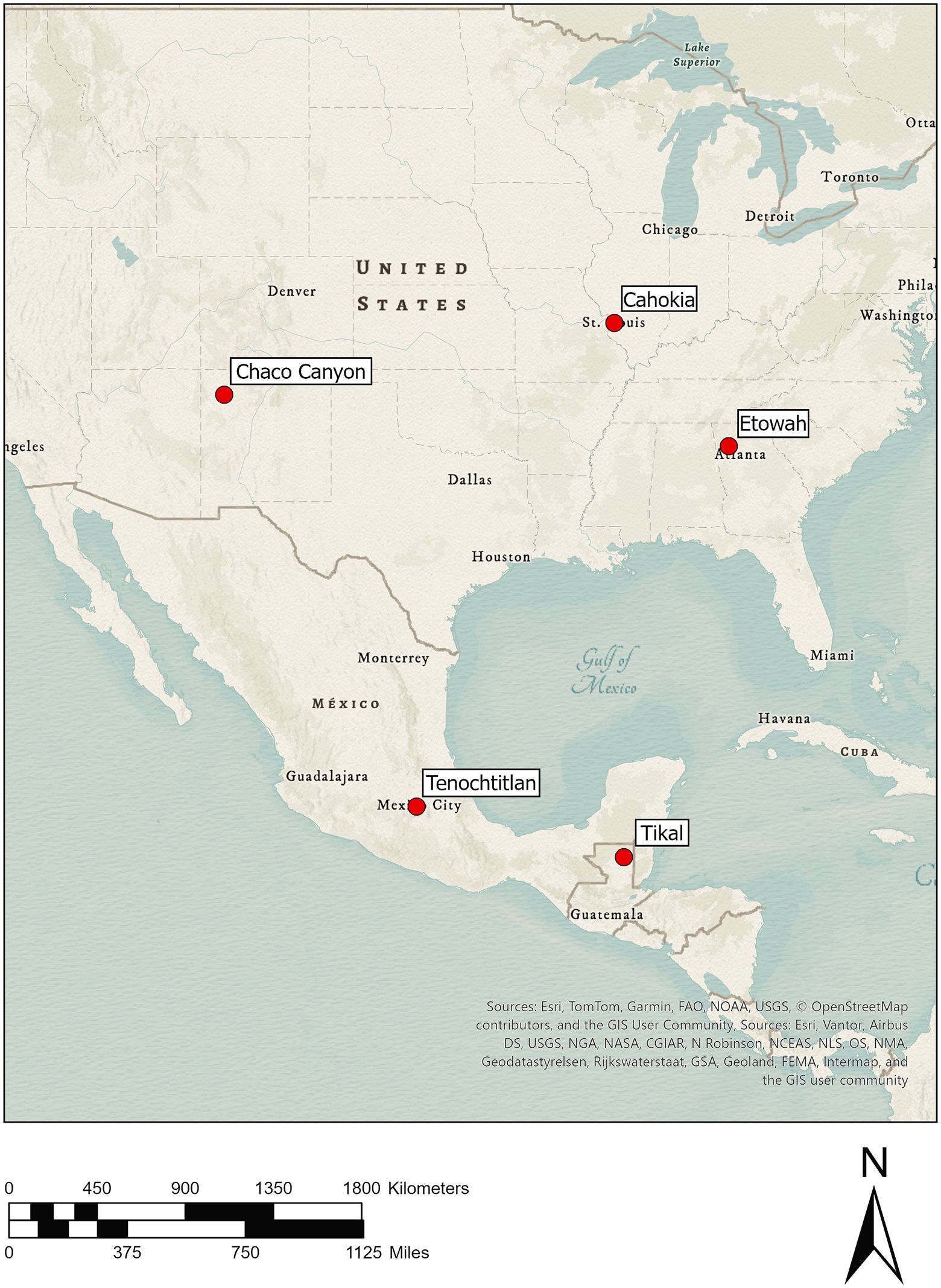 Mesoamerican commodities reached the Southwest. Southwestern materials traveled toward Mexico and eastward into other regions. Marine shell from the Gulf and Atlantic coasts traveled hundreds of miles inland. Great Lakes copper circulated across much of eastern North America. Mississippian religious imagery spread over enormous territories. People, objects, technologies, and ideas were constantly moving through these interconnected landscapes.
We can now add cacao to that list.
Approximately 900 years ago, people gathered beside the Etowah River in north Georgia to feast and participate in ceremonies associated with construction of one of the earliest monumental structures at what would become a great Mississippian center. Among the beverages consumed during those events was one made from a tropical plant whose ancient homeland lay far to the south.
We still don’t know who transported that cacao to Georgia. We don’t know whether it traveled through the Southwest, followed exchange networks along the Gulf Coast, moved by canoe for portions of its journey, or passed through numerous intermediary societies. We don’t know whether the people drinking it at Etowah understood where it originated or whether ceremonial ideas accompanied the cacao as it moved northward.
Those questions remain unanswered, but the discovery has fundamentally altered the starting point of the debate. For generations, researchers investigating possible connections between Mesoamerica and the Mississippian Southeast faced a persistent question: Where is the physical evidence?
At Etowah, part of that evidence may have been sitting unnoticed in museum collections for nearly seventy years. It wasn’t carved into a stone monument or depicted on a copper plate. It survived as microscopic fragments of ancient DNA embedded inside broken pieces of pottery.
And after 900 years, that DNA still had a story to tell.
Source
King, Adam, Terry G. Powis, Xavier Argout, Hélène Vignes, Jose Utge, Bénédicte Rhoné, Olivier Fouet, Nilesh W. Gaikwad, and Claire Lanaud. 2026. “Cacao in the Mississippian World: Archaeogenomic evidence for T. cacaoconsumption at the Etowah Site, Georgia.” PLOS ONE 21(8): e0353607.