Ocmulgee Mounds (1000 AD)

Conflict and Compromise: Building the Great City of Ocmulgee

Yet the area they chose for their town was already occupied by the people who had built such places as Kolomoki, Rock Eagle and Fort Mountain. These people had been in Georgia for hundreds and thousands of years thus this Muskogean invasion would be met, like all invasions, by fierce resistance from the local population.

The Ocmulgee Mounds site was protected by two defensive ditches with log palisade walls. These moat/wall features protected three sides of the new Muskogean colony from attacks by their neighbors. The Ocmulgee River provided natural protection on the fourth side. (When another group of invaders showed up in Georgia many centuries later– the British– they also followed a similar pattern and located their colony of Frederica near a river and then surrounded the other three sides with a defensive ditch and palisade wall.) The moats also served as trash pits since large amounts of broken pottery and other artifacts were excavated from them.

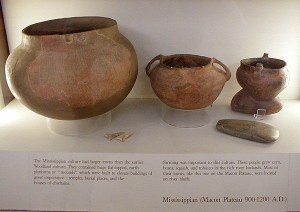
This museum display shows how the mounds were built with simple tools and hard labor.

The building of the large temple mound required a herculean effort. Only simple stone and shell tools were used to dig the dirt and clay required for its construction. This dirt and clay were then loaded into baskets and carried on the backs of laborers to the construction site. Here it was dumped and amazingly a thousand years later archaeologists were able to make out individual basket loads in the mounds they excavated.

The labor for this immense effort most likely came from enslaved local woodland Indians. This would not have endeared these newcomers to the local population especially when combined with the knowledge that the previous inhabitants of the site were all massacred save two people and a dog according to the migration legends. Thus the defensive ditches and palisade walls were likely built of necessity!

One characteristic of Mississippian culture is they built structures on top of their mounds which served as temples and also residences of an elite class of people. (Watch Animation) These people inherited their status as opposed to earning it. This fact undoubtedly caused much suspicion on the side of the indigenous Woodland people who were an egalitarian society where status was earned. Even as late as the historic period when Spanish explorers came into contact with these societies there is evidence that this inherited status was looked upon with great disdain by many Native Americans in the region and was the source of many conflicts. This seems to be a very human and natural reaction to inherited power that cuts across all cultures thus it must be assumed that this animosity probably existed from the beginning of Mississippian influence and grew as their influence grew.

The location of Ocmulgee Mounds was ideally situated to dominate local trade routes. It was located right on the boundary between two distinct geographical regions of Georgia: the coastal plain and the piedmont. The dividing line between these two geographical regions is called the Fall Line. It is here where a drastic change in elevation takes place (as anyone who’s driven on I-75 through Macon can attest since it appears one is driving straight up– or down– hill, depending on the direction.) This also means there are natural shoals and falls in the Ocmulgee River at this point which force cargo-laden dugout canoes to shore. In fact the name Ocmulgee is actually a Hitchiti word that means “bubbling/boiling water” due to these rapids.

Ocmulgee Mounds Port of Entry
This computer reconstruction by architect & author Richard Thornton shows the wetland as a probable “port of entry” for the Ocmulgee Mounds site.

Thus Ocmulgee Mounds was perfectly located to be the middle men between the coastal and piedmont traders. Smoked or dried seafood and alligator meat, alligator skins and teeth, seashells and seashell jewelry, sea salt, and other items would be traded inland by coastal peoples in exchange for items they lacked such as stone for tools and weapons, and vice versa. The wetland immediately below and to the east of the Great Temple Mound was likely a port where trade canoes docked to unload their wares. Interestingly, magnetometer scans have revealed that the Great Temple Mound had a spiraling staircase oriented towards this “port of entry.” This spiral staircase makes it unique among all Mississippian platform mounds discovered so far.

History shows that middle men and facilitators of such trading transactions usually create great wealth and power for themselves and so it was for the elite class who lived at Ocmulgee. It is likely as their power grew so did their greed as they demanded a larger and larger cut for themselves by manipulating exchange rates between trade goods. The weaker tribes would have had no choice but to abide by the exchange rates set by the powerful traders at Ocmulgee. As these rates became more and more unfair, the weaker tribes would have looked for ways to bypass these middle men. This would, of course, lead to conflict when discovered and the elites at Ocmulgee would naturally mete out harsh consequences for such activity. This, in turn, would lead to greater resentment by the weaker tribes until, over time, Ocmulgee found itself surrounded by angry tribes in every direction. All that would be needed is a moment of weakness caused by some natural calamity such as a drought and Ocmulgee would find itself in a hazardous situation. Such seems to be the natural pattern of human interaction throughout the globe and across all time periods including today.

Ocmulgee Earth Lodge

Earth Lodge at Ocmulgee Mounds in Macon, GA
School kids entering the Earth Lodge at Ocmulgee Mounds.

The Ocmulgee Earth Lodge was the likely location where this trading empire was centered. It is the most unique structure at Ocmulgee and although at first it appears to be a conical mound, it is, in fact, a building covered with earth. As mentioned previously, one version of the migration legend states that the first structure the Cussitaws built after conquering the Ocmulgee Mounds site was a “mound with a central chamber.” That is a perfect description of the Ocmulgee Earth Lodge.

The structure includes characteristics of both the midwestern Pawnee earth lodges as well as the kivas associated with southwestern Ancestral Puebloan (Anasazi) settlements. It has a circular solid outer wall upon which the roof beams rested like the kivas of the Southwest and unlike the earth-covered log walls of the midwestern earth lodge. Yet it had the tunnel-like entrance of the midwestern earth lodge which the southwestern kivas lacked. Thus it seems the Cussitaws likely blended elements from the various cultures they came in contact with on their long migration out of west Mexico, through the southwest and midwest before finally settling at Ocmulgee.

Ocmulgee Mounds Earth Lodge
Model of the interior of the Ocmulgee Mounds Earth Lodge.

The Earth Lodge seems to have been a council house where important discussions took place. One version of the migration legend suggests it was a place where warriors would gather. Forty-seven seats on a low clay bench were arranged around the interior wall. A central opening in the roof admitted light and emitted smoke from the council fire. A bird-shaped platform west of the central fire pit contained three elevated seats (bringing the total number of seats to 50.) Clearly the three people who sat here were very important people among Ocmulgee’s leadership.

Black Drink at Fort Caroline among the Timucua
A Black Drink ceremony among the coastal Timucua tribe as witnessed by the French at Fort Caroline in Jacksonville, Florida in the 1500s.

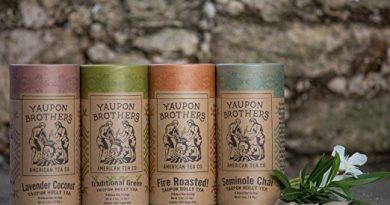
A large seashell was unearthed by archaeologists during excavations of the Earth Lodge. Early European explorers noted that this type of seashell was used as a communal drinking vessel for a drink known as cassina or the “black drink.” Cassina was a type of tea made from the leaves of the yaupon holly plant which contain high concentrations of caffeine (perhaps as much as three times the caffeine as a similar quantity of coffee.) Women prepared the beverage, which was only drank by the men, and served it hot by using a gourd to dip it from the main brewing pot into the shell drinking cup. (Apparently they also used the gourd to froth the tea as well.) Drinking a highly caffeinated beverage hot allows more of the caffeine to be absorbed and passed into the bloodstream.

The men drank this beverage before long council meetings, going to war, or participating in their ball game (which they referred to as the “little brother of war” and sometimes could last for days.) It appears this was the Native American version of an energy drink! They would also use this beverage as a body purifier by consuming large quantities and then forcefully regurgitating it. For this reason it was also sometimes known as the “white drink” since white was associated with purity. Also, since the yaupon holly plant only grows in coastal areas, its leaves were likely an important trade item controlled by the elites at Ocmulgee.

Caddoan Hampson Head Pot
This Caddoan head pot features a stylized bird design engraved around its eye. View an interactive 3D model.

The most interesting feature of the Earth Lodge is the raised platform in the shape of a bird. This bird design is very similar in design to a decoration on a Caddoan head pot from Arkansas. The pot features an individual, clearly modeled from real life, with an eye-surround in the shape of a stylized bird very similar in design to the bird platform in the Ocmulgee Earth Lodge. Several of the Caddoan tribes, including the previously mentioned Pawnee, built round earth lodges. (I explore this connection further in the featured article “Were Georgia’s Indians from West Mexico?“) Continues….

Comments are closed.